
01.10.2026
Threats, walkouts and secret talks
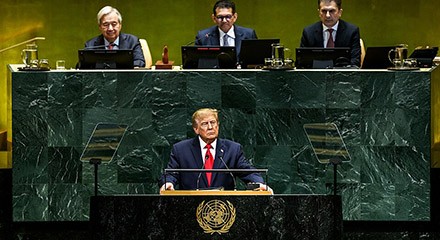
Trump set the tone. From the podium of an organisation supposedly founded to prevent war between states, he mused about the “annihilation” of Iran. Yassamine Mather looks at the theatre that is the UN general assembly
Every September world leaders descend on New York for the United Nations general assembly. For one week the podium is occupied by an apparently endless procession of presidents, prime ministers and foreign ministers, each invoking peace, dialogue and international law - often before an audience whose attention lies somewhere else entirely. This year, however, the general assembly was more than the usual diplomatic ritual. The continuing Iran-US war, the destruction in Gaza and widening divisions over Israel ensured that some of the speeches - and the reactions to them - attracted some genuine attention.
Trump set the tone. From the podium of an organisation supposedly founded to prevent war between states, the US president openly raised the possibility of the “annihilation” of Iran if Tehran refused to reach an agreement over the Strait of Hormuz. It was an extraordinary threat to make, even by the standards of Trump.
Iranian president Massoud Pezeshkian left the possibility of negotiations open, but rejected Trump’s threats. Iran would not surrender or bend the knee. He loftily described Trump’s language as contrary to the UN Charter. Pezeshkian also used his presence in New York for something resembling a media offensive, giving interviews and meeting American journalists. He even appeared on Fox News. An outrage for Iranian royalists.
There were walkouts too. The US delegation left during Pezeshkian’s address, Israel boycotted it. But the real spectacle came with Benjamin Netanyahu. He spoke to lots of empty chairs. What he said was typically aggressive and uncompromising. He defended Israel’s murderous conduct in Gaza, rejected accusations of genocide - the “biggest lie of the century”. The war against Iran was just and there will be no Palestinian state while he remains prime minister.
The walkout was politically significant. A substantial number left the chamber just as Netanyahu prepared to speak. It was a visible demonstration of Israel’s growing diplomatic isolation. There was also a bizarre element to it all. Israeli officials moved through the empty rows, recording which delegations had left.
Yet the general assembly mattered less for anything it formally decided than for what it revealed. Behind the theatre, actual negotiations were taking place. Iranian and American officials were certainly exploring whether military confrontation could be converted into some form of settlement. At this point speeches and walkouts give way to more difficult questions: Hormuz, sanctions, frozen Iranian assets, Lebanon and the regional balance of power.
Bargaining card
Obviously Iran’s principal advantage in the confrontation is not military parity with the US, but geography and the ability to impose economic costs far beyond the battlefield - and the Strait of Hormuz is central to that strategy.
Closure of Hormuz had affected shipping, energy markets and ultimately prices throughout the world. This was magnified by renewed uncertainty and disruption to the Bab al-Mandab route, thanks to the Houthis. This means Saudi superptankers heading down the Red Sea for the Cape face a real prospect of drone and missile attack. Insurance costs must have skyrocketed. Eventually these costs feed through to companies and consumers.
Contrary to the endless propaganda of sections of the Iranian regime, none of this amounts to an Iranian ‘victory’. Iran itself remains under immense economic and military pressure. It is under siege. The Iranian currency has fallen further and further to around 250,000 tomans to the dollar.
According to Iran’s foreign minister, Abbas Araghchi, the latest Iranian proposals draw on the June 17 memorandum of understanding, under which shipping could pass without tolls for 60 days, while negotiations proceeded. The new proposal envisages specified US steps such as lifting the blockade and lifting sanctions, followed by reopening Hormuz at the end of a seven-day period and the resumption of talks. Behind the seven day offer, however, there lie thorny questions such as frozen funds, Lebanon, naval deployment and the broader relationship between Iran and the US.
The American side faces its own contradictions. Trump and his administration have attempted to shape the political narrative surrounding the conflict, but, the longer the war continues, the harder it becomes to present it simply as a demonstration of overwhelming American might. At some point the administration has to explain what the war has actually achieved.
That creates several possibilities. Trump could escalate militarily after the mid-terms, including through renewed bombing, before returning to negotiations. Alternatively, he could seek an agreement and present Iranian concessions as evidence that military pressure succeeded. Either course would be shaped not simply by the military balance, but by the economic and political costs of continuing the conflict.
Nor can Washington ignore the domestic economic consequences. Some Democrats and a few Republicans have begun distancing themselves from the war, partly because of concerns about rising prices, interest rates and wider economic pressures. This should not be exaggerated. Congress has limited powers. It is the president who is in charge when it comes to matters of war and peace.
Global effects
The first meeting between Trump and Andy Burnham took place on the fringes of the general assembly and was relatively uneventful. For a nervous Burnham, the absence of a major mishap - and Trump’s description of him as a “natural businessperson” who would be a “great prime minister” - must have come as some relief.
Britain was also active elsewhere on the sidelines. Foreign secretary Ed Miliband met Araghchi and expressed concerns over threats to dissident Iranian journalists in Britain. Britain’s more consequential role, however, concerned Saudi Arabia. While in New York, Burnham confirmed that he had agreed to a Saudi request for British support, while Britain and France provided assistance involving refuelling aircraft. This places Britain firmly on the Saudi side in what could easily blow up again and turn into a major confrontation.
Saudi Arabia has spent enormous sums on its military establishment and has long regarded the Houthis as a serious security problem. Yet Washington reportedly opened direct communication with the Houthis in early September, despite Saudi displeasure. This is important, because Saudi policy towards the Houthis has been tied to the broader confrontation with Iran and the so-called axis of resistance. Saudi leaders appear to have assumed that they were acting within a wider American strategy aimed at weakening Iran’s regional allies, only to discover once again that Washington is prepared to make its own deal when it suits US interests. One explanation is that Washington does not want its strategic priorities blurred.
Turkey and Pakistan, which signed a tripartite agreement with Saudi Arabia only weeks ago, have meanwhile reiterated that Riyadh has not asked them for assistance. Neither appears eager to volunteer for what could be a quagmire. What emerges is not a coherent alliance pursuing a single strategy, but a collection of states attempting to protect their own interests, while avoiding the consequences of further escalation.
Perhaps the most significant development surrounding the UN general assembly concerns China. The Iran-US confrontation increasingly appears inseparable from the wider rivalry between Washington and Beijing. According to comments by the US ambassador to China, Trump directly told the Chinese president that Beijing’s support for Iran was unacceptable. US officials have also alleged that Iran obtained high-resolution imagery from Chinese satellites that helped locate US military bases, aircraft carriers and other naval vessels.
Whether every allegation of Chinese assistance is substantiated is less important than the broader development: Washington increasingly views Chinese support for Iran through the prism of US-China competition. Beijing, meanwhile, has its own reasons for opposing American attempts to isolate Tehran. This is not primarily a question of diplomatic friendship between China and Iran. China has economic and energy interests, a need to resist the extraterritorial application of American sanctions, and a strategic interest in preventing Washington from demonstrating that it can unilaterally determine political and economic arrangements across the Middle East.
Sanctions therefore cannot be treated simply as measures directed against Tehran. They also affect companies, airlines, banks and states trading with Iran. And China’s rejection of new unilateral sanctions cannot simply be understood as solidarity with Iran: Beijing is defending its own interests.
This forms part of a wider struggle over American power within the international financial system. Washington has historically made sanctions effective not merely by preventing American companies from dealing with a targeted state, but by threatening consequences for third parties that continue doing business with it. For China, accepting that principle indefinitely would mean accepting the United States’ ability to influence Chinese economic relations with other countries.
Sanctions are therefore not peripheral to military confrontation. They constitute another arena in which the international balance of power is being decided.
Where next?
For all the diplomatic theatre surrounding the general assembly, the decisive question is what happens after New York. Can the Iranian proposal become a framework for serious negotiations? Will Washington accept sanctions relief and other concessions in return for reopening Hormuz? Will Tehran accept American conditions? Can Lebanon be incorporated into a wider settlement? And can China and the US prevent their own rivalry from making compromise still more difficult?
The general assembly provided answers for none of these questions. What it demonstrated was that diplomacy has not disappeared. Negotiations remain possible precisely because neither side has been able simply to impose its preferred outcome: Tehran is attempting to convert disruption of Hormuz into diplomatic leverage; Washington is trying to convert military and economic pressure into Iranian concessions. China is resisting an outcome that would strengthen American strategic dominance, while Saudi Arabia and other regional powers are attempting to protect their own interests without being dragged into an even wider conflict.
Wars do not end simply because one side possesses superior weapons. They end when the political, economic and strategic calculations of those involved change sufficiently to make some form of settlement preferable to continuing the conflict.