
18.06.2026
Labour’s toxic arms race
British imperialism is weak economically and yet feels obliged to commit to bigger and bigger arms budgets. However, we need to do more than oppose increases in so-called defence spending, argues Carl Collins
John Healey’s resignation as defence secretary has exposed deep contradictions within the state and within the Labour government. On the surface, the dispute concerns the level of so-called ‘defence’ spending and whether Britain is committing sufficient resources to its armed forces. Yet a proper analysis requires us to look beyond the immediate political drama and examine the underlying geopolitical pressures and structural constraints that shape the debate.
Healey’s resignation has naturally intensified speculation about Sir Keir’s future and the possibility of one or more leadership challenges. However, much of this discussion proceeds from a mistaken assumption: namely, that replacing Starmer would significantly alter the fortunes of capitalism in Britain.
Economic stagnation, weak productivity growth, high levels of public debt, pressure on public services and the constant scrutiny of financial markets - all place severe limits on what any capitalist government can do. The experience of successive governments since the financial crisis has demonstrated that even modest departures from accepted economic orthodoxy can provoke punishing reactions from what is widely described as ‘the market’. Remember Liz Truss?
Then there is the geopolitical reality of Britain’s position within a US-led international order. Particularly under Donald Trump, American demands towards allies have become increasingly explicit. Washington expects them to spend more on the military, align themselves with American strategic priorities and contribute more resources to maintaining the existing international balance of power - preferably whilst buying American-made war equipment and services. Members of the government may occasionally disagree with particular US actions, but all remain fundamentally committed to the so-called ‘special relationship’.
Any future Labour leader would therefore find themselves constrained by demands for fiscal restraint on the one side and US demands to increase military spending on the other. Clearly, Healey is one of those who is willing to solve the dilemma by savaging the welfare state and cutting spending on infrastructure, health, benefits, etc.
Defence spending
The point must be made that the term, ‘defence spending’, is itself something of a misnomer. Until Trump, almost to his credit, signed an executive order to rename the Department of Defense to ‘Department of War’ (even changing its URL to ‘war.gov’), states have commonly presented their military expenditure as ‘defensive’.
Historically, however, military establishments have, of course, served not primarily to defend the territory of individual states, but to protect strategic interests, secure access to markets and resources, maintain alliances and project power abroad. Britain’s military posture cannot be understood separately from its role within Nato, its close relationship with the US and its continuing attempts to preserve influence in a world where its relative economic weight has declined.
Military spending is therefore not about defending the British population from external attack: it is about preserving a particular international order. The language of ‘defence’ obscures the reality that Britain’s armed forces are integrated into a wider network of alliances and commitments, led overwhelmingly by the United States. The debate is not merely about how much Britain should spend, but how Britain should contribute to a broader imperial system.
While Healey’s resignation speech on June 16 centred on GDP percentages, that cannot be said of Al Cairns, the former armed forces minister. Carns has made himself the champion of radical military reform and fighting tomorrow’s wars, not yesterday’s.
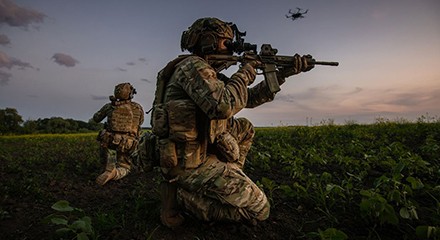
The character of warfare is rapidly changing. Wars in Ukraine, the Middle East and the spread of advanced technologies have demonstrated that military power is no longer measured solely through expensive platforms such as aircraft carriers, tanks and fifth generation fighters. Increasingly, relatively inexpensive drones, autonomous systems, electronic warfare capabilities and cyber tools can have disproportionate effects.
This creates contradictory pressures. On the one hand, military establishments continue to pursue ever more sophisticated and expensive weapons systems. On the other, smaller states and non-state actors have shown an ability to innovate, using cheaper, more flexible technologies. The result is an arms race characterised not merely by greater expenditure, but by uncertainty about where expenditure should be directed.
For Britain, this raises difficult questions. Should resources continue to flow towards major prestige projects and legacy systems? Or should investment shift towards newer technologies, whose effectiveness appears increasingly evident? The disagreements between sections of the political and military establishment reflect this uncertainty.
Yet, regardless of how these questions are answered, a more fundamental problem remains: military expenditure requires resources, and those resources must come from somewhere. This is where the political crisis surrounding defence spending intersects with the broader economic difficulties facing British capitalism. For much of the public, calls for increased military spending are difficult to reconcile with everyday experience. Britain continues to face sluggish economic growth, strained public services, housing shortages, stagnant living standards and persistent insecurity. Large sections of the population are asked to accept tangible sacrifices, while simultaneously being told that billions more must be devoted to future or faraway military purposes.
We have already seen elements of this emerge in public reaction to the war in Ukraine. While many in the US initially supported aid and assistance, there has also been a noticeable backlash from sections of the population who say that ‘it’s not our war’ and that resources should instead be used to ‘look after our own’.
Similar sentiments have emerged in Britain with the likes of Reform UK and Robert Lowe’s Restore. Such developments reflect a broader difficulty governments face, when attempting to secure public support for increased military expenditure during periods of economic strain. The old phrase, ‘butter or guns’, captures the dilemma perfectly. Resources devoted to military expenditure are resources that cannot simultaneously be spent elsewhere. The precise trade-offs may vary, but the underlying contradiction remains (we can put aside the Keynesian stimulus argument - which probably applies in the US).
Andy Burnham
This is especially significant because governments increasingly find that the low-hanging fruit of fiscal retrenchment has already been harvested. Years of austerity have reduced many areas of public spending, particularly in welfare.
However, welfare cuts are likely to remain among the most politically accessible targets. Benefits, disability support and other forms of social expenditure will continue to face pressure. Even the state pension and the ‘triple lock’ is becoming increasingly prominent in debates.
Pension expenditure represents a growing share of government spending, yet for psephologists, pensioners also constitute one of the most electorally significant groups in British politics. Capitalist common sense, class struggle, the ownership of the means of persuasion, all go discounted. Focus groups, pitches, policy offers, positioning is everything. Either way, pensioners are divided along class lines, and yet the fact of the matter is that they are more likely than any other section of the population to have a petty bourgeois outlook. It is not only a matter of age: private pensions, managing little property portfolios, paid-off mortgages, etc, provide a better explanation.
Either way, the Labour government, whoever is prime minister, is likely to rob every big spending department to pay for bigger and bigger military budgets. Some of Andy Burnham’s supporters portray him as representing a more social democratic or left-leaning alternative to the current leadership. There are even those who hope he will solve all spending problems by ‘taxing the rich’ (as if they are not already taxed). Such demands feature in almost every edition of the Morning Star, Socialist Worker, The Socialist and The Communist. The inevitability of capital flight goes all but ignored.
Burnham should certainly be treated with considerable scepticism. Individual leaders operate within structures that constrain their choices. Britain’s economic position, its membership of Nato, its financial dependence on international markets and its strategic relationship with the US all place limits on what any mainstream Labour leader can realistically do.
This does not mean that personalities are irrelevant. Different leaders may emphasise different priorities, adopt different rhetoric or pursue different tactical approaches. Yet the underlying direction of policy is shaped by forces that extend beyond their individual control.
Burnham himself provides a useful illustration of the problem. On several occasions he has sought to position himself to the left of Sir Keir’s leadership - only to retreat, when confronted with institutional or political pressure. During debates over Labour’s fiscal rules he suggested that they should be examined and reconsidered. Yet, as soon as concerns emerged about market reactions and financial credibility, the language softened and the position moved back towards orthodoxy. Similarly, on the issue of compensation raised by Women Against State Pension Inequality, Burnham initially appeared sympathetic to campaigners - before subsequently moderating his stance, when confronted with the practical and political implications.
The significance of these episodes lies not in Burnham’s personal failings, but in what they reveal about the operation of the political system. Politicians may signal dissent, while operating in opposition or in regional government. Yet, once questions of state power, financial markets and governing responsibility arise, the room for manoeuvre narrows dramatically.
A Burnham leadership might therefore employ a more socially conscious language. It might seek to distance itself rhetorically from aspects of Starmerism. It might promise greater attention to inequality or regional development. Nevertheless, when confronted by pressure from Nato, the Treasury, financial markets and Britain’s security establishment, it would face many of the same constraints as the current government.
The same logic applies to defence policy. Whatever differences emerge within Labour, there is little evidence that any serious contender for the leadership intends fundamentally to challenge Britain’s strategic alignment with the US. On the contrary, support for Nato and close cooperation with Washington remains one of the strongest areas of consensus across the British political establishment.
Our approach is entirely different. We have no interest in the argument about how to increase so-called defence spending. Well, except to get a handle on the contradictions in the governing class and its rival parties and factions.
The same goes for left calls for ‘cutting defence spending’ by this or that percentage: by a half is the usual going rate nowadays. Others on the left speak in even more moderate tones: Stop the War Coalition commits merely to resisting “any increase in military spending” (2025 conference resolution).
Nor are we interested in how Volodymyr Zelenskyy’s Ukraine should be financed and armed. We can safely leave that to Trump, Starmer, Macron, Merz, etc … and the Alliance for Workers’ Liberty, Workers Power and other social imperialists. We are not concerned with Britain alone and some leftwing British nationalism. Ukraine is a capitalist country ruled by a thoroughly corrupt oligarchy. It is also a proxy for western imperialism - something that was crystal clear from 2014 and the Maidan coup.
Marxist slogan
Nor are we pacifists. Everywhere we support just wars - above all revolutionary civil wars for socialism. Communists will therefore strive to expose the war preparations of the bourgeoisie, the lies of social imperialists and illusions fostered by social pacifism.
We therefore stand by the traditional Marxist slogan: ‘Not a person, not a penny’ for the armed forces of British imperialism. That does not mean indifference towards the armed forces and defence spending.
We are against the standing army, but for a popular militia. Of course, that will have to be financed. But we recommend the popular militia not because it would be considerably cheaper than the standing armed forces. We recommend it for two main reasons: a popular militia is the most effective means to ensure national defence and the most effective way of making revolution.
The popular militia will never be realised voluntarily by some benign capitalist state. It has to be won, in the first place by the working class developing its own fighting formations. Such fighting formations grow out of the class struggle itself: defending picket lines, mass demonstrations, workplace occupations, fending off fascists, etc. We saw that in the Russian Revolution with its Red Guards. We saw it too in Britain, albeit on a smaller scale, in 1926 with the Workers’ Defence Corps.
As the class struggle intensifies, conditions are created for the workers to arm themselves and win over sections of the military forces of the capitalist state. Every opportunity must be used to take even tentative steps towards this goal. As circumstances allow, the working class must equip itself with all weaponry necessary to bring about revolution.
To facilitate this we demand:
- Rank-and-file personnel in the state’s armed bodies must be protected from bullying, humiliating treatment and being used against the working class.
- There must be full trade union and democratic rights, including the right to form bodies such as soldiers’ councils.
- The privileges of the officer caste must be abolished. Officers must be elected. Workers in uniform must become the allies of the masses in struggle.
- The people have the right to bear arms and defend themselves.