
14.05.2026
Ceasefire on life support
With Donald Trump in Beijing, hopes of an Iran deal rose. But not by much. Yassamine Mather does not believe that China will come to the rescue of the US. There is, therefore, the danger of another outbreak of hostilities. Meanwhile many poor countries stand on the brink of economic collapse
What began as a series of back-channel negotiations in Islamabad has become a volatile stand-off between Washington and Tehran, leaving the world’s most critical energy artery - the Strait of Hormuz - effectively closed. While diplomats from all sides trade insults and threats, a stark divide has emerged: the global south is being pushed toward systemic collapse, at a time when a select number of western financial and industrial giants are reaping record-breaking ‘blood profits’ from war and the instability it has created.
On May 8, reports surfaced that the United States and Iran might resume direct talks in Islamabad. As I wrote last week, mediators were reportedly circulating a 14-point memorandum of understanding, designed to address the most controversial issues of the conflict, including the security of the Strait of Hormuz, and the potential transfer of Iran’s highly enriched uranium to a third-party country.1 By May 10, Iranian state media confirmed that Tehran had dispatched its formal response to the American proposal through Pakistani intermediaries. According to news agency reports, this response prioritised a total cessation of hostilities, before addressing more detailed, technical nuclear questions. There was a lot of speculation over the weekend regarding the ‘delayed’ Iranian reply.
Make him wait
On the one hand, the Iranian government claimed it would not respond, because there are numerous breaches of the ceasefire in the Strait of Hormuz. This alludes both to US attacks on Iranian ships as well as attacks on the United Arab Emirates. Some journalists in the Iranian press suggested that the government actually takes pleasure in making Trump wait as part of a game they are playing. According to them, Iran is essentially saying, ‘Look, Trump makes these promises, but we don’t just jump. We are in a strong position. We are not weak, we haven’t lost this war, and there is no reason we should succumb to his deadlines.’
In the western press, however, there was a repetition of another theory. First, the pro-Trump media - like the New York Post - used it, and later CNN reported on it as well. It follows a standard theme: there are deep divisions within the Iranian regime and that is why they cannot send replies to US proposals.
The CNN article was slightly more accurate, as it described the internal pressures Tehran is facing, as opposed to factional disagreements. Essentially what we have is a very small political faction in Iran that is not currently in power. So claims by the BBC, CNN and others that those in power ‘cannot reach an agreement because of factional in-fighting’ is simply wrong - at times an expression of the false hopes of sections of the media.
The faction I referred to has around six seats in the Majles out of 290. It has no representation in the current ‘reformist’ government, nor does it play a significant role in the ‘conservative’-dominated parliament. It is a pressure group called the Jebheh Paydari (Front for Resistance). It has a loyal following which, back in 2015, opposed Iran’s nuclear deal with the US. They were rebuked by the then-supreme leader for their consistent opposition to any negotiations, any deal. Last week around 260 MPS signed a motion opposing this faction’s proposal to withdraw from any talks.
The optimism about negotiations faded on May 11, when Donald Trump summarily rejected the Iranian reply, labelling it “totally unacceptable” and declaring the existing ceasefire to be on “life support”. According to reports from Associated Press, Iran had actually included significant nuclear concessions in its reply: quoting two regional officials, the agency reported Iran had offered to dilute part of its highly enriched uranium and send the rest to a third country, possibly Russia. According to Al Jazeera, Iran had offered to halt all uranium enrichment for at least 12 years and hand over about 440kg of uranium enriched to 60%. The US position is a demand for a 20-year enrichment suspension and Washington dismissed the counterproposal as “a piece of garbage”.
Irrespective of these aspects of negotiations, the fundamental rift remains: Iran demands immediate sanctions relief and an end to the maritime blockade as prerequisites for broader dialogue - a position the US continues to rebuff.
On May 12, Mohammad Bagher Qalibaf, the Iranian parliamentary speaker and top negotiator, issued a scathing rebuttal via X. His message was one of calculated defiance, framing Tehran’s 14-point proposal as the “no alternative” ultimatum. He warned that any American attempt to deviate from recognising the “rights of the Iranian people” would be “completely inconclusive” and lead to a repetitive cycle of failure. Qalibaf also targeted the American electorate, asserting that, the longer the US government “drags its feet”, the more the American taxpayer will be forced to subsidise the escalating costs of the conflict.
Profiteering
Although it is correct to point out that ordinary citizens in the US, and indeed throughout the world, are suffering from the economic consequences of the war, many large companies are actually benefiting from it. Indeed for some it is a bonanza.
While the two-month closure of the Strait of Hormuz has crippled global supply chains, the resulting market ‘uncertainty’ has proved to be an unparalleled goldmine for specific corporate sectors. The effective cessation of shipments, representing one-fifth of the world’s oil and gas, has produced extreme volatility - a condition exploited by the world’s largest energy and financial institutions.
The most immediate beneficiaries have been European oil conglomerates, whose sophisticated trading divisions have turned price spikes into massive windfalls:
- BP reported that its first-quarter profits more than doubled to $3.2 billion - a surge the company attributed to the “exceptional” performance of its trading unit amidst the chaos.
- Shell shattered analyst expectations by posting Q1 profits of $6.92 billion.
-
TotalEnergies saw a nearly 30% jump in profit, earning $5.4 billion due to the very market volatility that is currently impoverishing families globally.
In contrast, US majors like ExxonMobil and Chevron saw lower revenues, compared to the previous year, due to direct supply disruptions from the Middle East. However, even these firms outpaced analyst forecasts and are positioning themselves for higher profit margins, as oil prices remain elevated.
The banking sector has similarly capitalised on the atmosphere of fear. As investors flee ‘risky’ assets in favour of ‘safe havens’, trading volumes have reached fever pitch.
- JPMorgan Chase: Its trading division alone generated a record $11.6 billion in the first quarter of 2026, driving the bank to its second-largest quarterly profit in its history.
- The Big Six: Collectively, JPMorgan, Bank of America, Morgan Stanley, Citigroup, Goldman Sachs, and Wells Fargo reported a staggering $47.7 billion in profits for the first quarter.
-
Investment-heavy firms like Goldman Sachs and Morgan Stanley have been the primary beneficiaries of the ‘extreme market volatility’ that has taken others to the brink of ruin.
As air defence vulnerabilities are exposed in real-time, the defence industry has seen a massive influx of capital. Analysts note that military contractors are the “fastest winners.”
-
BAE Systems, Lockheed Martin, Boeing and Northrop Grumman have all reported record-breaking order backlogs. There is a renewed and accelerated investment in missile defence and counter-drone systems across the US and Europe, as the conflict rumbles on.
Paradoxically, the war has acted as a violent catalyst for energy transition. With fossil fuel dependency now viewed as a critical national security liability, investment is flooding into renewables as a source of stability.
- NextEra Energy has seen its stock value climb 17% since the start of 2026.
- Both Danish wind giants, Vestas and Ørsted, have reported significantly higher profits, as counties scramble for energy independence.
In the UK, solar panel sales have surged by 50%. Simultaneously, the skyrocketing cost of petrol has driven a massive demand for electric vehicles, with Chinese EV manufacturers emerging as the primary global beneficiaries.
Human toll
While corporate boardrooms are celebrating ‘exceptional’ first-quarter results, the global south is enduring the brunt of the war. The closure of the Strait of Hormuz has triggered a domino effect of higher transport costs, food inflation and currency devaluation.
As the primary destination for oil passing through Hormuz, Asia has been particularly hard hit. In the Philippines, the government has been forced to impose a four-day work week for executive offices simply to conserve fuel. There is a similar picture in Thailand where energy-saving measures, including state-mandated work-from-home orders, have been implemented.
In Africa, the impact of the war has resulted in acute shortages and the emergence of black markets. Ethiopian reports indicate rampant fuel scarcity and long queues, forcing the government to prioritise fuel for essential services and mandate work-from-home for public servants. The shock has even dampened religious celebrations and sent food prices soaring. In the Kenyan capital of Nairobi motorists face long queues at the few petrol stations still holding supplies.
For Latin America, the crisis is an “external strain” that tests the very foundations of their economies. The International Monetary Fund and World Bank warn that net importers - such as Chile, Peru and much of central America - are facing devastating “inflation expectations” due to energy costs. Even for the region’s oil exporters, any potential revenue gains are overshadowed by slower regional growth and systemic financial stress.
China
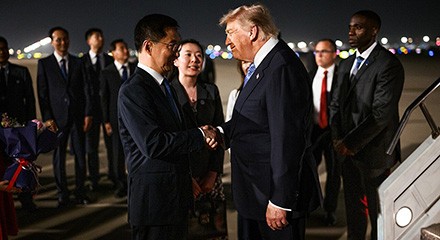
There has been much discussion about China’s role as a mediator in the current crisis. This is undoubtedly a significant political gain for Beijing. And Xi Jinping will milk it as much as he can with Donald Trump in China. Xi will present China to the world as a responsible international actor, capable of dialogue and de-escalation. By contrast the US is widely seen as associated with coercion, sanctions and military threats.
China has a close relationship with Pakistan. While Trump may enjoy a certain rapport with the Pakistani military establishment, and while Iran may view Pakistan as an important Islamic neighbour, the deeper strategic force operating behind the scenes is clearly China. Pakistan is central to Beijing’s regional strategy, not least through the China-Pakistan Economic Corridor and China’s broader ambition to secure trade routes, energy supplies and geopolitical influence across southern Asia. For that reason, China is not merely observing Pakistan’s role in the negotiations: it is shaping it.
Economically, China is also vulnerable to any major escalation. If the war blows up again, it would threaten energy markets, shipping routes and global supply chains. As of early 2026 China accounted for some 80-90% of Iran’s oil exports. So the effective closure of the Strait of Hormuz is a huge problem for the Chinese economy.
This helps explain why Beijing is doing everything it can to broker negotiations and prevent a wider market collapse. China’s diplomacy is not simply an expression of peace-loving neutrality: it reflects the material interests of a rising power that wants stability - not because it opposes exploitation or imperial rivalry in principle, but because instability threatens its own global strategy. Beijing’s mediation is therefore both a political opportunity and an economic necessity.
The message from Tehran, meanwhile, appears uncompromising. Iran’s armed forces have warned that they are prepared to deliver a “memorable lesson” in response to any further aggression, insisting that “all options” remain on the table. All this could change very quickly if there is pressure from China, forcing Iran to accept a modified version of the US proposals.
-
‘Standoff amid talk of a deal’ Weekly Worker May 7: weeklyworker.co.uk/worker/1584/standoff-amid-talk-of-a-deal.↩︎