
23.04.2026
Sloganeering on autopilot
Marxism demands concrete analysis: it embraces complexity, it rejects trite formulations. With that in mind, Carl Collins takes issue with those who use the slogan, ‘No war but the class war’, to negate political struggle
Amid the proliferation of global conflicts, the CPGB’s weekly Online Communist Forum reports have, unsurprisingly, generated wide-ranging discussion on war, from military strategy to broader geopolitical dynamics. The CPGB, its OCF and the Weekly Worker are almost unique among leftwing organisations in welcoming and actively encouraging such debate.
One regular OCF participant, comrade Ant, a classic ‘left’ communist, consistently, almost obsessively, advances the slogan, ‘No war but the class war’ (from here on referred to as NWBCW), irrespective of the context. Whether the subject under discussion is tactical, strategic or theoretical, this slogan is automatically applied, as if it answers all questions.
The slogan obviously contains a certain truth. After all, as it says in the Manifesto, “the history of all hitherto society is the history of class struggles”. But what such leftists mean by NWBCW is that workers should support no class struggle apart from their own narrowly defined class struggle. Clearly then, NWBCW is a variety, or form, of economism.
Allies, strategic or tactical, doing deals, weighing options, taking advantage of contradictions between other classes, including between states, developing the working class, so that it has its own highly sophisticated hegemonic political outlook, including its own foreign policy - that is what is being rejected.
Nothing could be further from Marx and Engels. Resisting a murderous foreign invader alongside members of other classes was considered not merely legitimate, but often heroic. Eg, they supported the 1848-49 Hungarian national movement against the Russian army sent to crush it. At workers’ meetings they would propose toasts to its leader, Lajos Kossuth.
Both Marx and Engels actively participated in the struggle to unify Germany through an armed democratic revolution. That with the strong expectation that revolutionary war against Russian absolutism would follow. They supported Italian unification (the Risorgimento) too.
Their comrades in America helped get Abraham Lincoln elected in 1860 and Red ’48ers fought in the American civil war with a fearsome bravery. Their close friend and comrade, Joseph Weydemeyer, became a lieutenant colonel. Under their leadership the First International urged Lincoln to abolish slavery and thereby boost black recruitment to Union ranks and open up a second front within the Confederacy itself. They heaped fulsome praise upon cotton workers in Britain for siding with the north against the south, though it cost them dear in the purse.
Marx and Engels
What always decided matters for Marx and Engels was furthering the strategic interests of the working class - or, more accurately, the strategic interests of the global working class. With exactly that in mind they singled out particular struggles for national liberation - Poland springs to mind, so does Ireland.
The writings of Marx and Engels on Ireland are unequivocal. They came to the view that British working class emancipation was impossible without the liberation of Ireland from British rule. In a letter to Engels in 1869, Marx argued that the English proletariat would never achieve revolutionary consciousness so long as it benefited, however indirectly, from the subjugation of Ireland.1 National oppression, in this sense, was not an incidental issue, but a central pillar of imperialist domination. They did not treat the struggle for Irish independence with aloof dismissal, invoking the slogan, NWBCW. Rather than regarding it as a diversion from the class struggle, they understood it as a necessary component of it.
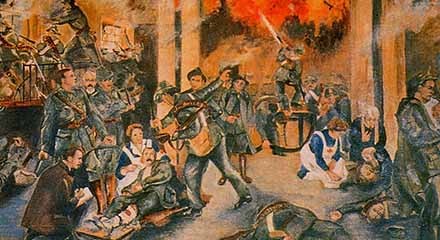
Nowhere is this clearer than in Ireland in 1916. There are, of course, justifiable reasons for saying that the Easter Rising - April 24 was the 110th anniversary - had no fully rounded socialist programme. Many of its leaders came from the romantic sections of the intelligentsia, embodied most clearly in Patrick Pearse and the Irish Republican Brotherhood. Their vision of Irish independence was steeped in cultural nationalism, red martyrdom and, in many respects, a backward-looking idealisation of Gaelic and Catholic society. Pearse, in particular, framed the rising in quasi-religious terms, glorifying blood sacrifice as a means of national regeneration.2
From a Marxist standpoint, these elements were deeply flawed. The IRB was a secretive, conspiratorial organisation with little connection to the organised working class. Its strategy relied on insurrectionary action, carried out by a relatively small group, rather than mass mobilisation. Moreover, its social programme was vague at best. Independence, in their conception, did not necessarily imply a transformation of class relations. An Ireland freed from British rule, but still dominated by native capitalists and landlords, would offer little to the working class.
Indeed, there was always the danger that a purely bourgeois nationalist movement would reproduce the very structures of exploitation it claimed to oppose. It is true that Marx himself warned of this possibility in relation to other national struggles.3 Independence, while necessary, was not sufficient. Whilst conceding that, in the absence of a clear class perspective, such movements may simply replace one ruling class with another, it must nevertheless be emphasised that this is not equivalent to dismissing them outright on the grounds that they do not conform to a ‘pure’ conception of class war.
Unlike Pearse, James Connolly and the Irish Citizen Army stood apart. In bringing a form of Marxist analysis to the rising, he refused to separate the national question from the class question and did not stand back from the movement. Yes, the struggle for Irish independence was inseparable from the struggle for socialism. As he famously declared, “The cause of labour is the cause of Ireland, and the cause of Ireland is the cause of labour.”4 He did not, however, dogmatically forgo the opportunity to advance his position, but instead demonstrated a strategic orientation that the rigid NWBCW slogan precludes.
Connolly understood that national liberation without social revolution would be incomplete and unstable. At the same time, he rejected the notion that the working class could ignore the national struggle. British imperialism was not an abstract force: it was a concrete system of domination that shaped the conditions of Irish workers’ lives. To fight for socialism in Ireland required confronting imperialism directly in the concrete terms in which it presented itself.
In the lead-up to the rising, James Connolly grew increasingly impatient with the hesitations of the broader nationalist movement, fearing the opportunity for insurrection might pass and even contemplating an independent uprising by the ICA. He understood that waiting for an abstractly ‘pure’ class conflict was no option: to have adopted NWBCW would have meant immediate defeat without advancing the working class in the slightest. Instead, he demonstrated a necessary strategic flexibility, acting in accordance with both his revolutionary commitment and the concrete historical moment. The balance of forces did not permit a purely proletarian uprising, as the Irish working class, though militant, was insufficiently organised or numerous to seize power alone. Under such conditions, a united front against imperialism represented a rational, if fraught, strategy.
Connolly’s participation in the rising was therefore a calculated risk. He sought to push the movement in a more radical direction, to inject it with a socialist content that might otherwise be absent. His often paraphrased remarks about preferring to hoist over Dublin ‘the red flag rather than the flag of the Irish bourgeoisie’ captures this tension.5 He recognised that the national struggle could be coopted by bourgeois forces, but he also saw the possibility of transforming it.
In practice, the rising itself bore the marks of these contradictions. The Proclamation of the Irish Republic contained elements that reflected Connolly’s influence, including references to equal rights and opportunities for all citizens. However, it stopped short of articulating a socialist perspective. The leadership structure, dominated by the IRB, limited the extent to which the uprising could become a vehicle for proletarian revolution. The slogan, NWBCW, would have completely precluded it. It could be argued, therefore, that NWBCW is less progressive than even the quasi-religious programme of the IRB.
Figures involved in the rising, such as Liam Mellows - initially rooted in a more traditional republican framework - began to properly understand Connolly’s position in the period following the rising, moving toward a clearer appreciation of the inseparability of national liberation and class struggle before being unforgivably killed by Michael Collins’ pro-treaty forces.6
Connolly’s heritage
More recently, a similar trajectory could be seen in Seamus Costello’s political thinking. Until he was killed in a factional dispute, Costello moved more fully towards Connolly’s Marxist position. As Nora Connolly observed, “Of all the politicians and public men with whom I have come in contact, and who called themselves followers of Connolly, he alone really understood what my father meant by the freedom of Ireland.”7
Both Mellows and Costello point toward the potential for figures in the Irish revolutionary tradition who, had history taken a different course, might have followed Connolly’s teachings to their conclusion, expanding the war of national independence into a war for socialism and, in doing so, and with stronger organisational structures among workers and peasants, might have altered the outcome, potentially winning over the European proletariat to a broader revolutionary struggle.
Militarily, there are coherent arguments that the rising was doomed from the outset. The forces involved were too small, coordination was poor and the anticipated nationwide mobilisation failed to materialise. It is argued that the decision to seize and hold fixed positions in Dublin, rather than adopt more flexible guerrilla tactics, left the rebels vulnerable to superior British firepower. One does not need a military mind to recognise that, from a purely strategic standpoint, there were serious errors.
Yet to judge the rising solely on its immediate military outcome is to miss its broader significance. The execution of its leaders, including Connolly, transformed public opinion and reignited the struggle for independence. In this sense, the rising acted as a catalyst, reshaping the political landscape in Ireland.
Incapable of changing the past, for Marxists the key question is not whether the Easter Rising succeeded or failed in narrow terms, but what lessons it offers for revolutionary strategy. One such lesson is the importance of maintaining an independent class perspective within broader movements, without the complete isolation of the NWBCW philosophy. Connolly’s insistence on linking national and social liberation remains a vital contribution. He did not dissolve the working class into the nation, nor did he abstractly counterpose class struggle to national struggle. Instead, he sought to unite them in a single revolutionary project.
The NWBCW slogan fails as a guide to Marxist practice and theory in equal measure. It ignores the ways in which class struggle is mediated through other forms of conflict, including national oppression and uprisings such as those in Ireland. It reduces a complex, historically specific analysis to a simplistic formula. It takes no account not only of the balance of forces within the capitalist system, but the balance of forces within the capitalist and imperialist entities themselves. This is a grave miscalculation. We need to know and understand our enemies and be open to all and every form of struggle against that reality.
Marx and Engels did not reject national struggles for that very reason. They evaluated them in relation to their impact on the broader dynamics of class struggle. Where such struggles weakened reactionary forces and opened space for proletarian organisation, they offered critical support. Ireland, under British imperial domination, was a paradigmatic case.
The Easter Rising, despite its contradictions, fits within this framework. It was a blow against one of the most powerful imperial states of the time. It disrupted the existing order and created new possibilities for political development. That it was led in part by petty-bourgeois nationalists does not negate its significance, nor does it justify abstention by socialists.
Connolly’s role demonstrates what a Marxist approach to such a situation looks like in practice. He engaged with the national movement critically, seeking to advance the interests of the working class within it. He neither capitulated to bourgeois nationalism nor retreated into sectarian isolation. His vision of an Ireland where political independence would be inseparable from social emancipation remains a powerful counterpoint to both narrow nationalism and abstract class reductionism.
In the final analysis, the NWBCW slogan is not fit for any serious Marxist. It obscures more than it reveals, replacing concrete analysis with empty rhetoric. The history of Marxism, from Marx and Engels to Connolly, points instead toward a more nuanced understanding - one that recognises the interplay between national and class struggles, and the necessity of engaging with both in a dialectical manner.
-
K Marx and F Engels CW Vol 43: Letters 1868-70.↩︎
-
See SW Gilley Pearse’s sacrifice: Christ and Cuchulain crucified and risen in the Easter Rising Cambridge 1916.↩︎
-
See, for example, K Marx, ‘The Polish question’ Neue Rheinische Zeitung (1848-49), in CW Vol 8.↩︎
-
J Connolly, ‘Labour in Irish history’ The collected works of James Connolly Vol 1, Dublin 1987.↩︎
-
C Desmond Greaves The life and times of James Connolly London 1961.↩︎
-
C Townshend The republic: the fight for Irish independence London 2013.↩︎
-
N Connolly O’Brien James Connolly: portrait of a rebel father Dublin 1975.↩︎