
14.05.2026
Toxic nationalist recipes
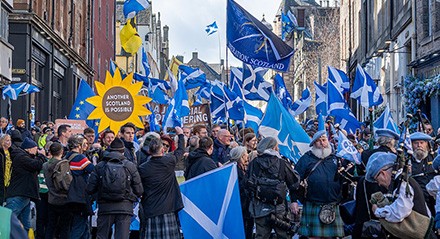
With the rise of Reform UK, the SNP and Plaid as the biggest parties in Scotland and Wales, our demand for a federal republic has become even more relevant, argues Eddie Ford
There used to be a situation when we were told that the CPGB’s call for a federal republic, together with the right of Scotland and Wales to self-determination, was either irrelevant or unnecessary. All you had to do, for example, was vote for the SNP in Scotland and eventually you will end up with independence, albeit one that sees it keeping the monarchy and retaining the pound sterling for an “extended” transition period.
But the supreme court disabused that easy notion in November 2022 in an unequivocal judgment, saying that Scotland does not have the right to self-determination based on the constitutional framework established in the 1999 laws that created the devolved Scottish parliament. All matters related to the union belong to Westminster alone. That is, it is up to the UK government to decide whether you are allowed to have a referendum in Scotland or not, let alone whether that referendum could be given actual binding legal status by a majority vote in Holyrood.
With that background in mind, the May 7 elections saw the SNP win the election with 58 MSPs, falling 13 short of an overall majority. Reform and Labour both won 17 seats, followed by the Greens on 15, the Conservatives on 12 and the Liberal Democrats on 10 - the worst performance at a Scottish parliament election for both Labour and the Conservatives. As for the Senedd elections, it was Plaid Cymru which emerged triumphant - surprising some with the ease of its victory - as the largest party for the first time, with 43 seats, while Reform secured second place with 34 seats, and Labour was reduced to third place with a historic low of nine - having previously completely dominated every Senedd vote since devolution in 1999 and general elections since 1922.
May 7 elections
What these elections obviously highlight is the national question in Britain, which has been pointed out by numerous observers, given that the heads of devolved government are people who do not want to be in the UK. It is a bit of an exaggeration to say that these elections bring us to the edge, but they could lead to what you might call “interesting” politics. In Northern Ireland, Sinn Féin’s Michelle O’Neil certainly thinks so, hailing the victories of the SNP and PC as “seismic” - arguing that the change voted for would be about getting “free from the limitations of Westminster”.
Reuters, for one, also thinks that the election results could be significant. “A divided kingdom: pro-independence parties surge across Britain”, runs its headline, saying that the outcome of the May 7 elections is “likely to make Britain harder to govern”. The media outlet also points out the fears of George Foulkes, a former minister for Scotland under Tony Blair, who said: “There is a real risk that we end up sleepwalking into the end of the United Kingdom”, because “once these things get momentum, they are hard to stop”.1 Both the SNP and Plaid politicians are anticipating, or hoping, that the possibility of Nigel Farage becoming prime minister in 2029 - supposedly an emblem of virulent English nationalism - could focus minds on the need for independence. But of course, given Reform’s second place in both Scotland and Wales, in reality it is a British nationalist party - just as the SNP is Scottish nationalist and PC is Welsh nationalist.
Exactly in that nationalist spirit there is talk about the pro-independence parties forming a ‘Celtic alliance’ to force Westminster to grant further powers on spending, taxation and welfare to the devolved authorities. This is not a new idea, of course: the SNP’s Nicola Sturgeon in 2016, when she was first minister of Scotland, declared that the idea of a “Celtic corridor” of Ireland and Scotland appealed to her.2 Similarly, a few years ago, Bangor University lecturer and journalist Ifan Morgan Jones suggested that “a short-term fix” for Wales, Scotland and Northern Ireland might be a greater degree of cooperation with each other, or a “union within a union”.3
So what is the left’s answer to all this? The general response is to tail the petty nationalists of the SNP and PC, just as there was a tailing of Nigel Farage when he led the United Kingdom Independence Party over Brexit. Some, such as the Morning Star’s CPB, are British nationalists. George Galloway’s Workers Party of Britain likewise falls into that category. But then there are the likes of the Socialist Workers Party - its line is determined by what is bad for British imperialism. The reasoning being that what is bad for British imperialism must be good for the working class. This is totally un-Marxist, of course. By the same measure, you might as well say that Covid-19 was bad for British imperialism, which it was. But does that mean it was good for the working class? Hardly.
As we have said countless times in the Weekly Worker, the idea that the working class would be strengthened by the break-up of the historically united labour movement in Britain is profoundly mistaken. Yes, the working class movement in England ought to champion the right of Scotland and Wales to self-determination up to and including independence. On the other hand, we should say, ‘Do not do it - we need a united working class’ (just as we would not want a married couple having difficulties together to automatically divorce). Working class organisations fighting for democracy and socialism are in a stronger position if they do so together, and that is why we also raise unity of Britain with the working class movement in Europe.
Internationalism
But, of course, you have heard near endless times the bogus argument from the Scottish Socialist Party and other left nationalists who think Scotland would be better off if it broke with England. Why? Because things are so rightwing south of the border - look at Reform, look at the Tories - therefore we need to be on our own. Hardly a socialist argument, true.
But what needs to be hammered home to the left is that if - and it’s a very big if - you had an independent Scotland, it would resemble something along the lines of Ireland in the 1920s-30s, rapidly losing people, as they get out of what would amount to a failed state. The Irish population crashed with the potato famine … and continued to decline well into the 20th century. The 26 counties recording a low of 2.8 million in the 1961 census. It only started to grow during the 1960s - although slowly, as emigration was the standard option for many young people till the ‘Celtic Tiger’ economic boom that came with entry into the EU and positioning the country as a low-tax location for transnational corporations.
The danger is that Scotland, instead of enjoying wonderful prosperity, would actually be plunged into poverty by independence - Scottish people would then, like the Irish, vote with their feet and head abroad. Even for the UK, few if any would argue that Brexit has been a boon. But a ‘Scoexit’ would be even more retrogressive.
Communists have never treated the bogus promises of left nationalists as anything other than risible. Once, for example, the Scottish Socialist Party’s Tommy Sheridan and Alan McCombes boasted that Scotland could become a Cuba off the north-eastern Atlantic coast. Well, looking at Cuba today, yes, that is imaginable.
But they were not promising grinding poverty, power cuts and mass migration. Does anyone remember their execrable book, Imagine? Here the former friends argued Scotland could become a shining example for the whole world because of its “long coastlines” and a “clean environment”, oil in “abundance” and a “flourishing” culture, etc, etc - supposedly what a country needs for socialism.4
In the real world, Scotland would undergo ‘push back’ if there was any genuine attempt at forming an SSP‑type government - it would be isolated, it would be blockaded, it would be sanctioned - it would, if necessary, be invaded. That is not something any genuine socialist should strive for.
In fact, the CPGB’s programmatic perspective of a federal republic of England, Scotland and Wales has become more and more relevant in the context of Brexit and the petty nationalist first ministers in Holyrood, Cardiff and Stormont.
Separation into small states is not the road to socialism. While our immediate demand is for a federal republic, as communists we favour voluntary unity and the biggest possible centralised states as providing the best conditions for the working class to do anything decisive in world politics. Hence our perspective of a United States of Europe.
-
reuters.com/world/uk/divided-kingdom-pro-independence-parties-surge-across-britain-2026-05-08.↩︎
-
independent.ie/news/scottish-first-minister-backs-calls-for-celtic-corridor/35253943.html.↩︎
-
nation.cymru/opinion/might-a-celtic-union-be-one-route-to-changing-the-balance-of-power-within-the-uk.↩︎
-
T Sheridan and A McCombes Imagine Edinburgh 2000.↩︎