
12.02.2026
Et tu, Bezos?
The Amazon oligarch’s attacks on his own Washington Post amounts to a betrayal of the vocation of journalism. More of the same should be expected, reckons Paul Demarty
On February 4, employees of the Washington Post were assembled for an all-hands Zoom call. There was little doubt among them what was coming - those familiar with the corporate world know that, when such meetings are arranged with no stated purpose, it is unlikely to be good news. The media world had been abuzz with rumours of lay-offs at the Post for weeks.
In the end though, both the scale and the shape of the bloodletting took many by surprise. This was not, as sometimes happens, a broad, horizontal slice of the staff being cast off, with the rest expected, in time-honoured fashion, to ‘do more with less’. Whole departments were to be wiped out. There would be no more books coverage. The sports pages were cast into the flames. Its local coverage - in the United States, papers like the Post and New York Times function ambiguously as both local and national outlets - would suffer considerable cuts. Foreign affairs was to be gutted, with the Post’s Middle East and Ukraine bureaux to be shuttered entirely; the remainder is to focus on “national security”.
This was all euphemised by editor-in-chief Matt Murray as a “strategic reset”, to deal with a declining readership, but nobody could be so cruel as to blame him for the message he was forced to deliver. This is the work, ultimately, of the Post’s owner, Jeff Bezos - the Amazon centi-billionaire. His main instrument in all this is the paper’s CEO, Will Lewis, who is an old hand at ruthless action on the part of media oligarchs - having handled the clean-up operation for Rupert Murdoch after the phone-hacking scandal blew up. His dirty work now done in DC, he resigned on February 7.
There are a couple of narratives to fit this into and the first is narrowly economic. The basis for the profitability of traditional news organisations (let us restrict ourselves to print for simplicity’s sake) had a couple of layers. At bottom, you needed a mass readership; this means something different for a local paper than a national tabloid, but the point is that this is an attractive, well-understood audience for adverts, which pay for the overall operation. Typically, more mass-market content (sports pages, lifestyle features, even horoscopes) subsidises (via the ad revenue) more niche content, which crucially includes the sort of deep, investigative reporting that more or less justifies journalism as an enterprise. (The Washington Post, legendarily, broke the Watergate scandal in the 1970s - a tortuous enterprise that took months of journalistic and legal effort.)
Since the advent of mass internet usage, however - and the central ad monopolies of Google, Meta and friends - the price of advertising has plummeted. The central link between the ‘popular’ stuff and the ‘real journalism’ - ad revenue - has been broken. The classified adverts in local papers - a surprisingly large portion of revenue in their day - have likewise been destroyed by eBay and friends. The result is an industry-wide death spiral.
This is true enough, and may suffice to explain some morbid symptoms: for instance, the increasingly dystopian death-grip on local media in this country held by the company, Reach, with each outlet slowly being reduced to a sluice for AI slop, generated by a few full-timers at central office. For all the focus on the beleaguered ‘high street’, the evisceration of local media is surely a significant driver of alienation and declining civic pride. My older brother and his fellow delinquents used to be avid readers of the Plymouth Evening Herald’s court reports to see which of them appeared this week: they nicknamed the column “Stars in their eyes”. Without such reporting, however, nobody - including more mature readers than those boys were then - can have much of a handle on local affairs of far greater import.
Influence
This is not enough to explain the decline of national or global media organisations, however. A purely capitalistic look at the old business model poses an obvious problem: if investigative journalism or literary pages require such a cost centre, why have them at all? The answer is that these prestige activities give you things that do not show up on the balance sheet - cultural cachet among the elite, or - crucially - political leverage.
Think of the impact that the Watergate reporting had on US politics. This is real influence in the halls of power, and press barons have traditionally valued this far beyond their bottom line. Rupert Murdoch - probably the last of the true press moguls, who even in his 90s likes the smell of printers’ ink on his fingers - exploited this to great effect. Whether it was the Sunday Times Spotlight team in high politics, or the antics of Mazher Mahmood, the ‘fake sheikh’, at the News of the World, this was an instrument of coercion, above all against the political class.
As the news of the Washington Post massacre filtered through, there was anger and bafflement that Bezos was being so miserly about the whole thing. He is, after all, rich enough to fly his then-fiancée, Lauren Sanchez, and washed-up pop star Katy Perry into space. The New York Times’s Peter Baker guessed that he could fund the paper for five years with the money he made in a week. Normally when such calculations are offered, scepticism is in order. Pacifists, for example, often translate the military budget into the number of hospitals, schools and so on that could be built, but in reality the ability to have a welfare state at all is dependent on comparative military advantage in the imperialist order.
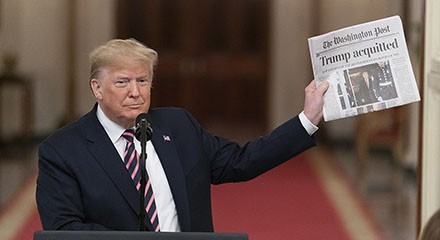
In this case, however, we must interpret Bezos’s decision not to run the paper at a loss as a deliberate choice. And it is a choice that must be placed in the history of his ownership overall. He bought the paper in 2013 at a low ebb for a little over $300 million, and spent the first few years - as many legacy outlets did then - ‘modernising’ it for the digital age. In 2016, however, a great steroid injection was given to it, the NYT and similar liberal-leaning outlets, by a certain Donald J Trump. The Post emerged as the house organ of the ‘#resistance’ to the new president. It added a portentous motto to its masthead: “Democracy dies in darkness”.
The ‘resistance’-aligned media, it must be said, suffered a great deal economically, when their dayglo-tanned money-spinner departed the White House in 2021. Panic about Trump translated readily into subscriptions, but, although the Joe Biden years were hardly serene, the emergency was over. When it loomed once more, in 2024, however, Bezos had something else in mind for the second Trump term, should it take place. He joined the general stampede of the tech billionaire set to the right, though he was more discreet about it than Elon Musk or Mark Zuckerberg.
The die was cast, finally, when the Post - under heavy manners from senior management - spiked its planned endorsement of Kamala Harris in October of that year. This was interpreted, no doubt accurately, as a favour from Bezos to Trump - a favour he would expect returned. In terms of high politics and, given where Bezos makes much of his real money (enormous Amazon Web Services contracts, including to the government), it was a canny move; if Harris had won, she would be less likely to punish him for it than Trump would be to punish him for a Harris endorsement.
For the paper, however, it was a total disaster. Hundreds of thousands of subscriptions were cancelled. Bezos and his agents doubled down, announcing that, henceforth, its op-ed pages would be used solely to promote “personal liberty and free markets”. The financial crisis at the Post is largely a matter of its management dissolving the existing readership, and failing to elect another.
Betrayal
In this light, the maiming of the Washington Post begins to look like a deliberate attack on what was, after all, a storied institution of the American press - one of only a few remaining with serious journalistic muscle, which was occasionally to be found holding the powerful to account. It is altogether poetic that it should have taken place during the release week for Melania, a by all accounts bizarre, Amazon-funded film about the first lady, whose budget - the highest ever for any documentary (if that is what we should call it) - included a $28 million bung directly to its subject herself. No doubt her finances are entirely separate from those of her husband, and everything is above board …
If this is a deliberate act of destruction, it would seem congruent with certain other recent developments in the broader media. The CBS television network has been manoeuvred into the hands of David Ellison, a Trump-aligned businessman, who promptly hired the self-regarding Zionist lunatic, Bari Weiss, to run operations. The new management has attracted controversy for repeatedly spiking news stories critical of the administration and hiring toadies. Its ratings are, at this point, positively subterranean.
Meanwhile, Ellison’s father, Larry - the notoriously-rapacious billionaire owner of the tech behemoth, Oracle, and a Bond villain right down to his preposterous goatee - found himself the beneficiary of the forced sale of the social network, TikTok. The sale, of course, was forced in stages, because it declined to censor coverage of the Gaza genocide. Failed Republican presidential hopeful Nikki Haley exemplified the logic, when she claimed that 30 minutes of TikTok use made the user “17% more anti-Semitic” - the sort of thing Chris Morris used to dupe celebrities into saying on Brass Eye (“paedophiles are more crab than human …”).
The takeover finally went through recently, with the immediate result of a comically heavy-handed censorship regime coming in. The short-term result is a stampede off the platform - although platforms of this sort are ‘stickier’ than individual media outlets, and so this may not turn out to be the kind of self-immolation seen at the Washington Post or CBS.
If this is the direction of the media - if it is doomed to be colonised by billionaires primarily motivated by other business interests, who are incentivised to grovel towards the buy-side on large government contracts - then things are bleak indeed. Serious journalism is a public good, and one which was imperfectly provided (but provided nevertheless) by the great bourgeois media firms. One could compare the situation to that of a private hospital: its driving force is profit, but it does really treat patients nevertheless. The betrayal of this vocation by the new oligarchs is encouraged by the economic headwinds mentioned above.
We are approaching the moment where, for journalism to survive at all, it must be divorced from the profit motive, which offers it only death. Here, the workers’ movement has much to offer - if it can revive. Mass-membership political parties could sustain journalistic operations without the sensibilities of oligarchs and advertisers to take into account. They could train journalists, defend them with lawyers, and supply them with an intelligent and demanding readership. Such was the case in the best times of the movement’s history. There is no reason, beyond our movement’s current political failings, why it may not be true again.
A real journalistic endeavour of this sort - tied to a coherent social movement - would have many salutary effects. It would provide an alternative to the aimless doomscrolling of social media, never mind the desperate scrabbling of the legacy outlets, slowly turning into vast approximations of the Daily Mail’s old ‘sidebar of shame’, full of trivia and smutty paparazzi shots. It might, for that matter, shame the bourgeoisie into meaningfully reviving its own media.
Until then, we can expect only more desecration of the public sphere by the incomprehensibly rich.