
12.11.2026
Slavery’s imperial apologists
Charles Windsor has not apologised for Britain’s role in Caribbean slavery. Nor has Andy Burnham. Mike Macnair says the official arguments against apologies and reparations are bogus. But to really right the wrongs of the past requires the overthrow of the world capitalist order
King Charles, attending the Commonwealth Heads of Government Meeting in Antigua and Barbuda, made a speech in which he said: “… that shameful chapter of history is one that fills my heart with horror and my soul with the most profound personal sorrow”. But he did not offer any apology from his government, let alone reparations.
On the contrary, he argued that “History is not ours to choose or to change. It is bequeathed to us in complex synthesis by forebears we can never know. Our inheritance includes both their achievements and their failures - the good they did as well as the wrongs.” That is, this is all history and does not affect the UK’s current moral or political obligations.
At the same event, Andy Burnham is reported as saying: “I’ve been very clear that we do not support reparations. But it’s not the case that we don’t support countries in the Commonwealth around development, and helping them with debt issues that they’ve got, green finance. That’s what we’ve done under all governments and in my view we should continue to do as part of being a Commonwealth.”1
These royal and prime-ministerial arguments for treating the history of British involvement in the slave trade, and British promotion of slave plantations in the Caribbean (and in the southern USA, Brazil and …) as merely history without present moral and political implications are flatly wrong. Why they are wrong is a matter of considerable importance for the left.
On the other hand, an apology would be merely empty; and reparations, even if they were formally conceded, would be rapidly recuperated, as long as the capitalist world order continues. Witness (for example) South Africa. This is not a reason for the Brit left to back Andy Burnham and Charles Windsor: it is a reason for proposing the overthrow of the global money system and its replacement by democratic planning, and in that context material forms of compensation for the continuing injuries of imperialism.
An admission of liability and compensation are due and overdue. June 23 2027 will be the 350th anniversary of the Court of King’s Bench’s decision in 1677 in Butts v Penny that “negroes being usually bought and sold among merchants, as merchandise, and also being infidels, there might be a property in them sufficient to maintain trover.”2 ‘Trover’ was an action for damages for dealing with claimant’s ‘chattels’: that is, moveable property (the word originally meant cattle).
Holly Brewer has offered persuasive arguments that Charles III’s 10th cousin, 10 times removed, Charles II (king 1660-85), was actively involved in the case management for Butts v Penny. The case was necessary for the ability of the Royal African Company to enforce security over slaves, and hence its financial stability. Charles had promoted the RAC, and his brother, James (king later James VII of Scotland and II of England), was its president.3
Butts v Penny was certainly not the beginning of British involvement in the slave trade. But it is a striking symbol of the role of British government policy in this activity.
Common
The argument that this is just history (and, by implication, we should let bygones be bygones) is inextricably involved with the defence of Britain’s imperialist status and its current assets and overseas holdings.
The first point is the argument that slavery was common practice when the English were engaged in the slave trade and plantation slavery - common practice that had been accepted for centuries. Hence, when the Brits were doing it, no-one thought it was wrong.
This is a half-truth and misleading. It is certainly true that slave personal status is an institution of great antiquity, going back certainly to the Bronze Age and probably to the Neolithic; and that it was endemic, and central to the extraction of social surplus product, in classical antiquity. It is also true that in the 1600s-1700s north African slave raiders from time to time landed on the south coast of England to take slaves.4
However, the idea that slavery was wrongful was also present from an early date. The Roman jurist, Ulpian, writing in the 210s CE, argued that slavery, though practised by ius gentium (the law, meaning common practices, of peoples) was contrary to ius naturae (natural law). His doctrine was drawn from the Stoic school of philosophy, contrary to the Aristotelians, who argued that some peoples are natural slaves: for example, north Europeans. Ulpian’s line was adopted by the compilers of the Institutes or elementary law textbook, issued by the government of the emperor, Justinian, in 534 CE.5 It thus came to be taught in universities, where the Institutes was part of the rhetoric course to undergraduates; and Ulpian’s argument became one of the central arguments of advocates of abolition of the slave trade and later of slavery.
Secondly, the early Muslim ‘ulama’ developed a doctrine that Muslims may not enslave other Muslims; and Christians later said the same about other Christians. For whatever reason, but perhaps partly through the influence of these ideas, from around 1100 personal unfreedom in Europe principally took the form of ‘serfdom’ or ‘villeinage’. The unfree were bound to the land and obliged to work for the lord of the manor. But the lord could only sell them with the land, and, unlike the slaves of classical antiquity, the lord was not permitted to kill or maim them. Thompson, counsel for the defendant in Butts, argued that English law only recognised villeinage (which was obsolete at the time of the case), not chattel slavery. A bare 19 years later in Chamberlain v Harvey (1696) the court of King’s Bench adopted Thompson’s line: chattel slavery, it declared, did not exist in English law.6 (The Dutch author, Arnold Vinnius, similarly argued that within the Netherlands there was only villeinage - “adscripticii” status - not chattel slavery.7) The issue remained controversial in English law down to the early 19th century.8 So slavery was not a universally accepted practice.
Thirdly and most fundamentally. The Atlantic slave trade and plantation slavery were on a different scale to pre-capitalist slavery. Pre-feudal slavery was predominantly domestic: creating a small-scale surplus product by freeing the small slaveowner from tasks like grinding grain on a hand-quern or cutting wood and fetching water. This small-scale surplus product was then centralised through rent and taxes to support class elites. Other forms were for elite display (including the human sacrifices of the Roman gladiatorial games). Industrial slavery was marginal (chiefly in the mines).
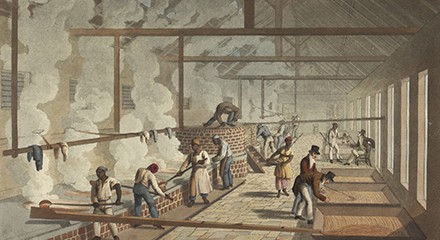
With capitalist slavery we became concerned with the industrial-scale acquisition and shipping of slaves. They were shipped to destinations - the plantations - which were a form of agri-factory, producing raw materials inputs to feed the industries and supply the consumers of the imperial centre. Both the sources of the supply of slaves and the places where plantations were set up had their economies substantially and permanently distorted in the interests of the capitalist imperial power.
Conversely, Joseph Inikori’s 2002 book, Africans and the industrial revolution in England, shows elaborately the role of the Atlantic slave trade and related activities in the accumulation of capital for the industrial ‘take-off’ in England: reprising with much more rigour and evidence, if in a neoclassical framework, the argument of Eric Williams’ 1944 Capitalism and slavery.
So from both these points of view, capitalist slave-trade and plantation-slavery is not the same thing as pre-capitalist slavery.
Of course - again - the Brits were not the original inventors of this practice. Late medieval Venice and Genoa have that dishonour. It was continued in the Portuguese empire (interlinked with Genoese finance) and the Dutch. But to use this argument to excuse British responsibility is an example of what is commonly damned as ‘whataboutery’9 - and worse, because it is not saying, ‘What about the crimes of west Africans against the Brits?’ (you can’t point to any), but rather: ‘There are lots of other burglars - why are you prosecuting me?’
Time
OK, so the enslavement and transportation of millions of Africans, treated as animals,10 with long-term distorting effects on both the economies of western Africa and of the Caribbean, was wrongful. But, argue the opponents of reparations, it is too long ago for compensation to be claimed.
Length of time is certainly an objection to claims in all legal systems, though some of the ‘school of natural law’ authors of the 17th-18th centuries argued that this should not be the case - and the argument has been revived in relation to property claims in the recent past.11 In English law the current position is based on the Limitation Act 1980, requiring claims for torts (wrongs) to be brought, in general, within six years. (There are special provisions applying where the damage does not become apparent till a later date.)12
There are a variety of underlying reasons why length of time should bar claims: it may be that there was an agreement in the remote past; the claimant who delays suing may be seen as acquiescing in the wrong done to him, or as careless; it may merely be that it is impractical to establish the disputed facts of what happened a long time ago.
But suppose that this reasoning might apply (other things apart) to the wrongs done by British capital’s activities in, and the British government’s support for, the slave trade and plantation slavery. There are ‘other things’. In general, time does not run against a claim where the defendant has fraudulently concealed the possibility of it coming from the potential claimant; or where the claimant is prevented from bringing an action by force: as, for example, in Annesley v Anglesey (1743), where a rival claimant had the under-age true heir to a peerage and estates sold as an indentured labourer to a plantation in Delaware to prevent him from claiming.13 Or, more generally, though the Indemnity and Oblivion Act 1660 prevented (most) prosecutions for conduct during the Civil War and Commonwealth, time did not run for limitation purposes against royalists unable to claim because they were in exile.
How this is relevant to reparations for slavery is that the victims of the slave trade and plantation slavery are both defrauded of recognition of the claim and kept out of it by force.
They are defrauded of recognition of the claims through capitalists’ and governments’ support for a variety of forms of fraudulent economic arguments that deny both the long-term damage inflicted by the slave trade and slave-plantation regimes, and the long-term benefits that accrued to the imperialists. Institutional subsidies support these fraudulent arguments.
The immediate form of this fraud emanates from the USA, but with the active support of the UK. By taking the dollar off gold in 1971, Richard Nixon’s administration converted the world economy into a global Ponzi scheme, in which more money has continually to be printed to keep the financial operations afloat each time a crash approaches or arrives. An early stage in this fraud was the misrepresentation that countries could achieve ‘development’, without expropriations and planning, by borrowing from Anglo-American and other banking syndicates. In reality, floating currencies implied that the debt interest already consumed the income from investments funded by borrowing; leading to the 1980s ‘third world debt crisis’ (which also affected those eastern European countries that allowed themselves to be sucked into the scam). There has been partial debt forgiveness, but never an acceptance that the 1970s move into loans was a systematic fraud. That fraud continues.
They are kept out of claiming by force, in the continuing imperialist military operations to protect imperialist bases, to intervene against leftist governments, and so on. Haiti was still paying indemnities to France for the abolition of slavery until 1947, and has been subjected to a succession of US interventions, including current indirect support for ‘multilateral’ forces. Cuba remains under US siege operations (the USA has sought regime change in Cuba consistently since 1960, though varying the intensity of its undeclared warfare). The January 2026 US kidnapping of Nicolas Maduro, the president of Venezuela, was in part aimed to block Venezuelan oil supplies to Cuba. The US invaded the Dominican Republic in 1965,14 conducted destabilisation operations in Jamaica in 198015 and invaded Grenada against the New Jewel Movement government in 1983.16 This is absolutely an incomplete list …
In a sense, the continuing use of force takes us back to Justinian’s Institutes: “Things again which we capture from the enemy at once become ours by the law of nations, so that by this rule even free men become our slaves, though, if they escape from our power and return to their own people, they recover their previous condition.”17
The unwillingness of the UK state to concede apology and reparations for slavery reflects the fact that the UK still defends title to territory by conquest, in relation to most of the British Overseas Territories;18 and, more generally, that, given the wrongs the British empire also inflicted on its other colonies, any other stance would open a can of worms.
So the argument from the lapse of time against apology and reparations is also false. This is not about a past injustice committed by British capital and its state. It is about continuing injustices, in which the UK client state and its US patron protect immunity from liability for past injustices, as well as inflicting new ones.
Bankrupt
The crimes of British imperialism are not merely long-dead history. The UK state, and UK capitalist firms that support the UK state, remain morally responsible for them. Demands for an apology and for reparations are entirely morally justified. This, however, does not mean that they are the right way forward for the movement.
The case of the call for an apology is straightforward. Since the end of apartheid in 1991-94 there has been an endless series of apologies for historical injustices. What have they achieved? The answer is, quite plainly, nothing except to make some participants feel a little better. If the injustice was merely historical, this might have some merit. Since it is continuing, this amounts to ‘Sorry for hitting you in the face’, followed by immediately repeating the offence.19
The case of a call for reparations is, in principle, stronger. There has been real relative impoverishment of the colonised countries by the African slave trade and plantation slave production, and real relative enrichment of the UK and other imperial powers. So surely compensation is in order?
The problem is that the UK is at present close to absolute bankruptcy. After the loss of imperial dominance to the USA, in the ‘cold war’ period it was, like the rest of Europe, allowed to preserve industry, full employment and welfarism as a sort of Potemkin village to show that capitalism could do better than the Soviet regime. In the 1970s these concessions began to be withdrawn (with Nixon taking the dollar off gold and what followed, and Carter redirecting political finance from right social democrats to neoliberals). As part of this exercise, Thatcher dumped British industry, claiming that the country could live from services (and especially finance) in a free-trade regime.
What has in fact followed is persistent trade and balance of payments deficits since the mid-1980s. These deficits have been met partly by attracting ‘hot money’ into the UK (aka the ‘London laundromat’); partly by selling UK capital assets to overseas (mainly US) investors. The UK is like a debtor who is selling off the furniture in order to stave off complete bankruptcy. There is now very little furniture left to sell. This situation explains the decay of UK infrastructure (not unique) and the budgetary paralysis of recent governments. It also explains regulation scandals, like those in water: only asset-strippers are willing to buy UK assets, so they cannot be penalised for the consequences (water scandals, post office scandal, and so on). Default is close to being inevitable in the near future.
The UK in relation to its liability for imperial slavery is, therefore, like a criminal who has stolen a high-value car, driven it around and crashed it into numerous other cars; but proves on investigation to have no resources to pay for the damage. Punishment may be possible: thus Karl Marx on the 1857 Indian rebellion:
The outrages committed by the revolted Sepoys in India are indeed appalling, hideous, ineffable - such as one is prepared to meet - only in wars of insurrection, of nationalities, of races, and above all of religion; in one word, such as respectable England used to applaud when perpetrated by the Vendeans on the ‘Blues’, by the Spanish guerrillas on the infidel Frenchmen, by Servians on their German and Hungarian neighbours, by Croats on Viennese rebels, by Cavaignac’s Garde Mobile or Bonaparte’s Decembrists on the sons and daughters of proletarian France.
However infamous the conduct of the Sepoys, it is only the reflex, in a concentrated form, of England’s own conduct in India, not only during the epoch of the foundation of her eastern empire, but even during the last 10 years of a long-settled rule. To characterise that rule, it suffices to say that torture formed an organic institution of its financial policy. There is something in human history like retribution: and it is a rule of historical retribution that its instrument be forged not by the offended, but by the offender himself.20
In the present case, “the instrument” is “forged by the offender” because the UK’s clinging to its imperial pretensions - the British Overseas Territories (and the Six Counties), the (US-controlled) nuclear weapons, the UN Security Council seat, the vanity aircraft carriers, Brexit - is a substantial element in the paralysis of the governments and the pressure towards the coming default. Reparations, then, would merely trigger default.
Suppose that reparations could be paid. Without structural transformation of the world economy, the result would be at best a temporary palliative. (This assumes that the local Caribbean governments handles the money in good faith, rather than its merely disappearing into offshore bank accounts.)
I have referred repeatedly in this article to debt and the control of subordinated economies through debts. Money is money because it serves as a means of exchange. It can only serve as a means of exchange if it also serves as a store of value: this is visible in the German hyperinflation of 1923 and the Zimbabwean of 2008-09. These, in turn, were triggered by failures of the relationship of the national money to world money (which in 1923 was sterling, in 2008-09 the US dollar.
The demand for reparations is thus the equivalent in relation to the crimes of imperialism of the slogan, ‘Tax the rich’, that has become widely popular. Such slogans appear to challenge capitalism, but do not, in fact, do so at all. The money of the rich - or money paid for reparations for slavery - is only worth having if it can buy useful goods and/or services. When the power of the rich is attacked, they go on ‘capital strike’, and hyperinflation and economic dislocation results. This is not a matter of bad faith on the part of political actors (though you do also get US sanctions and destabilisation activities): it is inherent in the nature of the capitalist system of money.
This does not mean that there should not be compensation for the wrongs of capitalist slavery and imperialism. It means, rather, that the only real road to such compensation is the actual overthrow of the global capitalist regime, and the withdrawal of large elements of production from market organisation to democratic planning.
Under conditions in which the global power of capital was broken, and large-scale production activities were taken into planning, it would now become possible to plan seriously for compensation for the wrongs of capitalist imperialism - in the form of the free supply of tech now protected by intellectual property rights, and of material goods (machinery, infrastructure, and so on).
That is an objective need, which the demand for reparations stands as an obstacle to, just as ‘tax the rich’ slogans stand as an obstacle to real communist politics.
-
Both Charles and Burnham are quoted in the BBC News report, ‘King calls slave trade a “shameful chapter” during Commonwealth address’: www.bbc.co.uk/news/articles/cr89znnnn7dno.↩︎
-
The printed reports of the case are available at slaverylawpower.org/chapters/reacting-absolutism/butts-v-penny-1677. Sir John Baker, Sources of English legal history: public law to 1750 Oxford 2024, p456 - note 102 has a summary of a manuscript report.↩︎
-
‘Creating a common law of slavery for England and its New World Empire’ Law and History Review Vol 39, pp765-834.↩︎
-
L Colley Captives London 2002.↩︎
-
Justinian Institutes Book I, title 2, sections 1-2; JB Moyle’s English translation is available at www.gutenberg.org/files/5983/5983-h/5983-h.htm.↩︎
-
Printed reports are available at slaverylawpower.org/chapters/whig-moments/chamberlain-v-harvey-1696.↩︎
-
In quatuor libros institutionum imperialium commentarius academicus et forensis (Commentary on the four books of the imperial institutes for academic and judicial use) 4th edition, book 1, title 3, section 1: cujasweb.univ-paris1.fr/book/app/resource/0607001512/#page/1/mode/2up.↩︎
-
See, for example, Forbes v Cochrane (1824) 2 B & C 448. My point is not to cite, as Sir Nicholas Mostyn comments, “Mr Justice Best’s magnificently self-righteous judgment in Forbes v Cochrane” (www.counselmagazine.co.uk/articles/law-disorder), but that, notwithstanding the usually celebrated case of Somerset v Stewart (1772), the line in Butts v Penny was still seriously arguable in court this late.↩︎
-
For a useful discussion and references see en.wikipedia.org/wiki/Whataboutism.↩︎
-
Thus in Gregson v Gilbert: the Zong (1783) slaves were thrown overboard for the sake of an insurance payout, and Lord Mansfield said that, “though it shocks one very much, the case of slaves was much the same as if horses had been thrown overboard” (www.counselmagazine.co.uk/articles/law-disorder).↩︎
-
There is discussion in several of the essays in H Dondorp, D Ibbetson and EJH Schrage (ed) Limitation and prescription: a comparative legal history Berlin 2019.↩︎
-
The point here is only the general principle, not the details of modern English limitation law.↩︎
-
AR Ekirch, Birthright: the true story that inspired ‘Kidnapped’ New York 2010.↩︎
-
espaillat.house.gov/media/in-the-news/remedying-past-unlawful-military-interventions-case-dominican-republic.↩︎
-
www.cia.gov/readingroom/docs/CIA-RDP90-00845R000100190003-4.pdf.↩︎
-
en.wikipedia.org/wiki/United_States_invasion_of_Grenada.↩︎
-
Inst. 2.1.17, Moyle’s translation (above n5).↩︎
-
en.wikipedia.org/wiki/British_Overseas_Territories. In a few of them (eg, British Antarctic territory), the claim is ‘res nullius’: the land was previously uninhabited (Justinian, Institutes 2.1.22: “When an island rises in the sea, though this rarely happens, it belongs to the first occupant; for, until occupied, it is held to belong to no-one.” Not the same thing as the colonialists’ claim that land occupied by hunter-gatherers was “terra nullius” because no-one was fencing and ploughing.↩︎
-
See, for instance, the discussion in the October 2022 special issue of Global Studies Quarterly: academic.oup.com/isagsq/issue/2/4.↩︎
-
www.marxists.org/archive/marx/works/1857/09/16.htm.↩︎