
10.09.2026
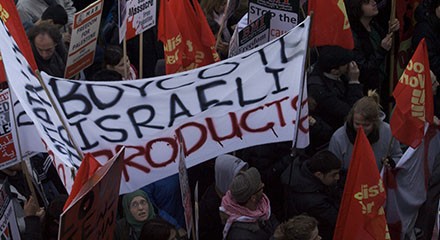
Palestine picket line
There are more and more government sanctions from above and economic, cultural and sporting boycotts from below. Carl Collins shows that this phenomenon has a long and highly contested history
Across the whole island of Ireland demonstrations have taken place in support of ‘Stop the Game’ - a broad coalition of football supporters, players, coaches, administrators and concerned citizens calling on the Football Association of Ireland to withdraw from all football fixtures against Israel and to “not cross the Palestinian picket line” amid Israel’s ongoing murderous operations in Gaza, the West Bank and the wider Middle East.1
In July, the FAI passed a motion in favour of proceeding with the matches, arguing that it had an obligation to fulfil its commitments in relation to UEFA Nations League fixtures. However, the matches are to be played at (so-called) ‘neutral’ venues, with the away fixture in Hungary and the ‘home’ fixture behind closed doors in Serbia.
While the immediate impetus behind the movement of solidarity with Palestine comes from the atrocities committed since October 2023, activists in Ireland, particularly within the Palestine Solidarity Campaign, have also correctly pointed to the longer history of occupation, settlement and dispossession.
There is some justification in thinking that the Irish state has adopted a more critical public position towards Israel than many other western governments. It has described the scale of Israel’s military actions in Gaza as incompatible with international humanitarian law and supported International Court of Justice genocide cases. Measures such as the Occupied Territories Bill, banning the importation of goods from illegal Israeli settlements, proposals for European sanctions and restrictions on imports and exports of military technology have also been advanced.
Yet other economic and logistical relationships with Israel have continued, alongside military support under pressure from the US - notably allowing Israel to use Shannon airport as a transit hub towards the Middle East, making it the site of protest and destructive intrusions by Palestine Action Eire.2
The contradiction is clear. There is a substantial difference between making condemnatory statements about Israel and taking measures that materially obstruct its ability to wage war. The same contradiction exists in international sport, and the Stop the Game campaign responds to the Irish government’s acceptance of the FAI’s decision to proceed with the fixtures.
Opposition to Israel’s sporting participation has not been confined to Ireland. Football supporters, athletes and ordinary people have repeatedly challenged the hypocrisy of allowing Israel to participate in international competition. The most obvious comparison is Russia. Western governments introduced extensive sanctions against Moscow, while FIFA, UEFA, the International Olympic Committee and other sporting bodies moved rapidly to suspend Russian teams and athletes.3 The contrast with Israel is difficult to ignore.
The argument that sport must remain ‘politically neutral’ rings particularly hollow, when sporting institutions have already demonstrated that they are capable of making political decisions. The supposedly ‘neutral’ rules of international sport are applied within a political world, and their application reflects the interests and geopolitical alignments of the states and institutions involved. This is why Stop the Game is significant beyond two football fixtures: it exposes the political character of supposedly apolitical institutions.
There is nothing new about sport becoming a battleground for political struggle. The history of sporting protest is extensive. Actions range from the tragic sacrifice of suffragette Emily Davison, who was killed after stepping in front of King George V’s horse at the Epsom Derby in 1913,4 to the comical boycott against a late-night kick-off time, led by supporters of Spanish football club, Rayo Vallecano, who left their usual section of the stadium empty.5
Without equating them politically, such actions demonstrate that supporters do not have to be passive consumers of sporting entertainment. They can act collectively and sporting events provide a highly visible arena for political grievances.
Viewed critically, the protests against the proposed European Super League in 2021 provide an inspiring example for communists. Supporters across numerous European clubs mobilised rapidly and succeeded in forcing clubs and institutions to retreat.6 The episode demonstrated the potential power of organised supporters, but also their limitations. As there was no mass political organisation capable of drawing together these struggles and giving them a coherent programme, the movement won a particular concession without developing the forces capable of challenging the social relations that produced the problem.
The same lesson can be seen in more recent events over a proposal by FIFA president Gianni Infantino to sell a 20% commercial stake in the World Cup to private investors. Following fan unrest, the proposals were withdrawn.7
These examples demonstrate that institutions respond to organised pressure, when they believe it is sufficiently powerful. Yet the same institutions that threaten boycotts when their own interests are affected have punished supporters for political solidarity with Palestine - such as Celtic supporters, who faced UEFA disciplinary action after displaying thousands of Palestinian flags at the height of the conflict.
Sporting bodies are therefore not neutral arbiters standing above politics. They operate within the political and economic order and respond to pressure according to their own interests and those of the establishment.
The irony will not be lost on the reader that the term ‘boycott’ originates from the successful employment of the tactic suggested by Charles Stewart Parnell and the Irish Land League in 1880 against Captain Charles Boycott - the agent of an absentee landlord who tried to evict tenants unable to pay increased rents.
The workers’ movement has repeatedly used boycotts and forms of non-participation as weapons of struggle. But Marxists should distinguish between boycotts as a tactic and as a strategy. The former can be extremely useful; the latter cannot replace the organised political struggle necessary to build a new society.
States and establishment organisations have themselves used boycotts. During the 1958 World Cup qualification process, Israel advanced through several rounds without playing because opponents refused or withdrew from fixtures for political reasons. The earliest World Cups also saw boycotts motivated by political and geographical disputes. Then there was also the international sporting boycott of apartheid South Africa. From 1964, South Africa was excluded from the Olympic Games and subsequently faced sporting isolation across cricket, rugby and other international competitions because of its apartheid system. That isolation continued into the early 1990s.
In 1974, the Soviet Union refused to travel to Chile for a World Cup qualifying play-off, because the match was scheduled for Santiago’s Estadio Nacional, which Augusto Pinochet’s dictatorship had transformed into a detention and torture centre following the military coup. FIFA refused to move the fixture, and Chile ‘played’ the game alone in an empty stadium, scoring against an absent opponent! In 1980, 65 countries participated in the boycott of the Moscow Olympics, led by the United States, in opposition to the Soviet invasion of Afghanistan. Four years later, the Soviet Union led a 14-country eastern bloc boycott of the Los Angeles Olympics.
These examples are not politically equivalent: state-led boycotts are mostly used as instruments of capitalist and imperialist competition and should not be viewed in isolation as progressive. Conversely, a boycott by ordinary people - football supporters, athletes or workers - can be an expression of solidarity and a means of obstructing an institution’s normal functioning. Forcing a sporting institution, government or other organisation to impose a boycott can also represent a significant victory.
However, the danger for the Stop the Game campaign and wider Palestine solidarity movements is that they become cross-class and dependent upon governments or institutions that have no interest in pursuing the struggle to its logical conclusion.
The demand that the FAI boycott Israel is entirely justified. Indeed, putting pressure on the FAI is preferable to treating the organisation as an authority whose decision must simply be accepted. Demanding that the Irish state sever military, logistical and economic relationships with Israel is legitimate. But the working class risks just outsourcing its politics to the Irish government, UEFA, FIFA, etc.
There is also a danger in treating every form of solidarity as automatically progressive. The politics surrounding the German club, FC St Pauli, demonstrate why this question cannot be oversimplified. St Pauli famously possesses a leftwing and anti-fascist supporter culture, while parts of its fanbase have maintained a long-standing relationship with leftwing supporters of Hapoel Tel Aviv in Israel. That relationship has obvious historical dimensions, including the holocaust and the particular politics that have developed in Germany. Following the Hamas breakout of October 7 2023, St Pauli uncritically condemned the attacks and expressed solidarity with its friends at Hapoel Tel Aviv. Other sections of its leftwing supporter base, and supporters of other left-leaning teams, uncritically condemned this position, producing arguments over Israel, Palestine, Zionism, anti-Semitism and the war in Gaza.8
This is precisely why a Marxist political programme matters. Without one, political movements can swing between liberal conceptions of neutrality and inadequate forms of political symbolism. Some conclude that opposition to Israel must be rejected as supposedly anti-Semitic because Israel is being singled out. Others argue that any criticism of Israel must automatically be progressive. Neither proposition is sufficient.
The question must always be: what interests does a particular political action serve, and how does it advance the independent organisation and political consciousness of the working class? There is no abstract Marxist rule that participation is always correct, any more than there is one saying boycott is always correct. The tactic has to be subordinated to strategy.
-
See www.aljazeera.com/amp/news/2026/3/30/palestine-aily-ireland-under-fire-for-allowing-weapons-transfers-to-israel.↩︎
-
www.thecanary.co/global/world-analysis/2026/03/02/fifa-hypocrisy.↩︎
-
www.independent.co.uk/sport/football/european/the-simpsons-make-an-appearance-at-rayo-vallecano-as-supporters-protest-against-monday-night-matches-9838604.html.↩︎
-
www.theguardian.com/football/2021/apr/20/european-super-league-unravelling-as-manchester-city-and-chelsea-withdraw.↩︎
-
See my article, ‘Infantino’s botched coup’ Weekly Worker August 6: weeklyworker.co.uk/worker/1597/infantinos-botched-coup.↩︎
-
See morningstaronline.co.uk/article/st-pauli-supporter-clubs-clash-over-palestine-solidarity.↩︎