
18.06.2026
Popular and respected
He loved many things: cigarettes, good-looking young men, restaurants, opera and Picasso ... but above all he loved his art. Mike Belbin remembers David Hockney July 9 1937-June 11 2026
Britain’s acclaimed, rich and arguably most famous artist, David Hockney, died at his London home aged 88. He was called ‘Britain’s Picasso’ and regarded as a national treasure. What would an artist have to do now to reach the same peak?
Hockney was born in Bradford in July 1937 - nowhere near the south of England, which is the launching pad for so many British artists (though Henry Moore also came from the West Riding of Yorkshire). Hockney’s father, Kenneth, was an accountant, who went on to run his own business, while his mother, Laura, was a strict vegetarian, who encouraged David’s interest in art. As a child, Hockney used to do drawings and paintngs and hawk them round the streets in an old pram (in those days there were not so many cars or drug gangs around to make it risky for a young artist).
He attended Bradford Grammar School at a time when even grammar school kids did not expect to make it to higher education. Hockney, however, proceeded to the free Bradford College of Art (that is, free, thanks to a post-war state grant). There he met future professional artists Derek Boshier and Pauline Boty, who would join him in promoting British pop art. Later at the Royal College of Art he met his mentor, RB Kitaj (it is useful to know fellow practitioners, who are about to become part of a lauded art movement). In 1961 Hockney joined Peter Blake and the others in the Young Contemporaries exhibition at the new Institute of Contemporary Arts in London.
Hockney’s work was pop art, but a lot more abstract than that of Blake and Boty, who pictured rock stars and film actors in their work. Hockney was more like Paul Klee and Pablo Picasso, painting simple box-like figures with sketchy heads and words across the surface. One such was We two boys together clinging (1961) - a defiant allusion to homosexuality, which was still illegal at that time (Hockney had already come out at the age of 23).
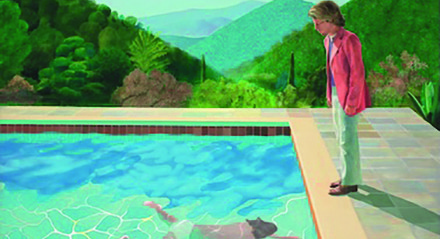
A love of the USA does not hurt and in 1964 Hockney wanted to go there. He first went to New York and later crossed to Los Angeles (where, even though he had never driven a car, he managed to acquire a licence!). Like many English intellectuals at the time, Hockney was excited by the promise of the US - it was ‘the future’ and the place to be. It was in LA that he famously began to do paintings of swimming pools, with and without human figures. He used a relatively new art material, acrylic, giving these works a bright sheen evocative of California’s sunshine.
When Hockney came out as gay, men were still getting busted (such as actor John Gielgud), but homosexuality was not treated by some as political or part of any ‘culture war’, but as ‘artistic’ and even entertainment. Unless the police were involved, the mainstream media treated gay artists with discretion, while sexless effeminacy began to fill radio and TV. The press referred to Hockney as “flamboyant”, a dandy - his colourful, round spectacles a code for his sexuality. As long as you did not mention actual sex, everyone was discreet and allusive.
In his art Hockney was never snobbish about trying new materials or media. His genres were traditional - portraits, interiors, landscape - but he was always interested in using new means and making a few formal innovations. He did develop a scepticism about the rigid use of perspective. He found the convention of lines of sight converging on the eye meant neglecting the human sense of space, the experience of being inside a place.
In 2012 at his solo Royal Academy show, ‘A bigger picture’, he produced huge paintings of landscapes and trees, some of which suggest ‘tunnels’ you might walk down, while other pictures of hills and roadways seemed to allude to driving a car. In the 1990s he had returned to Yorkshire on the advice of a friend to explore such places, and later went on to Normandy to do much of the same. He could be seen outside in all weather, making these pictures, without relying on photographs. However, at other times he did use photography - in fact polaroids and Photoshop, as well as iPad and iPlayer. You looked at the images in these new media: they were recognisable, but in collaboration with the latest means. You mused about the effect and why he had done it.
Hockney painted many portraits, chiefly of his own circle - friends, business acquaintances, a young lover (Peter Schlesinger) and the occasional private commission. Unlike other painters, such as Édouard Manet or indeed Lucian Freud, he rarely explored strangers.
One of his most famous portraits is that of his friends - textile designer Celia Birtwell and fashion designer Ossie Clark. This large painting - ‘Mr and Mrs Clark with Percy’ (1970-71) - is apparently the most popular art postcard from the shop in Tate Britain. Perhaps people take it as more than ‘personal’, belonging to Hockney’s affluent life, more symbolic of all our lives now (even if only in aspiration). It showed a tasteful modern bedroom, with Celia in a long formal dress and Ossie sitting with bare feet on a rug, one of their cats on his lap. Perhaps it can be taken as representative of what many think of as Britain’s two main leisure activities - going out on the town and relaxing at home.
In recent years, he was attached to the advisory board of the magazine Standpoint (2008-21), associated with the Thatcherite Institute of Economic Affairs. He used its pages to publish sketches, while writing against arts funding cuts and the ban on smoking cigarettes in pubs and restaurants.
From the 1970s on, Hockney appeared on many of the plethora of TV arts programmes typical of the period, exercising charm and directness. His earnings rose too. In 2005 one of his early ‘abstracts’, Seated woman being served tea by standing companion (1963), was sold at Sotheby’s to the Museum of Modern Art in New York for £1,800,000 - a new world record at the time. Other paintings are exhibited in galleries all over the world. Nowadays, though, some art entrepreneur (someone who has never been anywhere near the West Riding) may yet come up with an ‘AI Hockney’.
So how might you become another David Hockney?
- Be born at a time when only a few northern lower-middle class people went to a free art college; be ambitious; become part of an art movement (like pop art) that the media cannot help but be interested in; be pro-American.
- Be accepted as ‘flamboyant’ (aka gay), while having a series of relationships with younger men, without anyone making a point of it.
- Innovate within traditional subjects; be familiar in the mass media without the need of ‘reality TV’; don’t be afraid of making huge expensive canvases or using your opportunities as a member of the Royal Academy.
- Don’t even think of being pursued by the obnoxious rightwing media - be both popular and respected!
Good luck, comrade!