
06.08.2026
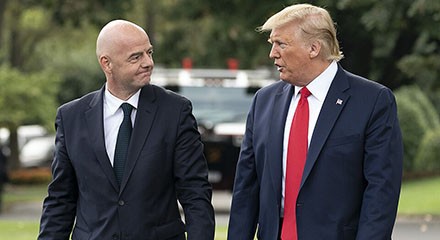
Infantino’s botched coup
FIFA’s president has survived for the moment, but his attempt to sell off the World Cup spectacularly backfired. Carl Collins says communists can organise supporters to take control of the beautiful game
During the 2026 World Cup we analysed the relentless monetisation and commercialisation of football. From ever-expanding sponsorship deals to political involvement in the tournament, we argued that the world’s most popular sport is increasingly treated not as a cultural institution belonging to the millions who sustain it, but as a commodity being exploited by capital.
A week after the final, many supporters would ordinarily have been taking a breather before the return of domestic football. Some may have had one eye on rumours that Argentina could face punishment for the violence witnessed at the end of the final, while many would be fixed on the annual transfer circus, as increasingly absurd sums of money changed hands between clubs yet again.
The next major football story, however, concerned a leaked proposal to allow private investors to purchase a stake in the commercial empire of global football’s ruling body, FIFA - ‘selling off the World Cup’ was the description in various newspapers.
Reports in The Times and Financial Times revealed plans for a new commercial vehicle, through which outside investors would be invited to (further) profit from FIFA competitions. The leaked plans caught FIFA and its president Gianni Infantino off guard, forcing the release of a lengthy statement defending the proposals before it had intended to do so.
Corporate structure
The new entity, to be called FIFA Forward Enterprise (FFE), would consolidate virtually every aspect of FIFA’s commercial activities. Broadcast rights, sponsorship, ticketing, licensing and the operational delivery of tournaments would all be brought together under one corporate structure. FIFA insisted that it would “retain sole control” of FFE, while inviting ‘carefully selected’ third parties to make “minority, non-controlling investments”, chosen according to “long-term governance and strategic criteria”.
The response also confirmed the suggestion in The Times that the proposed overseer of the project would be Joshua Kushner, the venture capitalist and brother of Jared Kushner, Donald Trump’s son-in-law. The Trump administration’s attempts to bend the World Cup to its own political ends have already been well documented in these pages. From Trump’s efforts to steal the limelight during the final to reports that he personally telephoned Infantino in a successful attempt to overturn a red card shown to USA striker Folarin Balogun. The White House treated football as just another arena in which political influence could be exercised. The administration’s visa restrictions affected supporters and football personnel from several countries, most notably Iran, in the lead-up to the tournament.
FIFA’s public defence of the proposals has rested almost entirely upon promises of redistribution. According to sources speaking to Guardian journalists, investors would not receive dividend payments from FFE, although they would be free to sell their stake in future, should its value appreciate. Instead, FIFA argues that outside investment would unlock greater funding for national associations.
The governing body claims every member association choosing to participate could receive an optional additional $20 million. Annual distributions would supposedly increase, while a staggering $10 billion in extra funding would eventually be shared across world football.
On paper this appears generous. In practice it illustrates the dependency FIFA itself has cultivated. There are 211 member associations, many of which already rely heavily upon FIFA grants simply to maintain basic football operations. Infantino himself boasted earlier this year that without FIFA “there would be no football in 150 countries in the world”. If that is true, then the promise of another $20 million hardly represents a free democratic choice. Financially dependent associations are hardly likely to reject the organisation’s preferred commercial strategy.
This is not the first attempt to deepen football’s relationship with global finance. In 2018 Infantino announced a partnership with the Japanese investment giant, SoftBank, to bankroll an expanded Club World Cup. That proposal collapsed amid fierce resistance from clubs, confederations and football administrators who feared both the concentration of commercial power and the implications for the football calendar.
Despite facing huge pressure, not least from UEFA, Infantino has managed to hang on and keep his job. Nevertheless, there is still a floodtide of opposition. His chief advisor has resigned, while football administrators and politicians have lined up to criticise his “errors”. Prime minister Andy Burnham went further, declaring that Infantino was “the wrong man” to continue leading FIFA. Significantly, this condemnation has accelerated only after widespread media reporting and visible supporter hostility. Once politicians sensed which way public opinion was moving, they were eager to position themselves as defenders of football’s traditions.
Supporters
Yet it is worth asking what would actually change if FFE came into existence. In many respects the financialisation of football is already deeply entrenched. Every available surface has become advertising space. Every competition is sponsored. Every broadcast interruption has become a commercial opportunity.
European football’s administrating body, UEFA, for example, already operates sophisticated commercial structures to market and sell rights to its competitions. Champions League broadcasting is an industrial exercise in extracting maximum value from audiences around the globe. FIFA itself justified FFE by pointing out that “many major sporting organisations have restructured their commercial operations in similar ways in recent years in pursuit of the same long-term goal - sustainable growth that can be reinvested in the sport itself.” That is the language of corporate management, not sporting administration.
Ordinary supporters have already demonstrated that they are perfectly capable of distinguishing between gradual commercial encroachment and sudden leaps in commodification. Take the much-criticised hydration breaks introduced during hot-weather tournaments. There are genuine welfare arguments for protecting players from dangerous temperatures, but supporters immediately recognised how quickly these pauses became TV advertising opportunities - complete with sponsored graphics, commercial messaging and carefully timed broadcast breaks. They were widely booed, precisely because the commodification was so visible.
The same dynamic appeared even more dramatically during the attempted creation of the European Super League. The proposals, announced in 2021, would have established a closed competition involving Europe’s richest clubs, guaranteeing permanent participation for founding members regardless of domestic sporting performance. It represented perhaps the clearest expression yet of football treated as an investment portfolio rather than a competitive sporting pyramid.
The backlash was immediate, organised and remarkably effective. Supporters mobilised outside stadiums, fan organisations coordinated opposition across Europe, while trade unions, journalists and community groups joined the campaign. Politicians quickly discovered the popularity of defending football against billionaire owners. Within days, clubs began withdrawing.
The remarkable feature is that all 12 founding clubs initially backed the scheme. Only after mass opposition threatened their wider interests did they retreat. Real Madrid remained the principal holdout, pursuing legal action against UEFA, the Spanish Football Federation and La Liga, alleging “anti-competitive behaviour” and “abuse of dominant market position” after sanctions were threatened against participating clubs.
Legal questions aside, politically the lesson was unmistakable. Football supporters still possess the capacity to organise collectively, when changes appear both obvious and immediate. The problem is that capitalism does not always advance only through dramatic ruptures. Far more often, it proceeds through incremental change.
Ticket prices rise season after season, justified by the surge in the transfer prices for football stars, which itself has been driven by commercial revenues. Supporters find themselves purchasing multiple subscription packages simply to watch competitions that were once available through public broadcasters. Kick-off times become increasingly inconvenient, as fixtures are tailored to global television audiences rather than local communities. Shirt sponsorship has expanded from the front of kits to sleeves, training wear and virtually every available backdrop. Stadium naming rights become normal. International tournaments expand beyond sporting necessity, because additional matches generate additional broadcasting revenue.
Ownership
Each individual change appears manageable, but together they fundamentally alter football’s social character. This is precisely how commodification generally succeeds.
In Britain the Football Governance Act 2025 represents a limited acknowledgement that football cannot simply be left to market forces. The legislation established an ‘independent football regulator’ with powers over club licensing, financial sustainability, fan engagement and protections against clubs joining unapproved breakaway competitions. These measures are welcome, as far as they go: they recognise football as possessing social value beyond shareholder returns. But they remain fundamentally defensive: they regulate capitalism rather than challenge it; they do little to confront the ownership structures, commercial monopolies and broadcasting arrangements that continue to reshape the game in favour of capital accumulation. Nor can purely national legislation adequately regulate institutions such as FIFA or UEFA, whose operations are inherently international.
That is why communists should refuse to limit themselves to defending yesterday’s settlement. Football’s future cannot simply be entrusted to regulators overseeing increasingly sophisticated forms of commercial exploitation. The struggle must become international, just as football itself is international.
Supporters’ organisations, trade unions, community clubs and socialist movements should demand democratic control over the governance of football, meaningful supporter representation at every level, restrictions upon speculative ownership and commercial extraction, and coordinated European (indeed global) protection against the relentless commodification of the sport.
In this latest instance, Infantino has struggled to recognise that death by a thousand cuts has been the safest strategy for marketising football. Small commercial concessions, introduced gradually, often pass with relatively little resistance. This latest proposal, however, looked rather different. Thanks to the reporting of The Times and the Financial Times, what was intended to appear as further technical restructuring instead resembled a dagger thrust directly towards the heart of the game.
Supporters recognised the danger almost instinctively and communists should do far more than simply recognise it: we should keep explaining how best to organise the resistance before football finally bleeds out.