
28.05.2026
T-traps and Punic wars
Michael Roberts delves into the history of the ancient world to find a suitable analogy for the rivalry between the US and China. It is not, he says, Athens and Sparta, but Rome and Carthage
On the first day of talks during Donald Trump’s recent state visit to China, his host, China’s Xi Jinping, invoked the so-called ‘Thucydides trap’ to warn against any war between the two superpowers that now dominate the world’s economic and political landscape.
Xi was referring to the 5th-century BC Greek historian, Thucydides, who (it is claimed) argued that the threat posed by the then rising power of the Athens maritime city state so frightened the longstanding, land-based hegemonic power, Sparta, that the latter went to war to crush Athens. Xi warned that, if America had any such ambitions with China, it would be a trap for the US.
The concept of the ‘Thucydides trap’ was first developed in 1980 by Herman Wouk, the novelist and World War II veteran. Wouk then compared the US-Soviet cold war to the one that developed between Athens and Sparta, once they had defeated Persia (their common enemy) in the middle of 5th century BC. In 2015, American political scientist Graham Allison took up the lessons of the Peloponnesian war between Athens and Sparts on a mainland Greek peninsular as an analogy for the rising conflict between the US and China. Allison claimed that, among a sample of 16 historical instances of an emerging power rivalling a ruling power, 12 had ended in war. He cited World War I, where the rising European power, Germany, went to war against the declining hegemonic powers of Britain and France. Then there was the rising economic power of Japan in World War II that launched an attack on the US in 1940.
Allison reckoned that Thucydides showed that when a rising power (such as Athens) challenges the status of a ruling power (such as Sparta), war would be difficult to avoid. This was the ‘trap’ that the US should avoid, said Xi, not surprisingly. Ironically, in the Peloponnesian war it was the emergent power (Athens) that lost and the dominant power (Sparta) that won, and it was the same for the world wars of the 20th century. So the Thucydides trap is not really a good analogy for Xi to use.
Anyway, is the Thucydides trap of ancient Greece relevant to the increased rivalry between the US and China in the 21st century? The examples that Allison cites are hardly convincing. For example, the US was no declining power in the 1930s - on the contrary. And World War I kicked off because a much weaker power, Austria-Hungary, launched an attack on the Balkan states, which brought Russia into the conflict and then spiralled to involve the world.
Moreover, the core lesson of the Peloponnesian war, according to Thucydides himself, was not the inevitability of war between rival powers, but the decisions made by the ruling elites in the two states. In the case of Athens, its rising economic strength led to hubris on the part of Athens’ leaders. They thought they could invade Sicily, which was supported by Sparta at the time, and so gain huge new prosperous lands. But Athens was heavily defeated in that invasion, which weakened it so much that eventually Sparta triumphed.
US historians and military strategists naturally like to raise this angle on the Thucydides trap to argue that, if China decides to invade Taiwan, it will suffer the same fate as Athens did in Sicily. They are happy to conclude that it was the ‘declining’ power, Sparta, that eventually crushed the ‘rising’ power, Athens. So the US will win its battle for hegemony if China attempts to occupy Taiwan.
But China is not so foolhardy. Yes, Taiwan is seen as part of China and so must be returned to the mainland, but Taiwan is not the same as 5th century BC Sicily. The US cannot really defend the Taiwanese statelet from China, short of outright war, which it is probably not capable of sustaining, unlike Sparta with Sicily. Moreover, in the 21st century, the rival powers have nuclear weapons of mass destruction that pose the possibility of annihilation for both (and the rest of us) in any war. Behind Xi’s comment is that China seeks to play the waiting game. His warning about the ‘trap’ is to push back against any ideas that the US may have about military conflict with China over Taiwan.
Declining empire
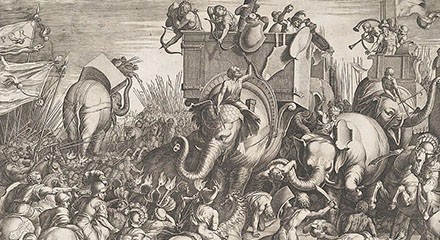
In my view, the T-trap analogy is not very applicable to the 21st century global power struggle. A better analogy is not the Peloponnesian Wars, but the Punic Wars between Rome and Carthage some 200 years later. By 250 BC, the Roman republic had come to dominate most parts of the Mediterranean through military prowess and a developing slave economy. But there was one major rival power that stood in the way of Rome’s total domination, the north African city state of Carthage. Carthage controlled Sicily just as Sparta had done.
Rome launched an invasion of Sicily, which it eventually captured from the Carthaginians after 25 years of conflict. Carthage was not finished, however, and it took a series of wars (including the famous invasion of Rome by Carthage’s military leader, Hannibal) before Rome was able to defeat its rival and completely destroy the city and its people. Rome then became the sole hegemonic power in the Mediterranean and it expanded its empire further through military conquest that provided millions of slaves for its domestic economy. But this did not last. Rome’s slave supply dried up and the Roman state eventually lost any form of civic democracy and slipped into a corrupt military dictatorship under a succession of (sometimes insane) emperors.
This analogy fits better to the rise of the US as the dominant power in the 20th century faced with only one rival, the Soviet Union. With the collapse of the USSR in the early 1990s, the US achieved complete dominance, as Rome did in 200 BC. But, as in Rome then, the internal economic contradictions within the US capitalist economy have now begun to eat into its power from within. The ‘globalists’ at the head of the US state machine are still trying to control the world with financial repression and military adventures, just as Rome did under its emperors; but US political institutions under Trump have taken an increasingly corrupt and autocratic (king-like) form.
The US empire is now in decline. This is starkly indicated by the rising net liabilities of the US economy to the rest of the world: ie, foreigners own more US assets that US investors own foreign assets. It is significant that the US net international investment position went negative just as the US became the sole hegemonic power in the early 1990s.
Collapse
US imperialism had managed to see the collapse of the Soviet Union, but it was losing relatively in trade and output to other major economies, particularly China. Europe had integrated further into the euro zone and widened towards eastern Europe using the cheap labour supply available there. And the Asian tigers leapt forward with new technologies. But particularly China took over as the manufacturing and trading global power (partly driven by US multinationals which had located there in the 1990s).
The negative investment position of the US reflects the inability of US industry to compete in world goods markets.1 The reaction of the Trump administration to the high US trade deficit has been to impose tariffs and other measures to ‘protect’ American industry and reduce imports, but with no discernible success. So increasingly, the US has relied on foreigners buying more US companies and stocks (‘the kindness of strangers’) to finance its trade deficit.
There is still a long way to go before the mighty US economy will be on its knees. It may have the largest net liabilities globally, but it can manage that because it is also the only country that can issue dollars - and the dollar is still the international currency for trade, investment and reserves. Trade-surplus nations like Germany, Japan and China must use most of their dollar earnings to buy dollar assets in the US economy. So the ‘exorbitant privilege’ of the dollar keeps the US empire ticking over.
Moreover, US investments abroad may be worth less in value than foreign investment into the US, creating that ‘negative investment’ position, but foreigners earn less income on those US assets than US investors do on their foreign assets. So there is a net surplus in income for the US of at least 0.5% of GDP on average since 2008, to add to its domestic economy.2
The US has not yet reached a ‘tipping point’, where the size of its net liabilities to foreigners is so high that its net income surplus disappears.3
From its peak of economic and military power in the Mediterranean in 200 BC, Rome took several centuries to decline and fall. It will not be so long in the modern capitalist world. Maybe, down the road, the US leaders will become more desperate and try to provoke China into a conflict. But China is unlikely to give Trump and the US globalists an excuse for outright war. As Xi says, China will not fall into the T-trap.
Michael Roberts blogs at thenextrecession.wordpress.com