
05.03.2026
German takes on the general strike
Marking the centenary of the 1926 General Strike, Jack Conrad looks at how Belgium’s 1893 suffrage strike and Russia’s 1905 revolution impacted on German social democracy. By 1914 plans were well afoot
Belgium’s successful 1893 suffrage general strike taught and inspired the Second (Socialist) International. As might be expected, that included its biggest and most influential affiliate, the Social Democratic Party in Germany.1 The prevailing orthodoxy had, till then, been to dismiss the idea of a, certainly the, general strike as an irresponsible diversion, a primitive throwback. Belgium changed things.
Russia’s 1905 revolution, though it ended in defeat, also taught and inspired.2 “There are,” as Gregory Zinoviev said, “defeats which are more valuable than any victory.”3 Beginning with a humble petition to the tsar, it reached its high point with the Moscow uprising: soviets, general strike, armed insurrection and innovative barricade tactics were combined together.4
This in no way refuted Marx and Engels. On the contrary it bore out their method and showed that the anarchist strategy of overthrowing the bourgeoisie with one big general strike was a non-starter. The land of Mikhail Bakunin’s birth provided an unsurpassed example of how to make a revolution. Yet no thanks to the marginalised anarchists. It was the Marxists, crucially the Bolshevik wing of the RSDLP, who led and gave the general strikes, mass demonstrations and urban uprisings their revolutionary programme.
Marxism by definition learns from life. It organises, generalises and gives conscious expression to the struggles and creative developments brought about by the masses themselves. Unlike anarchists and reformists, Marxists have no ready-made formulas, nor a list of forbidden methods of struggle. In principle we positively recognise all tactical forms.
Not only did the anarchists play no significant role whatsoever in 1905, but the idea of a general strike as a panacea was explicitly rejected. Having discovered the general strike as a tactic “essential under certain conditions”, its limitations were also discovered. The spontaneous general strike sounded the approach of revolution. However, even if led by the party, it could not take things to the finish. To do that an armed uprising was necessary. That is why Lenin argued, in the course of 1905, that as an “independent and predominant form of struggle” the general strike was “out of date”.5 The combination of general strike with insurrection was needed. That was the main lesson Lenin tried to drive home, when it came to the temporary reunification of the Bolsheviks and Mensheviks in 1906. In the “tactical platform for the unity congress” the Bolsheviks wanted this agreed:
With further growth of the movement, the peaceful general strike proved inadequate, while partial recourse to it failed its aim and disorganised the forces of the proletariat ... In the present stage of the movement, the general political strike must be regarded not so much as an independent means of struggle as an auxiliary means in relation to insurrection; that therefore the timing of such a strike, and the choice of its place and of the industries it is to involve, should preferably depend upon the time and circumstances of the main form of struggle: namely, the armed uprising.6
Needless to say, most Mensheviks were not prepared to accept any such thing. For Georgi Plekhanov, the key lesson of the Moscow uprising was that “they should not have taken up arms”.7 A view doubtless common on the right wing in the German SDP. Reichstag deputies who had grown complacent in that self-important little world; trade union officials who saw the class struggle limited to negotiating over wages and conditions; party functionaries who feared a revival of the anti-socialist laws - could only but look at Russia’s general strikes, street barricades and guerrilla fighters with consternation.
Leftist wing
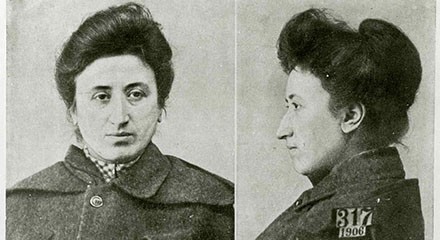
Not so the SDP’s, leftist, semi-syndicalist wing, and its leading figures, such as Alexander Parvus, Paul Lensch, Heinrich Cunow, Karl Liebknecht and, of course, Rosa Luxemburg. With her relationship with Karl Kautsky - and the SDP’s orthodox Marxist centre - already considerably strained, Luxemburg launched a polemical broadside against the party leadership over Russia’s 1905 revolution and the significance of its general strikes.
She did this most famously in her The mass strike, the political party and the trade unions, a pamphlet written in 1906 following her release from a Warsaw prison (Kingdom Poland was part of the tsarist empire). Usually simply known as The mass strike, its conclusions, as might be expected, were substantially different from Lenin’s. She had, after all, been a fierce critic of the Bolsheviks since 1903. Luxemburg condemned Lenin for “ultra-centralism” and his supposed attempt at transposing “Blanquism” onto the mass socialist movement in Russia.8
A bit rich, given how she willingly tolerated, enabled, the genuine “ultra-centralism” of Leo Jogiches in the Social Democracy of the Kingdom of Poland and Lithuania (SDKPiL).9 His own comrades described how Jogiches ran the party with an iron hand: he “imposed the greatest discipline on himself” and “compelled his fellow comrades to do likewise”.10 A dictatorial approach Jogiches took with him into the formation of the Communist Party of Germany in 1918-19.
Either way, whereas Lenin stressed the limits of the general strike, the necessity of a mass party and detailed preparations for an armed uprising, she positively celebrated spontaneity. Her take on 1905 was therefore much closer to Leon Trotsky’s (heavily influenced by Parvus). It should be added that Kautsky soon became something of an “honorary Bolshevik”. Lenin and other Bolsheviks, including a young Stalin, wrote enthusiastically about his 1906 article, ‘The driving forces of the Russian Revolution’, where he expressed his agreement with their strategic conception of a worker-peasant alliance and organised distrust of the liberals.11
Luxemburg wanted to inspire German workers with the stunning vistas offered by the general strike, compared with what she viewed as the dull and limited routine in Germany. A routine of standing in elections and patiently building the party which resulted in a million members and the state within a state that the Bolsheviks, and many others besides, so admired. Of course, objective circumstances were radically different. Between 1905 and 1907 Russia experienced a tremendous revolutionary upsurge, but Germany only the slow decay of social peace.
However, though originally a critic of Bolshevism, Luxemburg and her organisation, of which she was ‘the brains’, the SDKPiL, came to reconsider the Bolsheviks, not least in light of 1905 and the Moscow uprising. The SDKPiL tended to side with the Bolsheviks against the Mensheviks during the 1906 Stockholm (Unity) Congress: this is when the SDKPiL formally joined the RSDLP as an autonomous national section. The SDKPiL drew even closer to the Bolsheviks at the 1907 London congress: it supported the Bolsheviks on all major strategic questions.
One-sided
Luxemburg tended to produce one-sided theorisation. Thus on the national question she came out in opposition to self-determination as a matter of principle because of her correct view that the workers of Russia and her native Poland had no interest in fighting for separation (Poland was at the time divided three ways - by Germany, Austria and Russia). With Jogiches and Luxemburg taking the lead, the SDKPiL maintained a thoroughly sectarian attitude towards the Polish Socialist Party-Left. That despite the fact that this not inconsiderable 1906 split from Józef Piłsudski’s PSP had come round to virtually indistinguishable conclusions: demanding national independence should be rejected as a petty bourgeois diversion in favour of cooperation with the workers’ movement in Russia.
The failure, the refusal, to seriously pursue unity with the PSP-Left allowed Piłsudski and his national socialism to remain the dominant force within the Polish working class (Piłsudski and the PSP providing the unacknowledged template for today’s Scottish Socialist Party, Solidarity, Radical Independence Campaign, Commonweal, Your Party Scotland, etc). The SDKPiL and PSP-Left only merged in 1918 to form the Communist Workers Party of Poland.
In the same way, having adopted Germany and the German workers’ movement, Luxemburg hardened her theoretical overreliance on spontaneity. Her belief that “the directing organs of the socialist party ... play a conservative role” and that revolution is primarily “a spontaneous act”, theorised against Lenin in 1904, was confirmed by personal experience of what she saw as the timidity of the SDP.12
Luxemburg was sure that the party would act as a barrier to revolution. So, instead of fighting through the party, crucially by organising factionally, she banked on the broad mass of the working class propelling the party into decisive action. Hence spontaneity. Freed from the “barbed wire” of party control, the general strike rouses, unleashes, new, hitherto unorganised, layers who flood into the party and thereby transform the party.13
Though many aspects of her account of 1905 are unsatisfactory, she recognised that the class struggle, taken at the flood, leads on to fortune. She did not suffer from that dire pessimism of the intellect nor the paralysing construction that workers are forever doomed to trench-like warfare.
There were those on the SDP right who accused her of wanting to foist the general strike on Germany through winning a 51% congress resolution. Countering them, Luxemburg argued: “It is just as impossible to ‘propagate’ the mass strike as an abstract means of struggle as it is to propagate the ‘revolution’.”14 Resolutions at party congresses do not bring about a general strike. No party, no matter how strong, no matter how high the esteem of its leaders, can call a general strike without regard to the concrete historical situation.
Well, of course, the call can be made without regard to the concrete historical situation. Beginning this series of articles, we have already cited the antics of Gerry Healy’s Workers Revolutionary Party and Tony Cliff’s Socialist Workers Party.15 Quintessential confessional sects both. However, a real party, yes, by dint of a congress resolution, can actually stage a symbolic general strike on an agreed date, such as March 8 and May 1 (respectively International Working Women’s Day and International Workers’ Day). Such actions can, as year follows year, demonstrate the unity and growing power of the working class globally. We have also touched upon the 1893 suffrage general strike called by the Belgium Workers Party ... which did, of course, take full account of the concrete historical situation.
Obviously, though, what Luxemburg had in mind was the revolutionary general strike. She was convinced that Germany was heading towards a final crisis. Likewise global capitalism. With that in mind, there was nothing artificial about the workers’ movement in Germany learning from Russia 1905. The general strike was not, to state the obvious, a specific product of Russia 1905. However, for Luxemburg the general strike was no mere tactic to be included in a Swiss army knife medley: street demonstrations, standing in elections, publishing a newspaper and making agitational speeches in parliament. No, it was central to her strategy of overthrow (Niederwerfungsstrategie). Even if it begins by fusing various economic strikes together, her general strike drives onwards, through the elemental pulse of mass self-activity, to political demands and from there to a direct challenge for state power.
The SDP’s trade union officials had their own particular fears and were quick to voice them. After decades of slow and painstaking work building the unions into strong organisations, they did not want to risk disaster through importing Russia’s general strikes. The Reich state was just itching to clamp down. So they pleaded. According to Luxemburg, these guardians of the trade unions treated them not as weapons, but “like rare porcelain”.16
The general strike, she argued, is not a crafty device that can speed up the process of objective development. History cannot be cheated. The general strike can only be understood from the point of view of what is historically inevitable. General strikes result from social crises which, by definition, have deep, objective, causes.
Trade union officialdom had another excuse. The unions were too weak! Luxemburg had no difficulty in disposing of that particular argument either. General strikes do not come onto the agenda when trade union membership reaches x, y or z level. The class struggle cannot be conducted by “counting heads”. Furthermore, taking the example of Russia, it was clear that out of the “fire and the glow” of the general strike there had emerged “like Venus from the foam, fresh, young, powerful, buoyant trade unions”. Before the revolution, unions hardly existed in Russia.17 In the course of it, because of it, one industry after another spawned them, till they too counted members in the hundreds of thousands. What had taken decades in Germany, had, in Russia, been done in months. Luxemburg was sure that the revolutionary general strike in Germany would see the unions grow enormously in numbers and authority.
Luxemburg derided those who insisted for their own reasons in presenting her ideas as if they were dealing with an anarchist. The general strike should not be seen as “one act, one isolated action” which overthrows the bourgeoisie.18 Rather - as an elemental movement made up of millions of people now being economic, now being political - the general strike represents the culmination of a whole period of the class struggle. Drawing together all strands of the class struggle, the general strike “is inseparable from the revolution”.19
Turning Belgium
The SDP’s Jena congress in 1905 actually adopted a resolution, moved by August Bebel, agreeing to the general strike. The aim was to emulate the Belgium Workers Party and 1893. Not a revolutionary but a suffrage general strike. The objective being to force an extension of the franchise in Prussia (the pre-eminent and by far the largest political unit in the German empire). Its ‘three-class’ system favoured Junkers and big capitalists and ensured that their interests easily dominated Prussia’s indirectly elected Abgeordnetenhaus (lower house). The Herrenhaus (the upper house) was largely appointed by the kaiser.
In the same year, however, the Cologne trade union congress scandalously ruled out any discussion of the question. To do otherwise would be “playing with fire”. The biggest trade unions were, needless to say, closely aligned to the SDP and a secret deal was hatched not to implement the resolution.20 Nonetheless, at the SDP’s Mannheim 1906 congress, trade union leaders backtracked somewhat. It was agreed that the SDP would coordinate all actions (including strikes) of equal interest to the party and the unions.
The general suffrage strike was taken up by Luxemburg in 1910 - resulting in a big falling out with Kautsky. He refused to publish her article on the subject in Die Neue Zeit. Why? Essentially because Luxemburg wanted a revolutionary version of the Belgium suffrage general strike (there had been further such actions in 1902 and 1913). She argued that Belgian leaders such as Émile Vandervelde had intentionally restricted the strike to prevent it from turning into a movement that would “strike terror into the hearts of the bourgeoisie”. Hence the BWP had “deflated the latent political power of the general strike into thin air” by treating it as a one-off, legalistic action.21
Kautsky was quite prepared to criticise the conservatism of the right. Even threaten coalitionists with expulsion. But he also feared a split. Publishing Luxemburg would have triggered outrage on the right … and therefore his conciliationism. But events were moving, albeit not at the flood.
The new Prussian minister president and German chancellor, Theobald von Bethmann Hollweg, had proposed “half-hearted and limited reforms”, which the SDP had rejected. This failed reform attempt created a situation where Luxemburg and other SDP leftists began organising bigger and bigger street demonstrations. They rallied not only SDP members, but left-liberal, middle-class protesters too.
After a months-long campaign, some 200,000 demonstrated for democratic reform in Prussia on April 10 1910. Mass demonstrations on this scale were a new feature of political life in Germany. However, whereas Luxemburg and other SDP leftists wanted to springboard into launching a revolutionary general strike, the majority of party leaders were convinced that this was premature … and therefore dangerous.
Kautsky’s case against both the SDP’s impatient left and its conservative right can be found in his ‘Between Baden and Luxemburg’.22 According to Kautsky, objective circumstances demanded a continuation of his “strategy of attrition” ... for the moment. Only a revolutionary situation would demand Luxemburg’s “strategy of overthrow”. Moreover - and this is important - Kautsky believed that the SDP needed a majority in parliament as a mandate to shift from a “strategy of attrition” to a “strategy of overthrow.”
Incidentally, there can be little doubt that Lenin “stood closer to Kautsky than to Rosa Luxemburg”.23 He approvingly cites him to the effect that the moment for a “strategy of overthrow” had not yet arrived at “this moment” … but it was “unavoidable and imminent”. That said, Lenin celebrated the unity between Kautsky and Luxemburg at the SDP’s September 18-24 1910 Magdeburg congress. It voted for the first part of Luxemburg’s motion on the general strike which recognised its applicability when it came to electoral reform in Prussia … but she withdrew the second half which dealt with the general strike as a strategy in order to “make for peace between her and Kautsky”.24
Leaps and bounds
Since 1890 SDP membership had grown in leaps and bounds: it reached a million shortly before the outbreak of World War I. With the 1912 elections, its Reichstag fraction increased from 43 to 110 deputies - making it the largest parliamentary party. Political power appeared inevitable, if the SDP acted with caution. The reasoning being that capitalism not only produces its own grave-digger in ever greater numbers, but mounting internal contradictions above in the ruling apparatus. That did not imply passivity for what Kautsky happily described as a “revolutionary party, but not a revolution-making party”.25 A critical element of his strategy, outlined in his Road to power (1909), being the transformation of the standing army into a popular militia. In short, an expected, or actual, popular majority would be defended by the armed people. Nonetheless, achieving universal suffrage was considered central.
While the falling out between Kautsky and Luxemburg over the revolutionary general strike is often seen by historians as having led to a permanent split, Dieter Buse amply demonstrates that this is false. Leave aside the September 1910 rapprochement, by 1913 all party factions, impatient left, orthodox centre and conservative right, were working together and remarkably well at that.26
Over the course of three years a number of factors had changed. Firstly, though the 1912 Reichstag elections resulted in the SDP becoming the biggest parliamentary party, initial hopes of gaining sweeping reforms, including in Prussia, had been disappointed. Secondly, the attempt to promote parliamentary cooperation between the SDP and the liberals, promoted by the likes of Philipp Scheidemann and Friedrich Ebert, floundered. Thirdly, the Junker-big capitalist elite developed a “fortress Prussia” approach to defend the kaiser state.
As a result, by mid-1914, even “avowed mass strike sceptics” - among them, and most importantly, the trade union leader, Carl Legien - acknowledged that the government’s commitment to the status quo had become “so uncompromising and aggressive that a potentially violent confrontation of the labour movement and the Prussian and German authorities was becoming increasingly likely”.27
“Fortress Prussia” created considerable areas of “overlap” between the SDP’s main factional blocs. Hence, the SDP, almost as a whole, came round to the idea of a Belgian-style suffrage general strike - something which should, as we have argued, blow apart the bog-standard academic and leftist narrative of a reformist, non-revolutionary SDP, mired in bureaucratic inertia.28 Much to my surprise, and I am sure that of most readers, even Eduard Bernstein - the ‘father of revisionism’ - was up for the fight in 1914. Of course, when it comes to tactics, timing is everything. What might have been inappropriate adventurism in 1910 could well become appropriate in 1914.
Coup from above
Documents unearthed by Guettel show that on June 23 1914, just five days before the assassination of Archduke Franz Ferdinand in Sarajevo, Prussia’s interior minister, Friedrich Wilhelm von Loebell, was venting his worries, “not about a looming world war, but about the possibility of a general strike”. Loebell sent an urgent note to the president of the Prussian police, demanding “a report on all proposed, planned or potentially necessary police and economic measures in case of a mass strike in your district”. Meanwhile, at the Reich level, chancellor Theobald von Bethmann Hollweg planned to initiate criminal proceedings against SDP leaders. There were also genuine fears in the SDP that this would go hand-in-hand with an army-Junker ‘coup from above’ (Staatsstreich).
So objective circumstances were heading towards a stark choice: revolution or counterrevolution. What the outcome would have been is, however, hard to call. The SDP had no fighting formations and nor were there signs of splits in the state machine. Of course, a suffrage general strike could have created schisms. Even mutinies and changing sides. After all, young SDP members, trade unionists and voters made up a good portion of the army’s rank-and-file conscripts.
Karl Liebknecht had written his Militarism and anti-militarism book (1907), in which he exposed the ill-treatment of soldiers and how the army was used as a strike breaker. He advocated “a citizen’s army in place of the standing army” - and got an 18-month sentence for treason.29 But, as far as I know, however, no organised SDP work was being conducted in army barracks.
Despite that, Guettel argues that radical constitutional change was achievable (but by no means guaranteed). This is not to say, he argues, that a suffrage general strike would “definitely have occurred, had war not broken out”. Yet even in 1913 both SDP tops and rank-and-file members were actively engaged in exploring the possibility. In April 1913, Scheidemann, an SDP conservative, initiated contacts with the Belgium Workers Party to learn from its experience. By June 1913, the police’s surveillance report on Scheidemann’s activities noted that “the mood in comrades’ circles is beginning to become ‘Belgian’”.
Traditionally, scholars have stressed the unwillingness of the labour unions to follow the SDP down the path toward a suffrage general strike. True, Carl Legien opposed the strike - he clearly feared a coup from above. Yet he found himself in a tiny minority. Most union officials were strongly Belgian … that was certainly the case with SDP leaders and Reichstag deputies.
In the autumn of 1913, during the SDP’s Jena congress, the party’s executive committee proclaimed either “democratic suffrage or mass strike”. The new chair, Friedrich Ebert, confirmed the line: “either we will have free elections in Prussia or we will have the mass strike” (stormy applause). Later, during a meeting of the party’s general strike committee, in January 1914, the leftwing SDP Reichstag representative, Adolf Hoffmann - a future Communist Party member - echoed Ebert: “the fight against Prussia’s three-tier franchise is a battle of utmost revolutionary importance ... I completely concur with Bernstein, who has argued that surrendering in this all-important fight would be a betrayal of the cause of the proletariat (applause) … Of course, rash actions and everything that can lead to them have to be avoided.”
That the leftwinger Hoffmann could both refer positively to Bernstein “while simultaneously arguing for a cautious approach” as to how such a strike should be organised, is not without interest. The party’s debates about how to plan a future suffrage general strike therefore reveals considerable agreement, but also the need for “a process of slow, careful and deliberate preparation”. And concrete preparations soon began: special branch meetings, a membership levy for strike funds and concerted press agitation.
Why things petered out owed nothing to internal SDP divisions. Rather the explanation lies squarely with growing international tensions. The Archduke was assassinated on June 28 1914. The SDP organised numerous anti-war demonstrations till the August 4 collapse. By a fateful 96:14 vote the Reichstag fraction agreed to the Burgfrieden (fortress truce) proposed by Kaiser Wilhelm II. Abiding to party discipline, the entire fraction proceeded to vote for war credits.
On December 2 Karl Liebknecht was the first to rebel. He denounced the “imperialist war” as an attempt to “disrupt and split the growing movement of the working class” for the benefit of “capitalists and financiers”.30 The Reichstag president refused to allow him to read his statement, nor would a single German paper agree to print it.
The first victim of war is the truth.
-
See J Conrad ‘Classical Marxism and general strikes’ Weekly Worker January 29 2026 (www.weeklyworker.co.uk/worker/1570/classical-marxism-and-general-strikes).↩︎
-
Marx and Engels were surely right when, back in 1882, they suggested that Russia had become the world’s revolutionary centre: “Today ... Russia forms the vanguard of revolutionary action in Europe” (‘Preface to the Russian 1882 edition’ Manifesto of the Communist Party: CW Vol 24, London 1989, p426). The December 1905 uprising was therefore not simply a local event. It was a precursor of what was to come in other countries.↩︎
-
G Zinoviev History of the Bolshevik Party London 1973, p127.↩︎
-
See J Conrad ‘General strikes and insurrection’ Weekly Worker February 5 2026 (www.weeklyworker.co.uk/worker/1571).↩︎
-
VI Lenin CW Vol 10, Moscow 1977, pp152‑53.↩︎
-
Ibid, pp174-75.↩︎
-
Ibid, pp174-75.↩︎
-
R Luxemburg ‘Organizational questions of the Russian Social Democracy’: www.marxists.org/archive/luxemburg/1904/questions-rsd/ch01.htm. It was eagerly published by the Menshevik, new Iskra.↩︎
-
See M Macnair ‘Her life and her legacy’ Weekly Worker August 16 2012 (weeklyworker.co.uk/worker/927/her-life-and-her-legacy).↩︎
-
P Frölich Rosa Luxemburg: her life and work New York NY, 1972, p13.↩︎
-
“[A]fter the 1905 revolution Kautsky acquired a deserved reputation as an honorary Bolshevik. Particularly in his seminal 1906 article, ‘Driving forces and prospects of the Russian Revolution’, Kautsky endorsed the basic Bolshevik strategy of alliance with the peasants and distrust of the liberals” (LT Lih ‘Lenin, Kautsky and the “new era of revolutions”’ Weekly Worker December 22 2011: weeklyworker.co.uk/worker/895/lenin-kautsky-and-the-new-era-of-revolutions). Incidentally, Kautsky’s article, as well as commentaries by Trotsky and Lenin, can be found in the Richard B Day and Daniel Gaido collection, Witnesses to permanent revolution (Leiden 2009).↩︎
-
www.marxists.org/archive/luxemburg/1904/questions-rsd/ch01.htm.↩︎
-
Ibid.↩︎
-
R Luxemburg The mass strike London nd, p17.↩︎
-
J Conrad ‘Approaches to the general strike’ Weekly Worker January 22 2026 (weeklyworker.co.uk/worker/1569/approaches-to-the-general-strike).↩︎
-
R Luxemburg The mass strike London nd, p35.↩︎
-
The only independent - ie, non-police - trade union before 1905 was that of the printers, which was established in 1903. The 1905-07 period of revolution produced a huge number of small unions. Of the 600 or so, only 22 had memberships over 2,000. It was the factory commissions, however, which began to “take charge of all matters affecting the internal life of the factory, drawing up collective wage agreements and overseeing the hiring and firing of workers” (SA Smith Red Petrograd Cambridge 1983, pp57-58). The 1917 revolutions produced even more rapid growth. By October 1917 there were some two million trade union members, with Petrograd having “one of the highest levels of unionisation in the world” (Ibid p109). Incidentally at that point in time all major trade unions except the railworkers, postal and telegraph and printers had been won to Bolshevik leadership.↩︎
-
R Luxemburg The mass strike London nd, p44.↩︎
-
Ibid p47.↩︎
-
In February 1906 the SDP’s central committee secretly agreed with the trade union leaders not to implement the Jena resolution. Despite that, in the following years the Second International, in which the German party played a leading role, passed a number of resolutions which threatened the use of any means - and everyone knew that also included a general strike - in the event of an inter-imperialist war (see J Riddle Lenin’s struggle for a revolutionary International New York NY 1984, pp23, 25, 33-37).↩︎
-
rosalux-geneva.org/de/rosa-luxemburg-and-the-political-mass-strike.↩︎
-
www.marxists.org/deutsch/archiv/kautsky/1910/xx/luxemburg.htm (1910).↩︎
-
See VI Lenin ‘Two worlds’ CW Vol 16, Moscow 1977, pp305-13. There is also his October 7 1910 letter to Julian Marchlewski in CW Vol 34, Moscow 1977, pp424-29.↩︎
-
DK Buse ‘Party leadership and mechanisms of unity: the crisis of German Social Democracy reconsidered, 1910-1914’ The Journal of Modern History Vol 62, No3, September 1990, pp477-502.↩︎
-
J-W Guettel ‘Reform, revolution and the “Original catastrophe”: political change in Prussia and Germany on the eve of the First World War’ Journal of Modern History June 2019, pp311-40. All quotes unless otherwise stated come from this very useful article.↩︎
-
See CE Schorske German Social Democracy, 1905-1917: the development of the great schism Cambridge Mass 1955; JP Nettl Rosa Luxemburg Vols1 and 2, Oxford 1966; D McLellen Marxism after Marx: an introduction London 1979.↩︎
-
K Liebknecht Militarism and anti-militarism Cambridge 1973, p130.↩︎
-
www.marxists.org/archive/liebknecht-k/works/1916/future-belongs-people/ch06.htm.↩︎