
19.02.2026
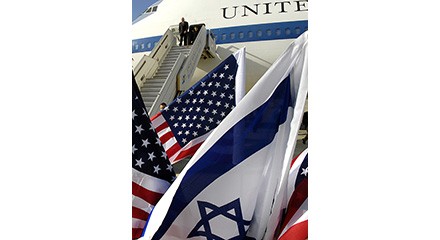
The dog and the tail
Many, including on the left, believe that America’s support for Israel damages its national interests, that the explanation for the irrational behaviour lies with the sinister influence of the pro-Israel lobby, even wealthy Jews. Moshé Machover disagrees. American support for Israel is not irrational: it serves its national interests
What is the basis for the relationship between the USA and Israel? There has been a lively debate over this since 2006 - initially sparked by an article and then a book by two US political scientists of the realist school, John Mearsheimer and Stephen Walt.1
They basically argued that US policy towards the Middle East is dictated by the pro-Israel lobby. Judiciously they do not refer to the ‘Jewish lobby’, because they recognise that the majority of this lobby is not in fact Jewish. There are many more Christian fundamentalist supporters of Israel than Jewish ones. An important institution in this lobby is the American Israel Public Affairs Committee, which is a coordinating committee for mobilising support for Israel.
Is the Mearsheimer-Walt analysis correct? There are some on the left today who put forward a similar analysis - a very crude version is given by James Petras - a former US academic who wrote well about Latin America, but in relation to Israel suddenly became an American patriot, claiming ‘we are colonised by Israel’. This view I call ‘Itwad’ - ‘Israeli tail wags the American dog’.
Another part of this theory is that the Israeli lobby influences US policy in a way that is against the real interests of the United States. Petras was especially sharp on this, as were Mearsheimer and Walt. But this theory shows both a deficiency of materialism and a deficiency of dialectics.
Ian Donovan put forward a sort of materialist explanation: he argued that this is all the doing of US Jewish-Zionist capitalists, who are in the vanguard of imperialism (this ‘theory’ sounds materialist because of its reference to capitalists). He was correct when he said that Jews are overrepresented among the US capitalist class. The proportion of Jews (depending on how you define them) among the general US population is around 2.5% and among American capitalists the figure is certainly higher (Of course, Jews in America are not the only ethnic or religious group overrepresented among the capitalist class).
However, do these Jewish capitalists actually need to influence US policy in such a way? Do US capitalists who are Jewish have interests distinct from US capitalists in general? Do they have a special material interest in Israel? There is no evidence for this. (As an aside, the idea that the foreign policy of imperialist states is dictated by rich individuals is ludicrous.)
Take, for instance, the famous case of Sheldon Adelson, a major capitalist and supporter of Israel. Did he have any investments in Israel? He did: he invested in a free daily newspaper, Israel HaYom, which is a propaganda sheet for Benjamin Netanyahu. But this was done as a political contribution - he had no material stake in Israel, but was a Las Vegas gambling magnate. Not a very strategic position from which to be influencing US policy on the Middle East!
What part of capital actually has influence on US policy on the Middle East? We know it from the horse’s mouth: the military-industrial complex. President Dwight D Eisenhower’s parting address to the nation in 1961 warned that the military-industrial complex has “unwarranted influence” on policy and must be stopped (in connection with the Middle East, I would add oil corporations). It is corporations, not individual capitalists, that exert hidden influence on policy and there is plenty of evidence that the military-industrial complex has a stake in Israel. Sheldon Adelson may not have had a material stake, but this section of US capital does and Israel is strongly integrated with it.
The most concentrated collection of evidence for this can be found in the report published in 2011 by the Washington Institute for Near East Policy, authored by Robert Blackwill and Walter Slocombe. A summary of the report was published in the Los Angeles Times. But there is older evidence. Israeli expert Yoram Ettinger, chair of special projects at the Ariel Center for Policy Research, wrote in 2005 that the relationship between Israel and the United States was not one-sided: Israel provides important services. He quoted former US secretary of state and ex-Nato commander Alexander Haig, who said he supported Israel because it is “the largest American aircraft carrier in the world that cannot be sunk, does not carry even one American soldier, and is located in a critical region for American national security”.
What Ettinger mainly concentrated on was the contribution of Israel to the military-industrial complex - especially in terms of modern IT and robot technology. Israel is a pioneer of drone production and in the use of drones for surveillance and assassination - particularly relevant since drones became an important tool of US global domination. In this niche Israel has played a vital role for the military-industrial complex. The vice-president of the company that produces the F-16 fighter jets was quoted by Ettinger as saying that Israel is “responsible for 600 improvements in the plane’s systems, modifications estimated to be worth billions of dollars, which spared dozens of research and development years”.2 This is where Israel specialised, in the absence of its own heavy industry. The US companies provided the hardware, but Israeli companies provided vital scientific and electronic expertise and were responsible for many improvements.
He continued:
Israel’s utilisation of American arms guarantees our existence, but at the same time gives US military industries a competitive edge, compared to European industries, while also boosting American military production, producing American jobs and improving America’s national security. Japan and South Korea, for example, preferred the Hawkeye spy plane and the MD-500 chopper - both purchased and upgraded by Israel - over comparable British and French aircraft.
This is the international role of Israel and its link to US global domination. It is nothing to do with Jewish-Zionist capitalists: it is to do with the military-industrial complex.
Israeli contribution
Now let me quote from the Blackwill and Slocombe report. First of all, they make a very pertinent point which I have also made myself, using different words: the US relationship with Israel is different from those it has with any other country in the region: “In a political context, it is important to note that Israel - unlike other Middle Eastern countries whose governments are partners with the United States - is already a stable democracy, which will not be swept aside by sudden uprising or explosive revolution: a fact that may become more important in the turbulent period ahead.”3
This is a reference to what happened in Iran, whose regime was a ‘partner’ of the US, but was swept aside by the 1979 revolution. They continue:
Moreover, for all our periodic squabbles, Israel’s people and politicians have a deeply entrenched pro-American outlook that is uniformly popular with the Israeli people. Thus, Israel’s support of US national interests is woven tightly into the fabric of Israeli democratic political culture - a crucial characteristic that is presently not found in any other nation in the greater Middle East.
They then go on to detail the various ways in which Israel helps the military-industrial complex. This is from the summary of the report in the Los Angeles Times:
Through joint training, exercises and exchanges on military doctrine, the United States has benefited in the areas of counter-terrorism, intelligence and experience in urban warfare. Increasingly, US homeland security and military agencies are turning to Israeli technology to solve some of their most vexing technical and strategic problems.
This support includes advice and expertise on behavioural screening techniques for airport security and acquisition of an Israeli-produced tactical radar system to enhance force protection. Israel has been a world leader in the development of unmanned aerial systems, both for intelligence collection and combat [‘combat’ here means assassination], and it has shared with the US military the technology, the doctrine and its experience regarding these systems. Israel is also a global pacesetter in armoured vehicle protection, defence against short-range rockets, and the techniques and procedures of robotics, all of which it has shared with the United States.4
And here comes a very remarkable passage. I have quoted Haig referring to Israel as an unsinkable aircraft carrier without US soldiers on it, but this is no longer the case apparently:
In missile defence, the United States has a broad and multifaceted partnership with Israel. Israel’s national missile defences - which include the US deployment in Israel of an advanced X-band radar system and more than 100 American military personnel who man it [the first admission I have seen of US troops stationed in Israel] - will be an integral part of a larger missile defence spanning Europe, the eastern Mediterranean and the Persian Gulf to help protect US forces and allies.5
And so it goes on and on - we can see that Israel’s role as a US ally is not just regional. Note that there is a very intimate synergy between the Israeli military industry and the American military-industrial complex. If you believe that Eisenhower was right (and I do), then this provides a material basis for the very special relationship between these two states.
I want to quote from another source: a leftwing commentator, William Greider, discussing a recently released report from the Institute for Defense Analyses in Washington, dating from 1987. He notes that the report implicitly confirms the fact that Israel has nuclear weapons; this is, of course, a non-secret that everyone knew. He says: “However, the IDA’s most powerful message may not be what it says about Israel’s nukes, but what it conveys about the US-Israel relationship. It resembles a technological marriage that over decades transformed the nature of modern warfare in numerous ways.”6
Note the global implications of this. The article continues:
The bulk of the report is really a detailed survey of Israel’s collaborative role in developing critical technologies - the research and industrial base that helped generate advanced armaments of all sorts. Most Americans, myself included, are used to assuming the US military-industrial complex invents and perfects the dazzling innovations, then shares some with favoured allies like Israel.
That is not altogether wrong, but the IDA report suggests a more meaningful understanding. The US and Israel are more like a very sophisticated high-tech partnership that collaborates on the frontiers of physics and other sciences in order to yield the gee-whiz weaponry that now defines modern warfare. Back in the 1980s, the two states were sharing and cross-pollinating their defence research at a very advanced level.
Today we have as a result the ‘electronic battlefield’ and many other awesome innovations:
- Tank commanders with small-screen maps that show where their adversaries are moving.
- Jet pilots who fire computer-guided bombs.
- Ships at sea that launch missiles over the horizon and hit targets 1,000 miles away ...
These experts were talking in the 1980s about technological challenges that were forerunners to the dazzling innovations that are now standard.
The Middle East wars became the live-fire testing ground, where new systems were perfected: “Scientists at Rafael [another Israeli centre] have come up with an ingenious way of using the properties of a glow discharge plasma to detect microwave and millimetre waves,” the report said. “The attractiveness of the project lies in the ability of the discharge to withstand nuclear weapons effects.”
This observation gave me a chill because the earnest defence scientists have yet to find a way for human beings to “withstand nuclear weapons effects”.
Dialectics
Now I have mentioned materialism and the material basis of the US-Israel relationship, but what about dialectics? Nobody can deny that the pro-Israeli lobby has immense political influence in the United States - it is an observable fact.
The question is, why is it allowed to have this power? Is it beyond the power of the real engines of American capitalism to mobilise, if they wanted to, enough funds to counteract this lobby? After all, corporations are now regarded as persons for the purposes of political contributions in the US. If the military-industrial complex felt the Israeli lobby in the US is against American interests, it could surely counteract it. However, they have no interests at all in doing so. What Aipac and other such bodies are aiming to do is simply silence dissent against US Middle East policy and American support of Israel, in the interests of the real engine of American capitalism.
What about the claim that this policy contradicts US interests in other ways? Blackwill and Slocombe deal with this question dialectically, as it happens - though, of course, they are not Marxist in any way. They say, ‘OK, the US has conflicting interests. This happens in relation to Israel and in relation to any other of our allies in the Middle East.’ Especially nowadays (although it has always been the case to some extent), the interests of any imperialist power are not entirely coherent. There is no such thing as the American interest: it is about conflicting interests, which have to be balanced. Blackwill and Slocombe show that in no way does American support for Israel damage US interests to such an extent that it is counterproductive. The contradiction with other American interests is a matter of the dialectics of interests of any power.
This does not simply apply to states, by the way. No class or any other power in the world has interests that are entirely monolithic and coherent. There is always some conflict that has to be resolved one way or the other.
So my conclusion is that Israel will remain for the foreseeable future America’s top ally in the Middle East and will continue to make trouble regarding its relationship with Iran.
-
‘The Israel lobby’ London Review of Books March 23 2006: www.lrb.co.uk/v28/n06/john-mearsheimer/the-israel-lobby. See also J Mearsheimer and S Walt The Israel lobby and US foreign policy New York 2007.↩︎
-
Y Ettinger, ‘American and Israeli military interdependence’: www.freeman.org/serendipity/index.php?/archives/46-Yoram-Ettinger-AMERICAN-AND-ISRAELI-MILITARY-INTERDEPENDENCE.html.↩︎
-
R Blackwill, W Slocombe Israel: a strategic asset for the United States Washington 2011, p14.↩︎
-
Los Angeles Times October 31 2011.↩︎
-
This is a reference to the US-operated twin towers near Dimona, which are the world’s tallest radar towers. See en.wikipedia.org/wiki/Dimona_Radar_Facility.↩︎
-
W Greider, ‘It’s official: the Pentagon finally admitted that Israel has nuclear weapons, too’ The Nation March 20 2015.↩︎