
12.02.2026
Spreading panic and confusion
Alex Callinicos is playing a cynical opportunist game when he compares the situation in Minneapolis with fascist terror in Italy. He wants to excuse the Together popular front, writes Eddie Ford
A simple Google search will reveal that there are plenty of people with an essentially liberal outlook who think that the US under Donald Trump is becoming fascist, or undergoing “creeping fascism”. The Atlantic magazine declares “yes, it’s fascism” as “the resemblances are too many and too strong to deny”1 and the Daily Kos tells us that “fascism is knocking at the door”.2
The Thom Hartmann Program develops this theme more colourfully by saying: “… fascism isn’t knocking: it’s here [sic] and those are unidentified ICE agents at your door at the behest of felon Donald Trump”.3 More dramatically still, Jason Stanley of the More to the story podcast boldly states that “I study fascism” and “I’ve already fled America”, as we discover that he “isn’t afraid to use the F-word when talking about” Trump and is also the author of How fascism works and Erasing history.4 Whatever the shortcomings of their analyses, which are profound, they are sincere expressions of moral outrage at Trump’s authoritarianism and his ICE thugs.
What then are we to make of Alex Callinicos and the Socialist Workers Party jumping on the liberal bandwagon? In his Socialist Worker column, the comrade writes about how the twin cities of Minneapolis and St Paul in Minnesota have been experiencing something “approximating” the violent assaults that town after town in Italy suffered from fascist squads in 1920-22. Indeed, he sees “parallels” between Trump’s ICE and “other fascist street thugs”.5 He immediately adds the caveat, “of course there are differences”, as “the Italian offensive laid the basis for the fascists under Benito Mussolini to take control”, whilst apparently in the US today, “the far right is already in power” and “its fascist wing” is directing the assault on Minneapolis and other Democrat-controlled cities. The main leader, he asserts, is “probably” Donald Trump’s deputy chief of staff, Stephen Miller - a stand-in for Mussolini?
Adding to the mess, Callinicos says that, just as many young ex-soldiers were recruited into the Italian fascist paramilitaries, “Trump’s squadristi” come “from a section of the state apparatus” - ie, ICE (hugely expanded over the past year and likely to grow more). Calling it a “quasi-fascist militia”, he quotes a Minneapolis protestor telling The Atlantic that “it became clear very quickly that ICE is the Proud Boys, the Boogaloo boys” - but “they’ve given them uniforms and let them run wild”. Callinicos urges, predictably enough, that “collective organisation” in the workplaces will have to be mobilised, “if anything like the national general strike people are calling for is to happen”.
Actually, for all of Callinicos’s feverish account, you do not need to be an expert to know what happened in Italy. Despite being on the winning side in World War I, the ruling elite felt cheated. Italy did not get the territories it wanted (like Dalmatia). Wartime spending resulted in massive government debts and quickly resulted in hyperinflation. Unemployment grew and grew. Demobilised soldiers went hungry. The weak government was paralysed.
Socialist failure
Formed in 1892 the Socialist Party of Italy took an anti-war position in World War I. This saw Benito Mussolini - formerly a direct action firebrand – splitting, in the name of Italy entering the war and ‘revolutionary nationalism’. The Fascio Rivoluzionario d’Azione Internazionalista was formed in October 1914. However, immediately after the war the PSI became the country’s biggest party. Membership rose to 250,000. In the 1919 general election it won nearly 33% of the vote and 156 seats in the Chamber of Deputies. The ‘two red years’ (biennio rosso) followed.
There were mass strikes and widespread workplace occupations. Factory councils were formed in Turin and Milan. Militants in the countryside seized farms. However, the centrist leadership of the SPI dithered and failed to consummate the revolutionary situation in a revolutionary insurrection. There were left militias and the Red Army of Turin had been formed. The PSI had also applied to affiliate to the Third (Communist) International but baulked at the famous 21 conditions. In 1921 the PSI left formed the Communist Party of Italy.
Fighting squads
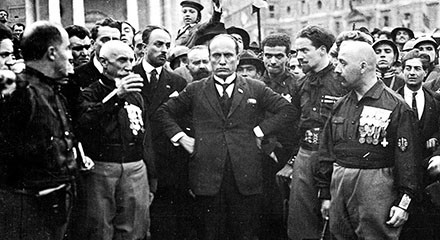
The ruling class was desperate and saw Mussolini’s fascist fighting squads, the blackshirts, as saviours. Counterrevolutionary terror was unleashed. Trade union, socialist and communist papers, print shops, meeting places and militants were attacked. Maybe 2,000 were killed. In October 1922 Mussolini staged his March on Rome. A piece of political theatre - prearranged with the monarchy, the army high command and the key capitalist magnates. By 1926 Mussolini had consolidated his fascist dictatorship (which saw the upper echelons of the fascist party merge with the ruling class, and the lower ranks incorporated into the state machine). Counterrevolution had triumphed.
Alex Callinicos is clearly an intelligent man. So how come he wrote such a terrible article for Socialist Worker? Either he is losing his marbles and showing early signs of senility, or he is playing a cynical, opportunist game. Occam’s Razor suggests the latter. Rather than writing a serious analysis of Trump, ICE and what fascism is and is not, he merely looks to provide excuses for the SWP’s popular front, the Together alliance. Sponsored by Amnesty International, Friends of the Earth, Sir Lenny Henry, Beverly Knight MBE, Paloma Faith, Gurinder Chadha OBE, the TUC and a host of trade unions and celebrities, Together is banking everything on getting a huge turnout for March 28 and its ‘unity’ demonstration. Naturally, it has the lowest of lowest common denominator ‘politics’: ‘Love not hate’.
This requires maximising the narrative - and panic - about fascism ‘knocking at the door’, which the above Socialist Worker article was presumably designed to feed, and trying to please everybody by fudging every issue: Trump’s America is sort of fascist, ICE is sort of fascist, … Stephen Miller is “probably” a fascist leader, but, but, but.
In Minneapolis, two people were killed - Renée Good and Alex Pretti. Sorry, Alex Callinicos, but this is obviously not the same as Italy 1920‑22. They were killed by agents of the state machine, not fascist gangs. OK, someone from the Proud Boys joined ICE - so what? People who join the army, the police, the prison service tend to come from the right. And such bodies tend to reinforce rightwing ideas and prejudices ... Britain being something of an exception, at least when it comes to the prison service.
Going back a bit in time, if you were banged up in jail, chances are that the person who locked your cell door would be ex-army, ex-police and maybe a card carrying member of the National Front. No longer so. The Prison Officers Association having a left leadership that actually endorsed Jeremy Corbyn’s campaign in the 2015 Labour Party leadership election.
But regardless, prison guards are part of the state machine just like ICE. It is absurd to suggest that the Trump administration’s brutal actions in Minnesota are in any way “approximating” fascist terror of early 1920s Italy (or the Nazi terror in the 1920s and early 1930s). Alex Callinicos knows all that, but he feels compelled to prostitute his intellect for the sake of rehabilitating the SWP in the eyes of the liberal establishment and the trade union bureaucracy (Stand Up to Racism is one of the sponsors of Together).
While it is far from universally accepted, Trotsky’s definition of fascism retains its value. Fascism feeds off plebeian discontent, it organises a disciplined movement based on top-down command-and-obey principles, it forms counterrevolutionary fighting squads, usually out of demobilised soldiers, that are protected by the state but are separate from the state. This distinguishes it from other forms of counterrevolution. Another central defining feature is that fascism objectively acts in the interests of the capitalist class, and its strutting leaders and their fanatical followers are often manipulated and financed by influential members of the capitalist class. The aim being to smash the revolutionary working class. Fascism in that sense is a kind of punishment for the working class failing to take power.
Roll back
What is also vital to understand is that, yes, something is changing in the US. But it is not mutating into fascism. There is no revolutionary working class that threatens the ruling class: rather it is the fact that the Trump administration not only wants to roll back the gains of the Civil Rights movement, the anti-discrimination legislation of the 1970s and so forth, but actually to roll back all the concessions which have been made to the working class since 1945.
Trump is not attempting to be a Mussolini or a Hitler. Any coup he carries out will be from within the state (like the botched January 6 2021 attack on the Capitol). There will be nothing like the March on Rome or the Munich Beerhall Putsch. Nonetheless, the velvet gloves are coming off.