
05.02.2026
Talks, threats and bots
War is not inevitable. But it is now a credible option. The US has its tariffs, missiles and armada in place. That is why there are negotiations, argues Yassamine Mather
After weeks of threats and counter-threats, negotiations between the United States and Iran are due to proceed in Oman (originally it was Istanbul). The first meaningful face-to-face engagement in months.
The US delegation is led by special envoy Steve Witkoff, while the Iranian delegation is headed by foreign minister Abbas Araghchi. Delegations from a long list of mediators will be attending too, including Turkey, Qatar, Egypt and, of course, Oman. The involvement of these states reflects their common fear of an uncontrolled escalation of war in the region, rather than confidence in diplomacy.
The significance of the meeting lies in the timing: it has been produced by pressure, not trust. By Donald Trump’s gunboat diplomacy. His administration has revived its ‘maximum pressure’ strategy, but in a sharper, more immediate form, with ultimatums: time is running out and failure to reach an agreement will lead to “bad things”. The ambiguity is deliberate. The message is aimed not just at Tehran, but at regional allies and domestic audiences.
Last week we saw the deployment of a major naval strike group, centred on the USS Abraham Lincoln, plus the reinforcement of air assets, including F-35s, EA-18Gs and B-52 bombers. The Pentagon is deploying additional air defence systems, including more Patriot missiles. There is confirmation that at least one nuclear-powered attack submarine, armed with Tomahawk missiles, has arrived in the region too. Clearly, this is not a symbolic deployment.
This configuration matters, because it shows what can be done. Three weeks ago, when Trump initially considered an attack against Iran, his military advisors pointed out they were not ready for war or for the possible repercussions of even a ‘limited’ strike. Such an operation might involve targeting senior members of the leadership or key facilities, but it would require secure basing, defence and regional contingency planning for retaliation. All that was simply not in place. It is now.
This does not mean that war is inevitable. It means that war is now a credible option, and this changes the negotiating dynamic entirely. Alongside military escalation, Washington has threatened new 25% tariffs on countries continuing with substantial Iranian trade - an attempt to further isolate the Iranian economy and signal to third parties that neutrality will be penalised.
Iran’s shift
Following the violent suppression of nationwide protests in January 2026, the Iranian regime is much weaker than before. On February 3, president Massoud Pezeshkian instructed the foreign ministry to pursue what he described as “just and equitable” negotiations.
We can assume that the supreme leader, Ayatollah Ali Khamenei, has approved all this. After all, he is determined to make sure the regime survives against all odds. So we can expect further flexibility - the continuation of the kind of policies that have allowed the Islamic Republic to survive for more than four decades.
Iran has already signalled conditional flexibility: a willingness to discuss uranium enrichment levels and a possible return to modified 2015-style nuclear constraints. However, so far Tehran has drawn firm red lines: the issue of ballistic missiles is non-negotiable, as is support for regional alliances. Foreign minister Abbas Araghchi has repeatedly emphasised that Iran’s central concern is trust. From Tehran’s perspective, the US is not a stable negotiating partner, but an episodic enforcer, whose commitments expire with the next administration.
So, despite the renewed talks, the gap between the two sides remains structural rather than technical. This is why diplomacy alone did not restart negotiations. That required a show of US force.
According to Thomas Karat’s Substack, analysis of over 235 news headlines across 11 countries shows a familiar pattern: synchronised political messaging, legal justifications, market conditioning and an absence of serious dissent from major powers. This mirrors the preparatory phases seen before the invasions of Iraq and Libya.1
However, there is an important difference: instead of closing off diplomacy, this pressure was used to allow direct talks. That does not make the media campaign benign. In fact, it makes it instrumental, as everyone is well aware of what will happen should negotiations fail.
It is well known that Arab states intervened in January to stop a US/Israeli war against Iran. Their position reflects fear, not alignment. Arab states today are not the same as before October 2023. They have watched Israel act with impunity, and drawn a clear lesson: regime removal is contagious. Their concerns are not ideological sympathy with Iran, but rather fear of domestic unrest, oil market chaos, embargoes, refugee flows, and a prolonged regional war rather than a short strike.
Regime change
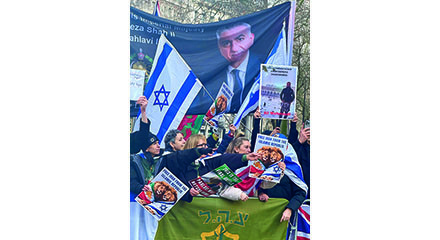
Contrary to all the hype, US potential plans for regime change in Iran do not include Reza Pahlavi, son of Iran’s last shah. It is now clear that most of the publicity about the popularity in Iran of Pahlavi was fake news - exaggerated and manufactured by Persian-speaking TV stations, financed by Israel and other foreign powers.
On January 30, Le Figaro carried a report regarding the current atmosphere in Iran. The report reveals efforts by digital media to influence the Iranian public’s mindset in favour of a “specific movement”. The title is ‘Fake accounts, ‘likes’ and the shah of Iran: Israel’s digital war in the shadows’.2
In today’s world, battles are not just fought with tanks, drones and missiles. War is also carried out through the silence of servers, behind anonymous accounts, and amidst hashtags and ‘likes’. The Le Figaro report pulls back the curtain on one of these hidden battles: an organised digital operation aimed at influencing public opinion on Iran and its political future.
This operation advances through fake accounts, amplified content and targeted narrative-building. It demonstrates that the primary arena of political competition has - at least in one significant layer - shifted from the streets and organisations to the “social media space”. In this space, what matters is not the number of real supporters, but the “constructed image of public support” - an image that can be manufactured using digital tools. What we have is an orchestrated influence campaign paid for and in the service of the Israeli government, or entities close to it.
The methodology is simple: the operation utilised a network of fake accounts, AI-enhanced content and targeted messaging. Specifically, a large number of Persian-language fake accounts were deployed on platforms like X. These accounts were created in 2023, but their overt activity began in early 2025, indicating meticulous prior coordination and planning.
The profile pictures of many of these accounts were generated by AI, confirming their inauthenticity. These accounts systematically posted content designed to appear as though it came from real Iranian citizens, while in reality they were manipulating the ‘truth’ to shift narratives and instil specific messages. The goal was to promote an alternative. The campaign did not just broadcast messages: it attempted to stage-manage a sense of public support that appeared far more widespread than actual trends on the ground.
A core pillar of this campaign was the dissemination of content in favour of Reza Pahlavi. The objective was to frame him as the primary alternative to the Islamic Republic or to create a digital illusion of massive popular support for him in Iran.
Le Figaro notes: “Reza Pahlavi is an individual who has lived in exile for years and has attempted to introduce himself as a representative of democracy and freedom in Iran. However, among Iranians inside the country there is no widespread or realistic support for the return of the monarchy.”
One prominent example highlighted in the report is the distribution of fake videos depicting an Israeli attack on Evin Prison in Tehran. These videos were circulated before any official news outlets reported such an event. It was later determined that the footage was created using AI tools. The objectives of such falsification include eroding legitimacy and intensifying feelings of distrust toward the government among citizens. Add to this emotional manipulation: steering emotions and narratives regarding internal Iranian events during sensitive political and social moments.
We also have research into the broadcasts of BBC Persian and Iran International, specifically regarding their alleged “exaggerated pro-Pahlavi” or monarchist leanings. Here we have a body of work by Swedish-based scholars and investigations by Swedish media that address this specific topic. According to a TV programme by a former Voice of America anchor interviewing a media analyst, two Persian language TV stations - Iran International and BBC Persian - exaggerated pro-shah slogans in recent protests by at least 83%!
Mazdak Azar presents a research report, indicating that Iran International and BBC media outlets heavily exaggerated pro-Pahlavi slogans in their coverage of the December protests, acting in favour of a specific faction.
The research documents that both media outlets, abandoning their journalistic duty, took steps to homogenise dissenting voices and unrealistically highlight a particular faction. According to the data, Iran International covered the protests with approximately 3,200 news items and the BBC with about 1,500 items on Telegram. In both cases, the proportion of coverage did not align with the statistical reality of the slogans in the digital space.
Eighty-three percent of the slogans focused on the following key themes:
- Opposition to the entirety of the system.
- Calls for its overthrow.
- Anti-system nature.
These real slogans shared a common goal and focused on fundamentally changing the entire political structure. They did not include pro-shah slogans, contrary to what Iran International and BBC Persian reported.
Another prominent researcher is Rouzbeh Parsi, a senior lecturer at Lund University and former head of the Middle East programme at the Swedish Institute of International Affairs. Parsi and his colleagues refer to the “nostalgic narrative” of the pre-1979 era. They argue that these TV stations project a sanitised version of the Pahlavi monarchy to appeal to younger Iranians, who did not live through it - often presenting the crown prince as a “convenient blank page” for various opposition grievances.
Swedish researchers have often cited external data to argue that pro-Pahlavi sentiment on social media - which is then reported as “news” by some Persian-language channels - is often artificially amplified by “hollow armies” of bots. They suggest that these broadcasts create an “echo chamber” that exaggerates the actual level of monarchist support within Iran.
Given all this, it is no surprise that even Trump has no illusions about Pahlavi’s popularity inside Iran. The US administration is looking for alternatives within the country, and perhaps even within the regime itself. If a limited attack results in further weakening the regime, or if it leads to the removal of its leadership, it could open the possibility of negotiations with various factions of the Islamic Republic. This includes both the wealthy oligarchs associated with or part of the Islamic Revolutionary Guard Corps and former ‘reformists’.