
29.01.2026
All above board
Donald Trump’s ‘Board of Peace’ is a ghoulish confection, but confirms the US intends to completely sideline the old global institutions, writes Paul Demarty
What with all the other excitement in world events, Gaza has fallen a little outside of the spotlight. Yet the main actors in that murderous drama tread on.
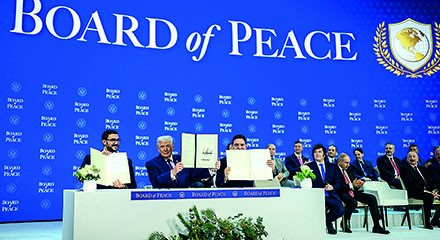
Donald Trump has unveiled his ‘Board of Peace’, which is supposed to govern the devastated territory in some form, when, supposedly, things have calmed down (and the mass of the population readied for expulsion). He is to chair it - for life (succession planning is, at this point, a little unclear). There is a bunch of activity concerning who is in and who is out. Most of the core European countries, including Britain, are presently out - presumably as a move in the great game being played over Greenland. Canada has been kicked out, thanks to Mark Carney’s lèse-majesté at Davos last week.
The individuals involved in prominent positions are a strange old crew. Formally in charge of Gaza is Nikolay Mladenov - a Bulgarian politician with dubious financial arrangements exposed in the Panama papers, who few outside of Bulgaria will have heard of. There are the Trump creatures - son-in-law Jared Kushner and New York real-estate fixer-turned-diplomat Steve Witkoff among them. There is Marc Rowan, a hedge-fund billionaire, and Ajay Banga of the World Bank.
Trump seemed to vacillate over whether to appoint Tony Blair, a rather divisive figure in the region for obvious reasons. But he is there now, grin intact. He seems increasingly stiff and parched, as if he had skipped directly to rigor mortis - one thinks of Dickens’s description, in Bleak house, of the Smallweeds: “a couple of sentinels long forgotten on their post by the Black Serjeant, Death”.
It is not clear, retrospectively, exactly when Blair developed a world view - his early years in parliament were characterised by entirely vacuous opportunism - but, when he did, he hit on the set of ideas now more commonly associated with the ‘tech right’. Progress means unleashing the forces of innovation, which in turn means the fusion of the state and the tech industry, pervasive surveillance and the naked dictatorship of the entrepreneur class.
Leopold II
In that respect, he is among friends. Kushner used the launch of the board to propose his vision of post-reconstruction Gaza, which is basically to turn it into a Dubai, with any remaining Palestinians reduced effectively to semi-free guest workers on their own land - after the fashion of the Gulf’s notorious kafala system. The American outlet Dropsite has come upon a leaked resolution on how this is all to work:
The draft resolution formalises a hierarchical structure for the Board of Peace, with Trump as the chairperson and an executive board that has “the same authority, powers and ability to make all delegations necessary and appropriate to carry out the Comprehensive Plan as the Board of Peace”. The Executive Board has the power to “enact new laws, or modify or repeal prior” civil and criminal laws in Gaza.1
In effect, Gaza will become the personal possession of Trump, as the Belgian Congo belonged to Leopold II. Palestinian involvement in all this will be limited to a “vetted, technocratic, apolitical committee”, subject to the supervision of Mladenov.
Can this possibly work? It is hard to say. Certainly history offers examples of similar set-ups that have failed dismally - the Coalition Provisional Authority in post-invasion Iraq succeeded only in enriching a lot of Dick Cheney’s mates and kick-starting a fearsome Sunni insurgency, before dissolving itself a year later. Gaza is not Iraq, however: it is impoverished, already ground down by years of occupation even before it was flattened by Israel after October 7. Militant groups may be able to continue limited guerrilla resistance, but they will have their work cut out making the Strip ungovernable.
There is, perhaps, a question over how on board Israel is with the whole thing. The strategic objective of Israel vis à vis the Palestinians is to be rid of them. Observers generally assume that Israel’s recognition of Somaliland - a breakaway territory of Somalia on the Red Sea - is at least partly to obtain a dumping ground for the refugees from a third Nakba. (It is also conveniently located for striking against the meddlesome Yemenis.) To a domestic audience, Benjamin Netanyahu has indicated that he will not accept any further steps in the ceasefire process until Hamas is disarmed, hinting perhaps at obstructionism. Finally, whether the Gulf states involved can truly weather the opprobrium from participation in all this remains to be seen.
New order
Yet the bigger picture is the more interesting one. Successful or otherwise, the Board of Peace is plainly an attempt to exclude historic organisations like the United Nations from what would usually have been their purview - of peacekeeping, reconstruction and maintaining some kind of fragile order in a situation like this. Poetically, Israel has also chosen this moment to demolish the old headquarters of the UN Relief and Works Administration, which was set up to do such work in Palestine. Its effective suppression during the Gaza onslaught - supported by Israel’s allies - was a significant moment that leads naturally to outfits like this Trump creation.
The reconstruction of order falls, then, to a coalition of rogue businessmen, and their willing accomplices like Blair. The checks built into the UN, of course, tended to render it ineffective, with the veto powers of the permanent Security Council members tending to ensure that decisive action took place outside its purview. The Board of Peace sweeps all this machinery aside in a vulgar display of power. Its logo is plainly an insult to the UN - a copy of its globe-and-laurels design that only shows the Americas and switches blue for a Trumpian gold, with that slightly greasy look that betrays the use of AI in its creation. The unity of raw state power and technological kitsch - a picture of the grim world to come.
This is the context, as much as the Greenland crisis, in which we must place Carney’s intervention at Davos. One could hardly but be struck by this event - Carney is the very image of the Pax Americana technocrat: a former central banker turned centrist politician. Yet here he was, announcing to his tribe that the world order they knew was at an end. Perhaps, indeed, it had never existed: “We knew the story of the international rules-based order was partially false: that the strongest would exempt themselves when convenient, that trade rules were enforced asymmetrically. And we knew that international law applied with varying rigour, depending on the identity of the accused or the victim.”
Yet “this fiction was useful, and American hegemony, in particular, helped provide public goods, open sea lanes, a stable financial system, collective security and support for frameworks for resolving disputes”. So they went along with it - he compared this to Vaclav Havel’s description of ordinary people making empty gestures of support for the Stalinist regime in Czechoslovakia. But this is no longer possible: there is a “rupture” afoot, and the world is moving to a period of great-power conflict. “Middle powers” - meaning Canada, Europe and the like - must stick together and box clever in a dangerous new international order.2
It may have been easier for Carney to break kayfabe in Davos because he owes his position, arguably, to the perverse consequences of Trump’s blundering expansionism. He triumphed in an election the Canadian Liberals were long expected to lose badly, in part because Trump was threatening to annex the country, and his Tory opponent, Pierre Poilievre, was a Trump sycophant. Sure enough, his approval ratings have soared since he poked the bear once more, even if it resulted in yet another tariff spat. He nevertheless deserves credit of some kind for even daring to think strategically at all, in which respect he outclasses the politically rudderless European governing class, and the sentiments he expressed will find an echo there.
War danger
Whether it will work is another matter. There are certainly opportunities for lesser powers at transitional moments like the present. Observe the ability of the Gulf states to influence events in Africa, for example; or even, on a smaller scale, the revival of Vatican diplomacy. Yet capitalism is intrinsically global, and thus tends towards the centralisation of key instruments like reserve currencies and systems of arbitration, and thus finally to unipolarity. Multipolarity is a feature of periods of transition, and invariably a prelude to great power war.
Trump’s Board of Peace may, in itself, be slightly silly - a rogue’s gallery of grifters and cronies, headed by a quite possibly senile and certainly mercurial tyrant. Yet it is the way things are going. In a brewing great-power conflict, the chief protagonists cannot waste time standing on ceremony, on polishing the old, beautiful lies. If Trump is replaced with someone more ‘sensible’ in the opinion of the Davos elite, that person will find it hard to give up the freedom Trump has won for the US executive in this period. One could not ask for a better image of what that means for the rest of us than Jared Kushner’s Gaza-lago horror show. Canadians and others should not imagine that they are immune from such indignities.
The left, plainly, must oppose any involvement of our own governments. But we must also address the deeper problems. Particularly among ‘official’ communists and left social democrats of the Jacobin stamp, there has been a drift towards a variant form of foreign policy ‘realism’ that supposes that there can be a managed decline of US supremacy and a smooth transition into a multipolar order. As we have argued, this is an illusion - and one that tends in the end to unite the working class with their rulers in pursuit of sectional advantage in the global hierarchy.
Instead, we need a revival of proletarian internationalism, solidarity between national sections of the class and - as rapidly as possible - united action to coerce our rulers: to prevent, where possible, great power conflict from breaking out and, ultimately, turning it into the battle of class against class. It is, paradoxically, precisely because we are excluded from this great game that we can be a real actor within it.