
11.12.2025
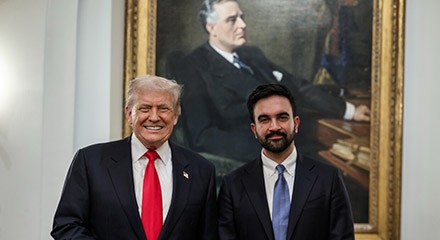
Zohran set to scab
He does not want to upset the Democratic Party establishment or anger the ruling class. Parker McQueeney reports on the manoeuvrings of New York City’s mayor-elect
In Germany’s November 1918 revolution, the working class occupied Berlin’s police headquarters, transferred the arms to themselves and put up as police chief Emil Eichorn, an Independent Social Democrat official.
A century later, New York mayor-elect Zohran Mamdani, who stood for the Democratic Party, has not yet taken up residence in Gracie Mansion, but his mayoralty has already created scandals within the Democratic Socialists of America, of which he is a member.
His promise to keep on as police commissioner the hardcore Zionist billionaire, Jessica Tisch, was designed to quell the fears of New York’s capitalist class. Meanwhile, her brother, Benjamin Tisch, gave a speech to fellow plutocrats calling Mamdani an anti-Semite and “enemy of the Jewish people”.1
Mamdani’s decision to retain Jessica Tisch as top cop conjures up photographs of general Augusto Pinochet standing innocently behind Salvador Allende in Chile before the 1973 military coup that overthrew the elected Marxist president.
The DSA’s ‘road to power’ in New York City was a campaign laser-focused on economic affordability demands - not the working class actually taking power, as they briefly did in Germany in 1918. New York’s DSA chapter is by far the largest in the country and is at the moment dominated by the right. However, its small leftwing minority have signed a joint-letter calling on Mamdani to drop Tisch. Naturally, though, this has been met by sneering condescension from of the NYC leadership.2
Mamdani was seen by comrades as a different breed than other ‘democratic socialist’ figures that the DSA has associated with, who have achieved political recognition nationally. Mainly, he was an active participant both in the chapter - even backing the Bread and Roses ‘1234’ plan for tightened electoral discipline at last year’s chapter convention. That as a leading member of the DSA fraction in New York State’s legislative lower chamber. It was correctly seen as a big deal when he actually participated in a recent electoral endorsement forum, which had to turn away people at the door of the large Manhattan church where it was held.
The way some comrades described it, he waltzed in like the world spirit on horseback to speak against the chapter endorsing New York City councilman and former DSA member Chi Ossé. Ossé was seeking to challenge US House of Representatives minority leader and arch-Zionist Democrat Hakeem Jeffries for New York’s 8th Congressional District. After all, Representatives Rashida Tlaib and Alexandria Ocasio-Cortez do not run for delegate to DSA’s national conventions or participate in the debates: they are happy to come around to give a radical-sounding speech every now and again. They see the DSA as a constituent part of their electoral coalition, not a democratic political party they are accountable to and serve under.
So it went underremarked that comrade Mamdani’s arguments against the endorsement were in fact opportunist ones: he was concerned that taking on the Democrat establishment’s leadership and angering the ruling class (who might otherwise concede on bus fares) would jeopardise his ability to deliver on his campaign items.
US democracy
There were good reasons for opposing the endorsement too - the chapter’s left and right were both internally divided over the question. By all indications, comrade Chi is a bit of a fair-weather friend - he only recently rejoined the DSA, presumably after deciding he owed the international proletariat the duty of running for Congress.3 Comrades on both the right and left also wanted to save chapter strength for seats that were actually winnable, and two of them in particular.
Before discussing these cases, let us briefly review the sham of representative democracy in the US. When our lovely Thermidorian constitution4 went into effect in 1789, the lower branch of the bicameral US legislature had one representative per 33,000 people. This was supposed to be the democratic branch of government, balanced out by the ‘monarchy’ of the presidential executive and the ‘aristocracy’ of the judiciary (not to mention the Senate, which has always elegantly malapportioned representation upward to gentlemen reactionaries). In 1929, the number of representatives in the House was permanently set at 435, with each Congressperson representing something like a quarter-million citizens (now counting black people as full human beings instead of ‘3/5ths’, as it was in the antebellum).
Even a century ago, that was quite a bit less representative than Britain’s parliament is now, which currently has constituencies representing 73,000 Windsor subjects. With America’s population growth over the last hundred years, Congresspeople have around three quarters of a million constituents now. Not only does that make deputies less connected to their constituents, but it requires bigger and more difficult campaigns for a large number of votes, especially in a ‘first past the post’ system. Bigger campaigns means raising more money, which obviously gives capitalists a severe advantage. (We will set aside the role of the bourgeois media in all this.)
The average cost of House races is something like $2 million, but in 2024 candidates in Virginia’s 7th Congressional district raised a total of $25 million. In Texas a whopping total of $200 million was spent to ultimately send the Evangelical Christian, Republican and notorious pervert, Ted Cruz, back to the Senate. This is a very lucrative game to get in if you are a consultant for one of the two cabals American voters are allowed to choose from at the ballot box. As a design for an oligarchy that presents itself as democratic, the system looks flawless.
Herculean task
But, for a socialist organisation, winning a political voice on the national stage is a Herculean task. It requires the collective effort and organisation of a historically large section of the working class.
The DSA members elected to Congress since 2018 were more the results of happy accidents. The DSA endorsed and participated in their campaigns, and was more than happy to take credit when an upset win occurred. But these people were not elected with the expectation that they would act as tribunes of the people, or treat the DSA as the political party they answer to.
That type of electoral programme had to be built up painstakingly from the ground over the last several years, from the municipal to the state level. The reality is there are only a handful of Congressional districts in the country where the DSA can make a real intervention - several of them being in New York.
The blue ribbon prize for NYC DSA is NY-7 - demonstrably the most leftwing Congressional district in the country, and recently given the moniker, “commie corridor”. The area has since 1993 been represented by Democrat Nydia Velazquez, who voted with Joe Biden 100% of the time in the 117th Congress. Velazquez announced her retirement the day before voting closed on the NY-8 DSA endorsement vote - it is hard not to see that as a carrot for the DSA, handed out by the Congressional Democratic leadership, in order to sway the vote to prevent a high-profile challenge to House minority leader Hakeem Jeffries.
The stick followed a day later, with the passage of House Concurrent Resolution 58, entitled “Denouncing the horrors of socialism” - introduced by Republicans and passed with 86 Democrat votes, including Jeffries. The DSA is looking likely to put forward for the seat Claire Valdez, a State Assemblywoman who is a former chair of the NYC DSA. She is seen as a reliable DSA loyalist, in a way that DSA Congresspeople have not yet been - for now anyway.
The other opportunity is NY-10. It is currently represented by Dan Goldman, a militantly Zionist Democrat, whose net worth hovers around a quarter of a billion dollars, and who won his election in a crowded primary with only around a quarter of the votes. That certainly is an attractive seat for the DSA to pick off. The campaign would be a serious referendum on Zionism in the city - even more so than the mayoral election. But it is also one of the few places where the DSA can run a competitive race. The NYC DSA voted to endorse Alexa Aviles, a DSA city councillor, to take on Goldman. The endorsement vote seemed uncontroversial.
However, the liberal Zionist city comptroller, Brad Lander, has also been eyeing the seat. Lander was a mayoral candidate who became an ally of Mamdani, with a base in the city’s progressive middle class, and the two cross-endorsed each other for top two in the ranked-choice primary election. They developed a buddy-cop shtick. You can see where this might be going. Indeed, Politico is now reporting that Lander is set to launch his campaign any day now, with Zohran’s endorsement.
Pinochet
Mayor Mamdani having a ‘Pinochet’ holding a knife to his back is one thing. Skulls will be cracked by Officer Tisch, but they could be cracked by anybody. Surely there will be twists and turns and all sorts of compromises with the ruling class throughout the Mamdani administration of New York City. But using his platform to move against the DSA’s democratic process, when there is a candidate of the working class chosen by the DSA who he is supposedly loyal to, is tantamount to scabbing. It is an unforgivable transgression of basic class solidarity that jeopardises the entire socialist electoral programme, in order to fill a backroom deal made with a liberal Democrat (who wanted the job of deputy mayor before he was offered a seat in Congress!).
Not that we should be merely oriented towards elections. However, politics starts in the millions. The US working class does not have a voice on the national political stage that can constantly indict the imperialist oligarchy, the slaver constitution and the ruling class as a whole. Building a bench of socialists in Congress - a caucus separate from the Democrats, even if elected under their ballot line - is an imperative. In theory, these comrades could agitate, from a position of constitutional disloyalism, on a much wider scale. In theory also, they could be accountable to our party through methods of genuine democratic centralism.
But - in part because of mayor-elect Mamdani’s recent actions - it looks like we are still a long way off from this.5
-
www.theyeshivaworld.com/news/general/2482013/nypd-commissioners-brother-calls-nyc-mayor-elect-mamdani-enemy-of-jewish-people-at-met-council-charity-gala.html.↩︎
-
wolpalestine.com/statements/from-new-york-to-palestine-stand-against-zohran-mamdanis-reappointment-of-nypd-commissioner-tisch.↩︎
-
To his credit, Ossé accepted the vote and pledged to remain in the organisation: (x.com/ossechi/status/1992433754229604592?s=46).↩︎
-
See my letter in Cosmonaut: cosmonautmag.com/2023/02/letter-response-to-dan-lazare.↩︎
-
With some back-of-the-napkin math, it seems like Reichstag members represented around 100,000 citizens of the German empire after the addition of Alsace-Lorraine, around the time when the SPD had its first batch of several deputies elected. In 1906 (the first election after the formation of the SFIO, when it won 54 seats in the Chamber of Deputies) constituencies in France accounted for around 69,000 people. China has a unicameral National People’s Congress of 2,977 deputies representing 1.4 billion citizens, and is more representative than the US House, with constituencies under half a million, though it is indirectly elected, and is a rubber-stamp, non-standing body. India’s Lok Sabha is more unrepresentative than the US House, with constituencies of around 2.7 million. Pakistan’s lower house is very slightly more representative than the US house. Indonesia’s is more representative than the US, at around 490,000 people in a constituency. Of the top five most populous countries, only India has a lower house with larger constituencies than the US.↩︎