
19.11.2026
Thinking beyond the streets
Momentum is not being maintained and the left is often pointlessly divided. Yet, though the government is playing a waiting game, discontent has not dissipated. Jean Laurel calls for principled unity
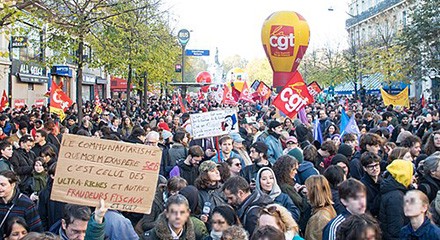
Protests in France seem to be experiencing a relative slowdown, though they have not yet run out of steam. A significant minority, particularly among young people, do not seem ready to stop. Nor has the unity of the inter-union coalition been broken.
On Saturday November 14, 200,000 people marched in the streets. On Tuesday November 17, there were 500,000 of us. Ultimately, that day saw a general strike in the public sector, joined by all the unions, along with a call from the leftwing unions (Confédération Générale du Travail, Solidaires) for the private sector to join as well. The most rightwing-led unions eventually joined the call after negotiations failed completely.
Since the protests against pension reform, the government has not budged an inch - a sign that the state is becoming increasingly firm in its austerity measures in the face of the crisis. Traditionally the most rightwing union federation, the Confédération Française Démocratique du Travail (a former Catholic union that converted to liberalism in the 1990s) would betray any inter-union coalition after just a few days of mobilisation to secure a few crumbs that the government granted it to break up the movement. But now even the unions most accustomed to social dialogue and non-confrontational negotiations are forced to maintain the unity of the inter-union coalition and to retain a minimum level of militancy in order to make their voices heard.
The main demand of public-sector unions is an adjustment to the civil service pay index (it is estimated that public employees have lost more than 16% of their purchasing power since 2017) and an increase in salaries that are - illegally - below the minimum wage. In fact, 862,000 public servants - 15% of the total - currently earn less than the minimum wage, even when their pay is supplemented by bonuses. This situation looks set to worsen, affecting 20% of public servants. In response, the government is talking about upcoming “structural reforms” and has announced that it will resume negotiations only after the next union elections on December 10.
Universities
In recent days, some universities have seen their largest demonstrations since the movement began, while others have been occupied or partially occupied for extended periods, organising open universities and providing support for secondary school students. Nevertheless, it appears that students prepared to mobilise remain very much in the minority, even if a majority passively supports them.
Within the student movement, most of the debates in recent weeks have centred on which tactics to adopt, particularly the practice of blockades. The autonomes (radical anti-capitalist and anti-authoritarian activists who reject traditional unions and political parties, and are often associated with ‘black bloc’ tactics: ie, wearing black clothes and face coverings during protests), who have a fairly strong presence on university campuses, advocate blockades at all costs and oppose holding demonstrations when they deem them too heavily controlled by political and union organisations.
This stance, which appears on paper to be the most ‘radical’, seems to hold some sway over a number of young people, who are also drawn to ineffective, fringe tactics such as direct-action stunts or unauthorised demonstrations in small, mobile groups that keep the police running around. Certain organisations, particularly Maoist groups and Révolution Permanente, are flirting with a kind of tailism towards this position.
The rest of the organised left is pushing instead for action that will broaden the movement’s base by reaching out to students who have not yet joined the protests, keeping the universities open to propagandise, and calling for demonstrations. Tensions between these two factions sometimes lead to absurdities: one of the two sides involved may fail to respect majority decisions, or conflicting decisions may alternate from one day to the next.
In secondary schools, the situation varies widely and is quite difficult to assess. What is clear is that the figures provided by the government are massive underestimates.1 According to the secondary-school principals’ union, between 150 and 200 schools have been unable to operate normally on any given day, with a peak of 1,000 on November 5 (out of 3,700 secondary schools). The action taken ranges from partial disruptions to complete shutdowns. The resilience of school students is particularly remarkable, given the numerous abstacles they face. In some secondary schools, parents are organising to break through the blockades and force classes to resume, going so far as to confront the protesting students.
Repression
Meanwhile, police repression shows no sign of letting up and is accompanied by legal reprisals based on summary judgments against students of legal age in immediate trials, and strict judicial supervision imposed on minors, resulting in suspended sentences and community service. Government directives also call for the systematic implementation of internal disciplinary sanctions within secondary schools.
In some secondary schools, the return to lessons has been difficult. Whilst visiting a secondary school in Nantes on November 16, the minister for education was heckled and was said to require police protection. Officers of the CRS riot police, who specialise in paramilitary law enforcement and counterinsurgency, were seen ‘maintaining order’ beneath a sign addressed to pupils which read: “Glad to see you again”!
Decrees restricting the freedom to demonstrate are on the rise, notably by altering protest routes (often with too little notice for appeals to be lodged). The state’s aim is not only to deter protest, but also to criminalise it. Since the start of the new school term, the government has stopped reporting the daily number of arrests. This week, there was an attempt to ban gatherings outside several secondary schools in Paris. The Administrative Court overturned these decisions, and on November 17 most of the traditional protest routes were authorised (except in Paris, where the route was a sort of compromise).
There is a real issue at stake here - one that is not merely symbolic: it is not just a question of where we demonstrate (closer to or further from the city centre and the seats of power), but also of how the route is chosen. Depending on the balance of power, we could impose our own routes. On November 5 in Toulouse (a city where protests are generally very strong), the unions actually tried to break through the police cordon to be able to follow the usual route, but without success.
It is noticeable that police officers are themselves beginning to show signs of exhaustion. Police unions are demanding pay rises and threatening to take industrial action, particularly amongst the CRS. On November 17, several CRS units had almost their entire complement of officers ‘attending medical appointments’ - a tactic they often use to stop work, as they do not have the right to strike themselves. According to the unions, this affected 1,000 officers out of 13,000. They are also demanding a bonus specific to their profession, rather than a general increase in the civil service pay index, as called for by the inter-union coalition. Despite significant staff shortages among the police in some towns, there were no incidents of violence on November 17, which confirms what we already knew: it is often the police who provoke such incidents through strategies that escalate tension.
To date, the outlet for the anger and militancy of recent weeks seems to be the possibility of voting for Jean-Luc Mélenchon’s party, La France Insoumise. On the fringes, a few people are becoming more radicalised in clashes with the police, whilst a few others are joining Marxist groups. Marxist activists are often among the best organised and most determined, but they are not reaping huge benefits from the protests.
What action should communists take? I believe we can draw the following short-term lessons. Recent events demonstrate once again that unity of action - at least on an occasional basis - is essential. The Nouveau Parti Anticapitaliste-Révolutionnaires and Révolution Permanente are organising two separate student demonstrations in the Île-de-France region on the basis of a minor difference over the organisational approach to be adopted. This essentially serves to mask the fact that each of these two organisations wants to control its own demo. This is all the more ridiculous, given that the number of students attending is extremely low in proportion to the total number in the Paris region. Subsequently, these organisations use such protests to swell the ranks of their contingents and secure television appearances on news channels.
Communist unity
What is even more problematic is that the dissolution into broad fronts prevents clear political expression: instead of the communist unity that should be on display at demonstrations, the disunited marches of the NPA-R and Révolution Permanente promote no distinctive political message, and sometimes do not even take part in the same final rally.
It is also necessary to explain what we want to do to ensure the movement truly succeeds: to develop the organised labour movement, ideally within a political party, as opposed to the purely electoralist tactics of LFI and those of the autonomes, which, despite their differences, both involve failing to organise people within the structures that would be necessary.
Of course, the activities of certain Trotskyist groups within this sort of student and secondary school movement are primarily geared towards recruiting into their own sect. But it so happens that, for them, recruiting means something that is completely unacceptable to the people they come into contact with - namely, fully adhering to a set of theses formulated in a direct lineage from Marx down to the leader of their particular confessional group. However, if this were proposed to people directly, they would be unable to recruit them: they are therefore reduced to devising a whole range of subterfuges to encourage people to draw closer to them gradually and accept their global doctrine bit by bit. This partly explains, for example, their determination to take control of demonstrations or broad-based coalitions at any cost, in order to create a semblance of hegemony in their favour.
If joining a Communist Party were essentially synonymous with accepting a clearly defined public programme, it would be entirely possible that Marxists’ arguments would consist of a defence of their programme, their demands and their strategy - and thus a case that might persuade people to join on clear political grounds.
-
www.lemonde.fr/societe/article/2026/11/14/mouvement-lyceen-la-communication-opaque-du-gouvernement-sur-les-chiffres-des-lycees-perturbes-et-des-interpellations_6809555_3224.html.↩︎