
12.11.2026
Strikes, streets and strategy
There have been massive protests of school and university students. November 5 took things to a higher level by mobilising the trade unions. What needs to happen next? Jean Laurel argues against the idea that rioting is positive, the way forward, something to celebrate
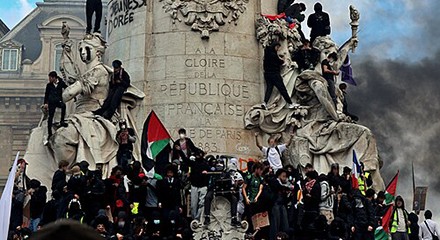
On Thursday November 5, France experienced a day of nationwide strikes and massive protests across the country. According to the unions, the demonstrations drew in more than 1.5 million people, but the number of strikers is quite difficult to estimate. What is clear is that the strike was widely supported in certain sectors known for their militancy, such as rail and education.
However, it is clear that the strike was not sufficient to have a real impact on the economy: for example, since strikes are common in the rail sector, there is an entire system in place to ensure that the railway continues to operate despite a relatively large number of strikers, by replacing them with managers or replacement workers hired for that purpose. Train lines can therefore continue to operate almost normally. This day was thus a success on the streets in terms of numbers, but not particularly within workplaces, contrary to what is claimed by Révolution Permanente (a Morenist group close to the Argentine PTS). It asserts with its usual triumphalism that “the convergence with the labour movement is taking shape”.1
However, this day had the merit of breaking with the practice - inherited from the Yellow Vests movement - of weekly Saturday demonstrations, which were intended to allow people to protest without going on strike. This form of protest, moreover, appears to have been on the decline in recent weeks: there were 800,000 of us on October 24, 500,000 on October 31, and 250,000 on November 7. So we have seen a real loss of momentum on that front, although it should be noted that these demonstrations are more often suppressed - or even banned in certain cities - than the calls for action issued by the inter-union coalition on weekdays.
There has also been a slowdown in high schools, although a number of them remain blockaded (it fluctuates from day to day: a few dozen according to the ministry, more than a hundred according to high school organisations). There was a huge surge in blockades on November 5 for the national day of mobilisation - many determined young people continue to participate in the movement and carry out actions at their high schools. But it is primarily the universities that continue to participate in the movement, with about 40 still blockaded as of November 10. And this is despite sometimes ridiculous divisions even among Marxist activists, as evidenced by the emergence of two separate general assemblies to ‘lead’ the student movement - one controlled by the NPA Révolutionnaire (a splinter group of the Fourth International United Secretariat) and the other by Révolution Permanente.
Unfortunately, there are few prospects following the events of the 5th, and it seems clear that the student movement risks losing momentum. Indeed, on November 10, there was a strike in the education sector with low participation, and a small demonstration, consisting mainly of political and union activists. The 5th also led to negotiations between the unions and the government, resulting in a paltry increase in the minimum wage of about €20 (which is actually only a five-euro gain, compared to the automatic adjustment). Unions are demanding an increase of between €100 and €150. This led to a call for another day of strikes and protests, but only in the public sector, and without the second and third largest union federations - the CFDT and Force Ouvrière - which are waiting to continue negotiations.
Meanwhile, the meetings between student and high school unions and the government have been no more successful. The government refuses to give an inch to the students, certainly because it is aware that the movement is on the wane. It knows these student organisations actually have very little grassroots support and do not really lead the movement.
Violence
In a letter to last week’s paper, Nicolas Girard responded to my October 29 article (‘Readying for the next stage’ October 29). He found it “despicable”. He argues that my failure to support the acts of vandalism makes me an authoritarian Stalinist: “Perhaps comrade Laurel and the Weekly Worker crew would have joined the French Communist Party in railing against ‘irresponsible’ street-fighting students in early May 68.”
It is true that the French Communist Party’s characterisation of the students in 1968 as “petty-bourgeois leftists” was a purely moral attack, ultimately justified by their unwillingness to really confront the state. Nevertheless, it is also true that the Grenelle Accords were not won through the cobblestones thrown by the students, but through mass strikes, made possible by the existence of mass organisations of the working class.
Similarly, regarding recent events in France: it is not a matter of morally condemning violence, but of opposing it politically. I am not opposed on principle to all violence, or to everything that is legally considered a ‘crime’. Violence is not a moral taboo: it must be examined in context, as a tactic within the framework of a revolutionary strategy.
However, individual violence is not a means by which we can move towards overcoming capitalism, which is the goal we must set for ourselves. I think all Marxists can agree on this point. If smashing things were enough to bring about socialism, you’d find me in the streets wearing a mask and wielding a crowbar, attacking every storefront in my path. If, instead, you find me writing for the Weekly Worker, it is because I believe that the “autonomist” strategy of individual and disorganised violence is a dead end. The Yellow Vests achieved absolutely nothing through this approach: the government was able to simply wait for the images of burning trash cans in the media to scare the majority of the population, all the while stalling with false promises.
Obviously, it would be absurd to reject outright any action that is not directly aimed at overthrowing capitalism. We must be clear that this violence is first and foremost the product of the violence of capitalist society (social violence in general, but also the police violence directly experienced in recent weeks), and that it constitutes, in part, a response to it. I obviously have no sympathy for the storefronts of big-box retailers charging exorbitant prices or for the injuries sustained by cops who have spent the last few weeks maiming children. Of course, we must also oppose at all costs the judicial and police repression being unleashed on the rioters (the ‘rioter pays’ law, expedited legal proceedings), as well as the vile and racist media commentary being spouted.
I therefore do not understand how comrade Girard could have interpreted my position as being to the right of the Trotskyists, who, “while rightly pointing out that destroying small shops is counterproductive, correctly recognised street fighting with police and attacks on private property as an expression of fully justified anger against the government, price-gouging capitalists big and small, and police violence in general”. This is an analysis of these acts of violence that I fully share. The question is what political response we should propose.
In fact, it is comrade Girard who is shifting the debate onto moral ground by accusing me of veering to the right: since the sociological background of the rioters is working class, he argues that it would be wrong to oppose them. But the sociological background of the rioters is not an argument in favour of automatic support for every action they take. We must not unconditionally support all acts carried out predominantly by the working class.
The fear of ‘playing into the hands’ of the prevailing media narrative certainly pushes many Marxists to tone down their criticism of acts of looting. But I believe it is important to offer a political opposition to these actions, which are often glorified by a segment of the far left - even among Marxists - without, however, jumping on the bandwagon. We must precisely offer a political critique of these actions to break free from the sterile dichotomy in which the government is trying to trap its opponents (“You have to choose a side: either that of the republic and law enforcement, or that of the rioters,” stated prime minister Sébastien Lecornu).
My goal is not to ‘wag my finger’ at the rioters, but to address the growing number of people who believe there is no other way to get a few crumbs than by rioting, and who appreciate the rioters’ actions without necessarily participating in them. This sentiment stems in part from the absence of a socialist and communist perspective for overthrowing capitalism, which must be championed by the working class organised within a Communist Party.
Revolutionary?
I believe that the role of Marxists is not to go along with public opinion, but rather to propose a strategy that can counter the ineffectiveness of large-scale union mobilisations: strengthening the organisation of the labour movement, within unions and political parties, to give political direction to the discontent. Progress can be achieved not by smashing more storefronts, but by workers organising mass strikes. Otherwise, if there is violence, at best we will see a few appeasement measures and probably nothing at all if there is not.
This is not the political direction of La France Insoumise, with which we cannot be accused of being aligned, contrary to what comrade Girard claims. Quoting Jean-Luc Mélenchon as saying that such actions are “not our methods” was certainly a blunder on my part - but mainly because he was not referring to the organised labour movement, but to his own electoral hopes. Unlike Mélenchon, who seeks to channel the movement towards an electoral outcome in the 2027 presidential election and fears that chaos could lead to a victory for the far right, I am not asking the police to maintain order. I believe the working class should be able to organise against both the police and the dismantling of social programmes if necessary, to ensure that these days of mobilisation are demonstrations of strength and to radicalise the movement.
Finally, it is wrong to say that mass protests are failures, compared to days when violence breaks out. In my view, the fact that the same number of people take to the streets again a week later - despite the crackdown and propaganda - is indeed a political success. It shows that the government’s tactic is not working and that social anger continues to be expressed.
As for the accusation of conspiracy-theorising regarding the analysis of the looting on October 17, I maintain that the ‘law enforcement’ strategy consisted in part of focusing on cracking down on protestors, while at times deliberately overlooking the vandalism and looting2 (this is in fact what the mayors of Paris, Marseille and Lyon argued). The political objective was to use the violence to crush the protests and foster ‘national unity’ behind law enforcement. This is accompanied by distorted figures - such as those uncritically repeated by comrade Girard, who speaks of 30,000 looters in Marseille: this figure, provided by the government, has since been refuted; in reality, there were 10 times fewer.3
The reality is, of course, more complex, and the police may indeed have been overwhelmed in certain situations. But my aim in highlighting this aspect was, above all, to counter the triumphalist narrative of those who claim that the situation was revolutionary in the wake of October 17, because the state supposedly proved to be incapable of maintaining order.
-
www.revolutionpermanente.fr/Plus-d-un-million-dans-la-rue-le-5-novembre-il-faut-transformer-cette-force-en-greve-generale.↩︎
-
www.lecanardenchaine.fr/police-justice/55230-comment-nunez-a-laisse-au-repos-14-compagnies-de-crs.↩︎
-
actu.fr/provence-alpes-cote-d-azur/marseille_13055/30-000-pilleurs-a-marseille-le-17-octobre-les-chiffres-de-la-prefecture-mis-a-mal-par-le-parquet_64958788.html.↩︎