
05.11.2026
A long old road
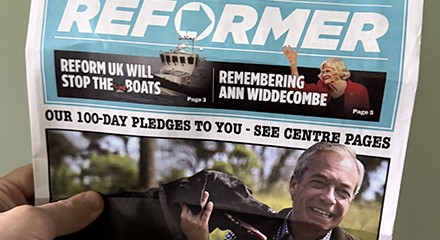
Nigel with pet dog, Nigel posing as Kitchener, Nigel solving the pothole crisis. Edited by ex-leftist Mick Hume, Reform UK’s new paper has been launched. Paul Demarty reads it, so you don’t have to
The rustling of paper at my front door the other day turned out to be an unexpected gift: the first issue of The Reformer, the house journal of Nigel Farage’s Reform UK.
“Free for patriots”, as the front page tells us (how much we non-patriots are supposed to pay for this is unclear), it is a rather airy confection. Reading it cover to cover took me about six minutes, which at least is probably longer than Richard Tice can keep going in bed. On the front is a picture of Nigel, beaming as he pets his dog (or at least one assumes it is his). On the back is another headshot of the great helmsman pointing his finger at us, as in the classic World War I poster (‘Britain needs YOU!’). Indeed, seven of its eight A4 pages feature snaps of Nigel (I’m cheating a bit, because one photo spills over the centrefold on pages 4 and 5, but still).
Dare we imagine that, in posing for his Kitchener tribute, Nigel was in fact pointing at a mirror? Britain seems not to need you, but rather him. Only he can fix it - the ‘broken Britain’ we hear so much about. This is hardly surprising: after all, Reform is not strictly a party, but a company (owned by Farage!). His political outfits have always been characterised by the ‘one man band’ aspect and, when he lands a ‘big beast’ recruit, it is rarely long before there is a split. His poaching of various recent Tory ministers has not panned out that way yet, perhaps because they are all too shop-soiled to challenge him, but there has already been a damaging split with Rupert Lowe, who went on to found the even fruitier Restore Britain.
Fakery
In any case, the paper seems to be a kind of direct-address system from Nigel (or his ghostwriters at least) to his adoring public. The overall package does not exactly have a very insurgent feel to it. It resembles nothing so much as the fake local papers put about by all parties at election time. A dodgy chart appears, claiming that only Reform can beat Labour (straight out of the Liberal Democrat playbook), as does a lot of material about a “pothole emergency” in Essex, which gets almost as much space as ‘stop the boats’ rants.
‘Broken Britain’ has been an invincible cliché of British politics at least as far back as David Cameron’s Tory leadership. It sums up so much of the intellectual and political poverty of the modern far right, in Britain and elsewhere: a formless, indistinct mass of grievances and anxieties, some real and some wholly factitious, for which direct blame is assigned to immigrants, lefties and the political elite. Responsibility for cleaning all this up rarely goes to a real outsider, but a supposedly disloyal insider - be it the celebrity businessman Donald Trump, the financier Farage, the fringe congressman Jair Bolsonaro (or, more recently, his flagrantly corrupt progeny). It is striking that even the lies of these men are taken somehow as proof of their authenticity, but it is an essential part of the package - proof that they are prepared to fight dirty.
Everything is fake here - the ‘authentic’ lies; the ‘patriotism’ of men who are plainly agents of foreign capitalists, specifically American; the staggeringly dishonest official optimism. The Reformer hails the recent Clacton by-election as a great victory over “the political establishment”, rather than a farcical victory over a man dressed as a bin. It trumpets the successes of Reform’s councillors, ignoring the predictable general chaos that has been the more abiding story of their municipal conquests. The real ‘pothole emergency’ is in the brain tissue of anyone who would believe any of this for a second.
Can there be a second issue of this preposterous production? What more would it be able to say? All its content targets elections years from now (though perhaps Andy Burnham fancies an early one). The quip of John Sullivan springs to mind about a plan to turn the Trotskyist Militant weekly into a daily: “really it would be better as an annual”. The Guardian notes a job advert that implies somewhat grander ambitions: “Reform UK is building a seven-day digital newsroom at its Westminster headquarters and is looking for hard-working, NCTJ-qualified multimedia reporter/producers who can report, write and publish high-quality content at speed.” If this comes to anything, we expect it will be the fraudulent ‘citizen journalism’ so beloved of the American right, but we will see.
All of that will be up to a certain Mick Hume, whom old hands on the left will know once edited a rather different journal by the name of Living Marxism. Yes, this dismal freesheet is somehow yet another way-station on the long political and intellectual decline of what once called itself the Revolutionary Communist Party, but since the late 1990s has been more or less a rightwing clique best known for its publication of the website, Spiked.
Alphabet soup
The story, as briefly as possible (I ask for patience during the following course of alphabet soup): the RCP originated in the mid-1970s in a series of splits from the International Socialists, forerunners of today’s Socialist Workers Party. The first split produced the Revolutionary Communist Group, but this almost immediately split again, when the core leaders around David Yaffe adopted a third-worldist, strongly ‘campist’ outlook.
A group around Frank Furedi decamped to form the Revolutionary Communist Tendency, whose theorisation of the Soviet Union and satellites was essentially the extremely critical analysis of Hillel Ticktin with the serial numbers filed off, and - as the 1970s gave way to the 1980s - became known for their extreme contrarianism with respect to the ‘default’ positions on the left. They were in favour of nuclear power at the very lowest ebb of its popularity. They held very strong positions in favour of Irish republicanism which - though salutary, given the British left’s general cowardice on the question - frequently spilled over into irresponsible provocations.
Their members, Don Milligan and Michael Fitzpatrick, bizarrely denounced government attempts to manage the spread of HIV/Aids. Most notoriously among the wider left, they insisted, all the way through the 1984-85 miners’ strike, on the need for a ballot - arguably a legitimate tactical question at the outset, but essentially an echo of government propaganda thereafter. More examples could be mentioned.
The RCT became the RCP in 1981, having taken the view that the Labour Party was moribund and that a new party - committed to sufficiently spiky and provocative positions in general politics, one assumes - was well placed to overtake it in the short term. Yet contrarianism was, with them, a terminal condition: they became addicted to the blood of sacred cows. After the fall of the Soviet bloc, the RCP took the view that class consciousness was buried for perhaps a generation, and the need was to rebuild the idea of political agency as such. The enemies now were not so much the right, but the liberal left, whose fussiness about climate change (a hoax, in their view) and political correctness formed a kind of iron cage around the human spirit of innovation and adventure.
The RCP as such receded from view, to be formally wound up some time in the mid-1990s; its magazine, Living Marxism, was rebranded more ambiguously as LM - Hume was the editor at this time. Its political line effectively echoed pro-capitalist libertarianism in all respects, since for it the key thing was human achievement and the defeat of anti-growth, misanthropic enemies like the green movement. The RCP maintained its eccentric foreign policy positions for a time, taking an extreme pro-Serb line during the Yugoslav wars, which eventually destroyed LM when it was sued for publishing an article claiming that ITN footage of war crimes was staged.
From the ashes of LM came forth Spiked. But that was only one of the many fronts of this odd clique, which also included the Institute of Ideas, Sense About Science and many others. (Not for nothing did our own Mark Fischer long ago nickname them “the SWP with hair gel”.) In this capacity, they began to hoover up corporate sponsorships and the like. The old anti-imperialist shibboleths began to atrophy, until, in 2009, with the chaos of Operation Cast Lead raging, they switched teams on Israel/Palestine, becoming fanatical Zionists.
Occultism
Retrospectively, it is clear that this began a transition from right-libertarianism to pure, culture-war, far-right nationalism. Spiked and the rest were gung-ho for Brexit, enthusiastic promoters of the trans panic, and apocalyptic critics of all forms of ‘wokery’. The tie-up with Farage dates back at least to 2019, when several ex-RCP people appeared on Brexit Party electoral lists in the European parliament elections. Furedi, having long been a sociologist at the University of Kent, showed up in a senior role at the Mathias Corvinus Collegium’s Brussels office - essentially a soft-power operation of Viktor Orbán’s regime. (He has recently resigned, claiming that cuts under the new government have made it impossible to continue.)
There are many theories out there about how all this happened. A popular one is that the whole thing was a state op - these were provocateurs in the strict sense. I do not think that can be ruled out, but it seems unlikely. (Why would the British state be contributing to Hungarian national ambitions via MCC Brussels?) Frankly, very many people go from youthful leftism to conservatism on an individual basis, partly because the left can be maddening. Why should a collective with a strong sense of loyalty to the founder-leader not walk the same road as Malcolm Muggeridge or Peter Hitchens?
In any case, some vestigial commitment to their particular condensation of the Marxist canon survived for a surprisingly long time, and may still do. (I was surprised, upon meeting their then-recent recruit, Philip Cunliffe, in 2012 or so, that he could quote Hillel Ticktin verbatim in conversation with some orthodox Trotskyists - clearly still on a reading list somewhere.) Yet with the post-Soviet turn, the RCP’s Marxism departed from even a notional push-and-pull with the workers’ movement, as it really was. Such ‘Marxism’, separated from an orientation to substantive class politics, ceases to be anything particularly special. Instead, it tends to degrade into an occultist historicism - essentially isomorphic with reactionary equivalents like the theories of Oswald Spengler, Rudolf Steiner and so forth (a problem that also afflicts similar outfits like Platypus).
For the occult historicist, the concrete substantive question is uninteresting, except inasmuch as it bears on the true motive forces in history, which abstractly stand over us (the cycle of ages, the progress of freedom, or whatever). This leads to a cavalier attitude to truth: an article is about giving history a little push. This in turn tends to degrade the intellectual level.
At the end of this process - I say that, but it is always possible to sink lower - lies something like the Reformer, eight squalid pages of purely instrumental, staggeringly dishonest political slop. What would the Mick Hume of the 1980s - always out-lefting the left, cheering on the Provos - say if he could see himself now? It is a long old road from Free Derry to the great Essex pothole emergency of 2025!
But that is between him and his conscience.
paul.demarty@weeklyworker.co.uk