
08.10.2026
Burnham on the front foot
With talk of a National Care Service, public ownership and electoral reform, Andy Burnham made the most of his first conference speech as prime minister. But he is not master of his own fate, suggests Paul Demarty
Given his robotic, gunshy public presentation in most situations, it is easy to forget that Sir Keir Starmer was capable of winning over the home crowd. He never had a Labour conference speech as disastrous, certainly, as Theresa May’s infamous evening to forget at the Tory conference of 2017, when she was overcome with coughing fits and presented with a P45 by a protester, while the stage setting slowly fell apart around her.
Still, the contrast in Liverpool on September 29, when the ‘king of the north’, Andy Burnham, delivered his first conference speech as prime minister, was quite striking. Both men have a habit of going on about their dads, but Burnham was happy to cry real (or realistic) tears over the father he recently lost - a notable change from the terminally focus-grouped waffling of Starmer. Burnham, moreover, had a theory of Britain’s parlous state beyond the incompetence of his predecessors. He was able to do a decent impression of hopefulness, while also starkly accusing the political class for its failures, including, at least once, specifically accusing himself.
He was also willing to make a show of taking risks. Thus the flagship policies: reducing the pension triple lock to a mere double lock, removing the tie-in to real wages, in order - he implied - to fund a new ‘National Care Service’, free at the point of use; greater use of the state in building council houses and controlling water services, up to and including public ownership; tacking back to closer relations with the EU, with rejoining pointedly not ruled out; and unspecified electoral reform in the direction of greater proportionality.
Each of these looks, at the present time of asking, like a good bet; but they are all bets. The triple lock has been in the sights of successive governments, but the electoral arithmetic of this ageing country has always defeated them. Posing it as a quid pro quo with free social care is one way to, as he put it, “rip the plaster off”. The politics of Brexit are thorny, to say the least, but there is enough buyer’s remorse out there that he can probably get away with it. That and the promise of some kind of proportional representation is a good sell to the Liberal Democrat and Green voters, worrying away at Labour’s share of the poll - although actually delivering PR would make that a one-time-only deal.
We are impressed so far, then, with his canniness. This whole combination - from the weeping to the constitutional tweaks - allows him to appear sincere, while also keeping a keen eye on the electoral bottom line, to offer a hopeful vision, while also signalling willingness to take ‘tough decisions’, and so on. In reply, Tory leader Kemi Badenoch had recourse only to fatuous “going back to the 1970s” clichés (as opposed to the roaring successes of the early 2020s?), and Nigel Farage huffed about the triple lock for his grey-skewing audience. The popularity of different elements of Burnham’s programme will no doubt fluctuate, as he receives the tender affections of the rightwing press, but it seems safe to say that he won the day.
Of course, it is necessary to have a look at the fine print here. We cannot go through every dot and comma of his programme, so we will make do with the housing and water proposals.
The first thing to say is that both of these are very much tied up with a 10-year time horizon. This is not unreasonable in itself. If a powerful wizard made Britain into a functioning socialist society tomorrow, and protected it from external sabotage, there would still be enormous work to do to restore the country’s social housing stock and repair the damage done to the water supply by decades of deterioration under the rule of finance capital. Nonetheless, it allowed him to bellow soaring promises to the eager crowd in Liverpool without even committing to putting them in the next manifesto. This is, let us say, a bit cheeky.
Build, build, build
On to the substance: Burnham promises the largest council house building programme since the “post-war era” - he deliberately stressed council house. He will exclude new council homes from right to buy (not backdated to existing ones). He announced a barrage of measures to rein in private landlords (no doubt to the annoyance of several of his own MPs). He will clamp down on exploitative leasehold charges, and make it easier to buy starter homes by reducing the deposit requirements.
It would be churlish to say that, from a socialist point of view, there is nothing to like here. Certainly the emphasis on council houses is good, as is the end to the beggar-thy-neighbour nightmare of right to buy (not including the existing estate is a grumble, but the numbers still leaking out are frankly trivial). On the other side of the ledger, the Tories already created 5% mortgages, ‘help to buy’ and the rest. How small is the required deposit envisaged by Burnham? Fifty quid and an eighth of weed? On top of all that, any Tory will immediately leap up and demand, ‘How do you intend to pay for all this?’ That is a good question, regardless of the political valence, but we defer it for now.
There is a more fundamental problem with this hodgepodge (also connected to the pensions and care issues). For many - probably most - private owners, the biggest upside over renting is that a house is an investment. But for that to work, a house must accrue value; for a house to accrue value means it must become more expensive, and for real estate to be a viable method of capital accumulation the housing market as a whole must rise in value above inflation.
The use of private home ownership as a personal investment is a deliberate political choice, designed to give elements of the lower middle and upper working classes buy-in to the success of the British economy in a narrow, line-go-up sense. Burnham likes to insist that everything went south in the 1980s; well, this is one of those things that went south. Seriously increasing the housing supply, whether through council house building or some kind of inducement to private developers, will hit house prices and throw a lot of ordinary people who drank the post-Thatcher property-porn Kool-Aid into negative equity. This is the kind of thing you can build a backlash on.
On water, there is a plan to abolish Margaret Thatcher’s rule against public ownership, and to give mayors (he always uses that word, and not ‘councils’) unspecified powers to hold water companies “to account”. This is even weaker tea, but, we suspect, similar problems: really attacking private ownership of the water companies would mean attacking finance capital and, by extension, the institutional investors, like pension funds, who ultimately own these things in many cases. Thatcher and her heirs succeeded in financialising the British economy, and that is one difficult plaster to rip off.
Dependency
The problem is further illustrated by stepping outside the conference hall for a moment. The day after his big speech, he was asked about the unfolding Manchester City football finance scandal, which could theoretically see the independent football regulator created by Starmer force a sale of the club on its Abu Dhabi royal owners.
This salt-of-the-earth populist was suddenly quite defensive: “I would be really concerned to lose [the Emiratis],” he said. “They’ve been such a huge partner in the building of modern Manchester and the building of Manchester City into the global force that it is.” He went on to “thank the City Football Group and the wider ownership for the money that they didn’t just put into the Etihad [Stadium] and the campus around it, but also into the city.”
In the football world, this was not received well. The City scandal is arguably the worst in the whole chequered history of the sport, and also a perfect image of what happens when - as Burnham often said in his speech - you “give up control” of something very important. Yet he is surely speaking the plain truth. Emirati money was, indeed, a key input to Burnham’s success as Manchester mayor, as no doubt was other foreign investment besides. That was the engine of the city’s transformation, for better or worse. Of course, it is now no longer a local problem: seriously alienating the United Arab Emirates would be a diplomatic headache, though probably survivable. Stripping them of ownership would be a serious blow to Britain’s reputation as a safe haven for such showy investments, and it is not clear what else we have to offer at this point in our long decline.
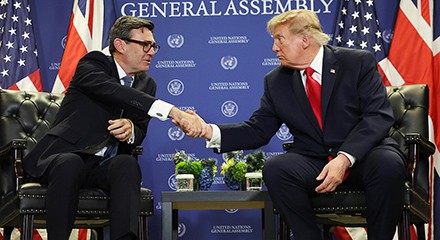
Such is the complexity of the ‘how do you pay for it?’ problem. Britain imports 40% of its food, never mind other goods. It is not built for autarky: it depends on playing its determinate role in a world system still dominated by the United States, with rich but smaller states like the Emirates within that alliance structure. It is a harder game to play now even than it was - what with an increasingly erratic and autocratic Donald Trump announcing and cancelling sanctions every half hour. There are few countries as vulnerable to capital flight in the advanced world as ours, and so we must keep our sponsors happy.
One indispensable item on the American list of demands - made more rudely by Trump than his immediate predecessors, but a plain concern at least back to the Obama administration - is increased military spending. The Americans expect their Nato allies to look more after their own defence - financially, at least; they expect all that money to be spent on American weapons. Within these constraints, Burnham faces classic ‘guns or butter’ dilemmas - made all the worse, since any Keynesian stimulus effect is likely to be appropriated by the Americans.
On top of that, the world financial system presents its own worries at the moment. Much of the at best tepid growth on display in recent years has overwhelmingly come from the AI subsector of big tech, but the idea is becoming more widespread in the investor class that this is a bubble. The build-out of AI-specialised data centres - a key part of Starmer’s ‘growth, growth, growth’ schtick, and also part of Burnham’s programme - is funded by increasingly elaborate and dubious debt structures and, under the inflationary pressure of Trump’s Iranian adventure, debt is getting more expensive, from treasuries to corporate bonds. Crisis may or may not be imminent, but the unwinding of all this stuff has the potential to be very destructive.
Homespun wisdom
What can Burnham do about that? What piece of homespun wisdom from his gran will he bring to bear on the problem of a new global financial crisis? Of course, action will be taken, as it was by Gordon Brown and Alistair Darling back in 2008. But it is not likely to be action of the ‘giving out sweeties’ variety. It will be painful for people; and, while it really cannot be helped if you are prime minister of the British capitalist state under such circumstances, voters tend to remember if sweeties are promised but not delivered. They do not ordinarily know the meaning of the phrase ‘force majeure’.
I say this by way of making the broader point: Burnham’s success or failure is, to a very large extent, out of his hands. He has freedom of action on the conference stage. He does not have much freedom of action in the way of - Starmer again - ‘delivery, delivery, delivery’.
Good luck, Andy: you’ll need it.