
10.09.2026
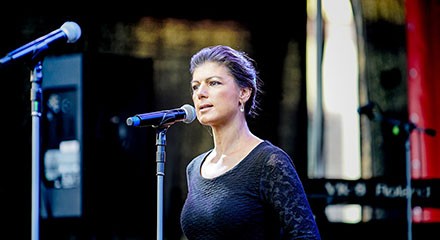
Politics of the firewall
Has fascism returned with the AfD? No, but we do have a problem with a left that is desperately trying to help save ‘German democracy’ by going into a cross-class coalition government, says Carla Roberts
A dramatic headline in The Guardian neatly sums up the panic of the liberal establishment across Europe in the wake of the September 6 regional election in Saxony-Anhalt: “Alarm that Berlin and Mecklenburg-Western Pomerania may fall next”.1
The implication - very much mirroring the mainstream media in Germany - is clear: as parts of Germany are in danger of falling to the fascists, all good people need to forget about their disagreements and unite to save democracy and the Federal Republic.
Having won 43.8% of the vote, Alternative für Deutschland now holds 39 of the 83 seats in the state parliament. The Christian Democrats (CDU) has 15 seats, while the SPD, Greens and Die Linke have eight seats each, and the Bündnis Sahra Wagenknecht (BSW) five.
Minister-president Sven Schulze (CDU) has said that his party will not try and cobble together a government coalition, declaring that “we see our role in opposition”. For now at least, the CDU is sticking to the Brandmauer (firewall), which means rejecting the formation of a government with the AfD - the same goes for all other parties, including Die Linke. If they all got together, they could in theory form an anti-AfD government with a slim majority of five seats.
However, this would require the BSW coming on board - without it, both the AfD and a potential CDU/SPD/Greens/Die Linke coalition hold 39 seats each. But the BSW says it has no interest in participating in such an anti-AfD coalition - in fact, the BSW is the only party that has, so far, expressed its willingness to work with the AfD.2 The former ‘communist’, Sahra Wagenknecht, has become regional king maker - and, boy, does she enjoy the role.
Dumb BSW
BSW’s lead candidate Thomas Schulze has repeatedly noted (correctly) the many points of agreement between the two parties: “We do have some common ground - especially regarding the issue of Russia, where we say we are opposed to sanctions that are effectively ruining our economy.” Like the AfD, BSW wants “normal relations” with Russia and “affordable energy” to address the increasing cost-of-living crisis in Germany - by which they mean that the Nord Stream pipeline, blown up in a CIA-directed act of sabotage, should be repaired and reopened, to supply German consumers (and, more importantly, German capitalism) with cheap Russian gas. Only the AfD and the BSW demand this openly, which has no doubt played a major role in their electoral successes (more below).
For the time being at least, the BSW insists on only one thing, when it comes to cooperating with the AfD - the new minister-president should be “überparteilich”- ie, not a member of any party. Apparently, this would mean that “all fractions can have a say”. The rest of the government programme is secondary.
This is the kind of dumb ‘radical idea’ that Sahra Wagenknecht has become infamous for. The former leader of the Communist Platform in Die Linke split in October 2023 to form the BSW, hoping that her brand of left-conservative populism would finally hit the big time. A couple of weeks before the February 2025 general election, she proposed a national referendum on migration, which, she hoped, would limit annual numbers to a “manageable” 50,000 (from the current 500,000). A cheap and nasty PR stunt - which immediately backfired: the BSW missed the 5% hurdle to enter national parliament, whereas Die Linke achieved a record 8.8% of the vote (it was the only party that did not move to the right over the question of migration).
The AfD has so far rejected the BSW proposal, calling the idea of a non-affiliated minister-president a “messy proposal.” It probably would not even take a ministerial job for the BSW to drop the idea and deliver the necessary votes to elect an AfD minister-president anyway. But it would not be impossible either to imagine a regional government coalition of the AfD and BSW, which might sound impossible, considering Wagenknecht’s past - but it would be entirely in keeping with her recent political trajectory.
The establishment parties (CDU, Social Democrats and Greens) would prefer holding new elections. These would become necessary if, after three rounds of voting, no majority for a new minister-president can be found. Perhaps they are hoping for a reduced voter turnout second time round (77.8% of the population voted on September 6 - a record). This could lead to BSW missing the 5% hurdle, which would entirely change the parliamentary arithmetic, giving the CDU a potential chance to govern without any “extremists”, either of the right or left.
Die Linke
The AfD meanwhile is appealing not just to “all parliamentary fractions to join us in talks to form a government”, but also seeks “individual parliamentarians” to jump on board. It might well have success with that strategy, seeing as the firewall has come under heavy fire from a number of politicians in the CDU in particular. According to a new poll, 45% of voters think the AfD should be able to appoint the minister-president and 51% agreed with the statement, “The other parties should do more to involve the AfD in their political work in the future.”3 The firewall is certainly getting weaker by the day.
Die Linke remains firmly committed to supporting the firewall and ruling class efforts to distance themselves from ‘fascism’ - it is also very keen on proving just how ‘responsible’ it is. Leader Ines Schwerdtner has stressed that the “primary goal of all democratic forces must now be to keep the AfD out of active government power”. She has expressed willingness to support a CDU-led minority government - either by ‘toleration’ (ie, not voting against) or by providing the CDU with Die Linke votes, as and when required. This is the same CDU that has just announced that it will be ‘fighting back’ against the AfD - by moving further to the right, naturally: “Senior figures in the CDU are discussing a ban on dual citizenship and tougher language requirements to counter the hard-right party.”4
Bizarrely, but not surprisingly, Die Linke’s view is also shared by a group of former members of the German section of the International Socialist Tendency, Marx21, they have outlined in an article penned just before the September 6 election:
If, after the election, a concrete opportunity arises to prevent an AfD minister-president by electing a CDU candidate, we should seize it. When faced with nothing but bad alternatives, there is no good solution - but there are less bad ones, and there is a way to handle the situation with composure. The greater ‘betrayal of one’s principles’ would be to pave the way to power for a party whose declared goal is to divide people based on ethnic affiliation.5
In their attempt to justify this rank opportunism, they waffle on about the “anti-fascists” that are allegedly to be found within the CDU, historically and today. This is the same method as that of their former mothership in Britain, of course: the Socialist Workers Party’s front campaign, Stand Up to Racism, pretty much supports anybody but Reform and Restore.
We would hope that, unlike their German ex-comrades, the SWP would stop short of calling for an explicit vote for Kemi Badenoch. But you never know.
Pro-Russian?
Why then is the AfD so successful? Yes, it reflects the global rightwing drift. And, yes, many working class people, particularly in the east, are attracted to the AfD’s anti-establishment posturing. The AfD is less obviously linked to sleazy businessmen than Reform, for example, though it does have its fair share of capitalist and petty bourgeois backers.
Naturally, it riles against migrants and wants to cut down on the rights of asylum-seekers. But it also makes populist - and popular - promises to help ‘German families’, which are currently being battered: it promises free childcare, major tax breaks to new parents and that families with three or more children would pay no tax up to an income of approximately £73,000. The cost-of-living crisis is hitting many people hard - inflation stands at almost 3%, while GDP growth is a meagre 0.3%, with many people being laid off (and not just in the mighty German car industry). There are cutbacks everywhere and there is a general sense of decline, particularly in the former German Democratic Republic, where “economic strength” stands at just 78% of the levels to the west6 - that more than 35 years after reunification. Fertile ground for the rise of rightwing populism, irrationality and fear of ‘the other’.
Under these circumstances, the fact that the government has been increasing its financial support for Ukraine is becoming ever more unpopular: since 2022, Germany has given more than €31 billion to Ukraine. At the beginning of the year, the government pledged €11.5 billion for 2026 alone. Only the US has provided more.7 In Germany, the economic misère is much more obviously linked to the Russia-Ukraine war than in Britain. While in the west of Germany, a small majority supports the ongoing financial and military aid, this is very different in the east, where a clear majority opposes it.8
AfD is the loudest opponent of the war and demands an immediate end to it, as well as stopping all German support for Ukraine. This has led to the AfD being labelled ‘Putin-Versteher’ (Putin sympathiser) - an image that the party has been very happy to embrace, particularly in the run-up to these elections (two more regional elections are taking place on September 20: in the east German state of Mecklenburg-Western Pomerania, where a similar outcome can be expected, and in Berlin, where the CDU, Die Linke and the AfD are all polling at around 19%).
In Saxony-Anhalt, the AfD’s regional leader, Ulrich Siegmund, leaned heavily on Ostalgie - nostalgia for the GDR, which has grown as the economy tanks. He was zooming around on a blue retro Simson scooter - a legendary 50cc, two-stroke, which was manufactured in the eastern city of Suhl from the 1950s until 2002.
No wonder Russia welcomes the success of the AfD - it means increased questioning of support for Ukraine. But it would be wrong to believe, as many lazy commentators do, that the AfD is either being controlled by Russia or at least ‘in cahoots’ with Putin. If that was the case, Elon Musk would not have tweeted “Well done!” - and JD Vance would not have very publicly met with AfD leader Alice Weidel. The US administration welcomes the AfD’s success, chiefly because it weakens the European Union. The AfD is not anti-capitalist and it is certainly not anti-establishment, but represents a particular wing of German capitalism.
AfD ban?
While there are a fair number of eccentrics and rightwing nut jobs in the AfD, it is clearly not a ‘fascist party’. The AfD does not break up meetings of trade unionists or communists. There are no armed fascist gangs roaming the streets - because the left is no threat to the status quo today. Historically, sections of the ruling class turned to fascism when the working class movement became so strong that the government of the day was unable to maintain control. That is not the case today, clearly. We should be precise in the words we use - otherwise we would not have any, should real fascism raise its ugly head again.
That does not mean that socialists should not oppose the AfD - or that they should suck up to it, as the BSW does. But calling for the state to ban the AfD - as the Greens, SPD and Die Linke do - is a dead end, and can only make the AfD stronger, by allowing it to falsely portray itself as a party of anti-establishment martyrs.
By standing firmly on the existing German constitution and wanting to “join forces” with the CDU, Die Linke is in effect propping up all those establishment parties that have not just led to the rise of the AfD in the first place - but are now actually copying most of its policy proposals.
Surely, a wide swathe of AfD supporters could be won over to a programme that presents a real alternative to this rotten system, unlike its cheap anti-migrant rhetoric. The left in Germany needs its own ‘firewall’ - against the AfD but, more importantly, against wanting to govern German capitalism and propping it up at all costs.
-
www.theguardian.com/world/2026/sep/08/anti-afd-protests-germany-far-right-berlin-mecklenburg-western-pomerania.↩︎
-
www.tagesschau.de/inland/innenpolitik/landtagswahl-sachsen-anhalt-180.html.↩︎
-
The Times September 9.↩︎
-
The Daily Telegraph September 9.↩︎
-
www.nd-aktuell.de/artikel/1202244.antifaschismus-und-die-linke-afd-verhindern-kapitalismus-bekaempfen.html.↩︎
-
www.iwkoeln.de/presse/pressemitteilungen/klaus-heiner-roehl-warum-der-osten-hinter-dem-westen-zurueckbleibt.html.↩︎
-
de.statista.com/infografik/27275/ruestungs-und-waffenhilfezusagen-von-regierungen-an-die-ukraine.↩︎
-
www.ndr.de/ndrfragt/ndrfragt-mehrheit-gegen-gebietsabtretungen-im-ukraine-krieg,ukraine-2558.html.↩︎