
03.09.2026
Rise of the robots
Headlines have been about outrunning Usain Bolt, playing football and learning to kickbox in just a couple of hours. But, explains Yassamine Mather, the development of humanoid and other such robots is about far more than entertainment and mere spectacle
Held in Beijing from August 19-23, the World Robot Conference 2026 featured roughly 3,000 products and over 300 global exhibitors, including 150 plus new products.
Despite its international branding, the entire event was dominated by domestic Chinese tech firms. Judging by the videos, there were eye-catching and standout moments: humanoid pioneer Unitree Robotics launched its Shanghai STAR Market listing to coincide with the event opening. Its stock rose more than fivefold by the close, while its bots entertained crowds by dancing, boxing and taking on human opponents at table tennis.
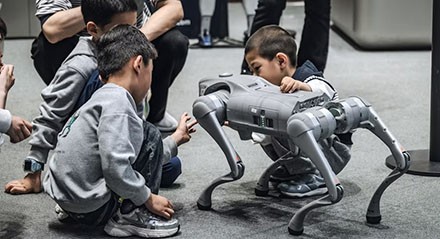
The presentations moved beyond industrial tasks - robotic arms showing dexterity, humanoid models walking down the aisle in bridal gowns, and a waterproof robotic hand operating inside a fish tank. Topsun Bot drew major crowds with a giant humanoid sculpture, while autonomous security vehicles monitored the entrance. Traditional quadrupeds (‘robot dogs’) performed. Some displays, shown online, featured practical applications, such as luggage scanning at mock security checkpoints, shelf-stocking retail units (Galbot G1), and relaxed domestic humanoids lounging on sofas (Robotera L7).
Humanoid football matches were a hit with attendees, highlighting bots competing against human goalkeepers. But I must admit to finding this particular presentation totally uninspiring. The goalkeepers seemed extremely slow in reacting to their opponents’ shots, and the human referee looked as bored and frustrated as I was watching it.
The conference unfolded against a backdrop of tightening trade tensions - all part of US-China rivalry and sanctions, widely seen as targeting Chinese robotics developers. There were other concurrent August events in China, including the World Humanoid Robot Games, also in Beijing, where hundreds of humanoid bots were tested across events ranging from track-and-field to medical sorting. In October 2026 we will have CIIF Robot Show (Shanghai), which will prioritise industrial automation, collaborative robots (cobots), high-precision robotic arms and digital-twin software.
If, like me, you started working with robots in the 1980s, you will remember the limitations of that era. The single-arm robot in the UK’s National Engineering Laboratory was designed to do one task: collect parts from specific, fixed holders in the right order and assemble an electric rotor ready for the next manufacturing operation. The work involved programming the arm’s movements, in assembler code, using sensors/transducers to prevent collisions with people, containers and other objects. All this took place in a cage - not because the arm could escape, but to protect those of us who worked in the lab. A similar arrangement existed in my second robot-related job, at Glasgow University’s Centre for Systems and Control. All these worked at a rather slow pace. So you can imagine my surprise when I read headlines describing robots recording a faster 100-metre sprint time than Usain Bolt’s world record (8.64 seconds, compared to Bolt’s 9.58.)
The combined events in China have initiated considerable debate and raised some important scientific and social criticisms - and, of course, we should also consider the security and military implications of some of the unbelievable advances in robotics technology. In this article I will look at some of the arguments raised about different categories.
Achievements
Iain Hunter, an exercise science professor at Brigham Young University, points out that Bolt and the robot started their sprint very differently. Bolt reacted in just 0.146 seconds using starting blocks, while Tiangong started upright and took almost a full second to get going. Hunter estimates that Bolt would have already been almost two seconds ahead after just five metres.
Park Suhan, a robotics professor at Kwangwoon University, makes the point that robot Tiangong’s quick, short-stepped running style is not really trying to copy how humans run - it is more likely just the best solution, given what electric motors can do. Bolt only needed 41 strides to finish the race; Tiangong needed more than 50.
Parunchaya Jamkrajang, a sports scientist at Mahidol University, thinks the short strides are mainly about staying stable - taking longer strides would make the robot more likely to fall. She says a better test of real progress would be whether robots can do things like change direction, spot obstacles, make decisions and slow down on their own - something they still cannot do at high speeds.
Matt Bundle, a biomechanics expert at the University of Montana, makes the point that human runners get physically tired near the end of a 100m race, but electric motors do not. On the other hand, humans have to stay in control of their bodies, even after hitting top speed. Tiangong, by contrast, just keeps going at speed until it hits a barrier. As Bundle puts it, being fast does not mean much if you end up as “a heap of broken bones” because you cannot stop.
So, yes, the robot, Tiangong, ran 100 metres faster than Bolt - but that does not mean it is actually a better sprinter in the way humans are. Those are two very different claims.
There is also a problem with how these things get measured. The National Institute of Standards and Technology (a US federal agency under the Department of Commerce) started a new project in 2026 to test humanoid robots side by side, precisely because the field does not have good enough standardised ways to compare them. The plan is to test a mix of walking/running with hands-on tasks, and to show basic skills that would actually matter for real business use, not just flashy one-off records.
The following summarises the criticism of the games themselves: if you tune a machine to do well on one narrow test, you can get eye-popping numbers without showing it actually has broad, real-world smarts. These robots are impressive - but what they demonstrate is different from what the spectacle encourages us to believe: not just ‘This robot can run’, but ‘Robots are becoming like humans’ and eventually ‘Robots will replace humans’. Those are three very different claims. The first may be demonstrated directly. The second involves interpretation. The third requires assumptions about economics, reliability, workplace organisation and politics that a sporting demonstration cannot establish.
So, in terms of replacing humans, Associated Press expressed a similar opinion: what actually matters is not whether a humanoid can sprint at 42 km/h on a smooth track, but whether it can reliably handle messy, unpredictable jobs in real warehouses and factories. Evan Ackerman’s 2025 article, ‘Reality is ruining the humanoid robot hype: the obstacles to scaling up humanoids that nobody is talking about’,1 reminds us that four problems have to be overcome before humanoids can scale commercially - demand, battery life, reliability and safety.
A more serious point is about capitalist cost calculation. A factory owner does not normally ask, ‘Can this robot perform the task as well as a human?’ The more relevant questions are: ‘How much does the system cost over its lifetime?’ ‘How often does it fail?’ ‘How much maintenance does it require?’ ‘How much electricity does it consume?’ ‘Does the factory need redesigning around it?’ ‘How many technicians are needed to keep it running?’ And ‘How quickly does the investment pay for itself?’
That changes the significance of humanoid robotics. A humanoid might eventually become technically capable of carrying a box across a warehouse. But, if a wheeled autonomous vehicle can move the same box for a fraction of the cost, the humanoid has not really ‘won’. This also explains why spectacular demonstrations can be misleading. Running, boxing and dancing are impressive demonstrations of control, balance and mechanical coordination, but they are not necessarily demonstrations of economic usefulness. Industrial automation rewards boring reliability more than spectacular versatility. A machine that performs one movement 100,000 times with almost no failure may be economically more transformative than a humanoid capable of performing 50 impressive tasks unreliably. The distinction is between technological possibility and social outcome. Technological determinism treats the sequence almost as automatic: invention→adoption→job destruction.
There are several political and economic decisions between those stages. A technology may exist without being profitable to deploy. It may be profitable in one country, but not another, because wages differ. Companies may automate because labour is expensive, but they may also automate because machinery gives management greater control over the labour process. Governments may encourage automation through subsidies, procurement and tax policy - or discourage particular applications through regulation. That means the claim that ‘Robots are coming for our jobs’ hides the actors actually making the key decisions. Robots do not decide to replace workers: private companies, managers, investors and states decide how technologies will be deployed.
There is also a useful Marxist extension available here. Automation can be understood not simply as replacing labour, but as changing the relationship between capital and labour. Machinery can reorganise the labour process, alter the balance of power inside the workplace, reduce management’s dependence on particular skilled workers, intensify work and create new systems of surveillance and control. So the political question becomes larger than unemployment. It becomes: who controls automation, for what purpose, and who receives its productivity gains?
Key questions
Those who study labour relations keep telling us that the real question is not whether humanoids eventually get good enough to replace workers technically - it is under what conditions companies and governments choose robots over people, which jobs get automated, whose jobs vanish, what new jobs pop up, and who ends up pocketing the extra profit that comes from it.
In China, a study by Yi Xu and Xin Ye, ‘Technology upgrading and labour degrading? A sociological study of three robotised factories’, examined Chinese institutions that had introduced industrial robots against the background of the government-backed drive for technological upgrading and ‘machine substitution’. Their findings complicate the familiar idea that automation simply eliminates human labour. In the factories they studied, production remained semi-automated: workers continued to perform essential tasks alongside and around the machines. Robotisation therefore did not simply replace labour: it reorganised the labour process.
In some cases, workers became assistants to the robots, carrying out tasks such as loading and unloading materials, packaging products, monitoring machinery and intervening when automated processes failed. Crucially, Xu and Ye found that technological upgrading at the level of the factory did not necessarily produce an equivalent upgrading of workers’ skills. It could instead result in deskilling.
Factory C provides a particularly revealing example. Workers designated as robot operators received some additional training and a technical allowance, which appeared at first sight to represent an improvement in their skills and status. Yet Xu and Ye argue that this apparent upgrading concealed a degradation of the actual labour process: much of the operator’s work consisted of assisting and monitoring the robot. Other workers employed around the automated production system received neither additional training nor corresponding improvements in their working conditions.
Xu and Ye describe one important mechanism behind this transformation as “execution substitution”. Instead of necessarily eliminating an occupation altogether, machinery takes over increasingly complex elements of its execution, leaving workers with simpler residual tasks or with responsibility for monitoring the automated system. In highly automated production, workers can consequently become what the authors describe as a “supervising crew”, whose principal responsibility is to ensure that the production line continues running.
This is an important distinction. A technologically more advanced factory does not necessarily produce more highly skilled or autonomous workers. Indeed, the opposite can occur: the production system becomes more sophisticated, while the individual worker’s role becomes narrower, more repetitive and increasingly subordinated to the requirements of the machine. Automation should therefore be understood not simply in terms of how many jobs disappear, but also in terms of how it reorganises the division of labour, redistributes skills and changes workers’ control over the production process.
A related, but distinct, issue arises with newer AI and humanoid robotic systems. Their apparent autonomy can itself depend on substantial amounts of human labour performed elsewhere: demonstrations, teleoperation, data annotation, correction of failures, maintenance and the production of training data. This should not be attributed to Xu’s and Ye’s three-factory study, but it reinforces their broader warning against equating technological sophistication with the disappearance of human labour. Automation can remove human labour from the most visible part of a process, while simultaneously creating or depending upon less visible forms of work elsewhere.
Another paper relevant to the Beijing Games is one by Phyllis Xue Wang, Sara Kim and Minki Kim: ‘Robot anthropomorphism and job insecurity: the role of social comparison’.2
They ran a number of studies on how human-like robots affect workers’ sense of job security. They found that, the more human a robot looked, the more insecure workers felt about their jobs - because they were more likely to compare themselves to the machine. That matters, because the whole Olympics framing anthropomorphises - humanises - the technology. The whole spectacle is built to invite comparison: robot boxer versus human boxer; robot runner versus Bolt; robot worker versus factory worker.
The Beijing event also showcased what China has called the technical architecture: ‘brain + small brain’ fusion. China’s 15th five-year plan explicitly calls for “integrated, embodied AI models and algorithms, combining the large brain and small brain” - meaning high-level cognition (perception, reasoning, language, planning) fused with low-level motor control (balance, locomotion, grasping, real-time feedback), rather than treating cognition and physical control as separate systems. The ‘co-agent’ framework, UBtech (a Shenzhen-based Chinese humanoid and service robotics company), is the flagship example.
Where the AI actually shows up in the hardware, UBtech’s patent portfolio shows that AI is not concentrated in one layer - it is spread across the whole stack: one model handles perception, reasoning, memory, planning and action together - so a robot can understand a task, choose the right tool, spot problems and act, while also coordinating with other robots on the line rather than working alone. Galaxy General’s AstraBrain claims something similar: full-body, full-hand control, running straight from perception to real-time motor response.
AI perception (vision, voice, ‘natural language processing’, ‘simultaneous localisation and mapping’), which allows the robot to build a map of an unfamiliar space (a factory floor), while also tracking its own position within that map in real time - is important. So is ‘light detection and ranging’ (LiDAR) - a sensor that fires laser pulses and measures the reflections to build a precise 3D picture of the robot’s surroundings - used for obstacle detection, navigation and depth perception. LiDAR is the single largest category (28%) of all patents, since perceiving and responding to messy, unstructured factory environments is what actually separates a lab demo from a deployable industrial worker. Navigation and autonomous mobility and motion/control (gait, balance, trajectory planning) are the ‘body’ side. Testing and calibration - life-testing rigs and zero-calibration devices - are the least glamorous patent category, but the most telling: you do not patent a calibration jig unless you are setting up a real production line, not just a lab.
Reinforcement learning (RL) works by trial and error: the robot tries an action, gets a score based on how well it worked (did it grasp the object, did it stay balanced?), and adjusts its behaviour to repeat what earns a good score. The problem for humanoids is that RL needs huge numbers of attempts - learning to walk or grasp this way in the real world would mean thousands of falls and drops per skill, which is slow, costly and hard on the hardware. So almost all training happens in simulation instead, where a robot can ‘fail’ a million times in an afternoon for free.
The catch is the ‘sim-to-real gap’: skills that work perfectly in simulation often break down on a real robot, which has real friction, sensor noise and play in its joints. Much of the unglamorous engineering work - domain randomisation, system identification, fine-tuning on real robot data - goes into closing that gap.
Imitation learning sidesteps some of this by learning directly from demonstrations - either human teleoperation (someone in a virtual-reality rig or motion-capture suit puppeting the robot’s arm through a task) or video of humans performing the task. This gives the robot a good starting policy much faster than RL from scratch, but on its own it tends to be brittle outside the exact conditions it was shown - it can struggle when the object is in a slightly different position than any demonstration. In practice, most labs combine the two: imitation learning to bootstrap a reasonable policy, then RL (in simulation, sometimes fine-tuned in the real world) to refine and generalise it.
Vision-language-action (VLA) models are the more recent architecture, and they are the ones doing the most work toward that ‘intuition’. A VLA takes in an image (or video) of the scene plus a natural-language instruction (‘pick up the red bottle’) and directly outputs a sequence of low-level motor commands - essentially treating ‘what to do next’ as a next-token-prediction problem (the same way as a large language model predicts the next word). The reason this matters is because these models are typically built on top of vision-language foundation models - pretrained on enormous internet-scale image-and-text data, they inherit a broad, semantic understanding of objects and concepts even for things the robot has never physically manipulated before. A VLA that has never picked up a specific model of a coffee mug can still often succeed, because it has generalised visual/semantic knowledge of ‘mugs’ and ‘grasping’ from its pretraining, not just from robot-specific data.
This is exactly the layer UBtech’s ‘co-agent’ system and Galaxy General’s AstraBrain are built around - an end-to-end model, fusing perception, reasoning and action rather than a hand-coded pipeline of separate modules. It is also why the earlier point about UBtech’s patent portfolio matters: 28% of UBtech’s patents sit in the ‘AI perception’ category, precisely because perception quality is the bottleneck for this whole learning approach. It explains the emphasis in Chinese policy documents on data - the training data vouchers: “100 high-quality industrial datasets” as an explicit 2027 target in the AI+ Manufacturing plan - since VLA-style learning is fundamentally data-hungry, and industrial deployment generates exactly the kind of large-scale, real-world, varied-failure data that is hard to get any other way. Mass deployment is not just commercialisation: it is also the data flywheel that makes the next generation of models better, which is arguably the sharpest edge of the ‘diffusion-forward’ strategy, meaning that diffusion itself becomes the training pipeline.
Robots wars
When it comes to political economy, some academics are detecting differences between the approaches of China and the USA to AI and its relationship to robots.
Hao Chen and Meg Rithmire call China’s approach “diffusion-forward AI”. Instead of treating the tech race as mainly a sprint toward super-smart AI, they argue China’s real strength is the government pushing AI out into the physical, real-world economy - manufacturing, industrial robots, and robots with bodies. They point to China’s state-linked investment system, its mix of top-down and spread-out decision-making, and its habit of running industrial policy like a campaign, as key reasons why.
You could read the Games, then, as more than just entertainment - as part of a whole ecosystem the government built on purpose: competitions set benchmarks, companies show off their hardware, universities test their software, the government hands out contracts and subsidies, and whatever works gets fed into real factories.
But there is a tricky economic question buried in there too: does government-backed competition build real, useful tech skills - or does it eventually just cause too much investment, too many copycat companies and way more capacity than anyone needs? That question matters, because humanoid robots might be heading into the same cycle we have seen before in Chinese industrial policy: subsidies→a flood of new companies→a price war - and then only a few survivors left standing.
In addition to jobs, we should be concerned about the use of AI-equipped robots in military operations and in state security … What Beijing demonstrated is potentially more dangerous: the beginnings of an industrial ecosystem, in which AI, relatively cheap robotics, autonomous navigation, sensors and mass manufacturing can be combined with existing military systems. At the World Robot Conference, the Aviation Industry Corporation of China - its main state-owned aerospace and defence conglomerate, responsible for designing and manufacturing military and civilian aircraft - showed work on humanoids intended for aviation-related tasks, including loading missiles onto aircraft and, at some stage, operating aircraft. Other systems demonstrated security, patrol and restraint functions.
Humanoid soldiers are probably the least significant near-term development. The athletic displays showed machines running, leaping and clearing obstacles at a speed and standard that would have been unthinkable just a few years ago. Yet the same machines still struggled with seemingly straightforward manipulation tasks, such as handling tools consistently.
Kaia Glickman, writing in Nature in an article entitled ‘“Robot Olympics” reveal humanoids’ rapid progress - and flaws’,3 draws this distinction well: robots are getting very good at motions that can be rehearsed along fixed paths, while dexterous handling of unpredictable environments remains tougher. That is significant for warfare. A battlefield is close to the opposite of a controlled robotics contest. There is mud, debris, smoke, wrecked buildings, civilians, electronic jamming, deliberate trickery, GPS interference, signal disruption and erratic human behaviour. As a result, a £50,000 humanoid armed with a rifle could often prove less militarily useful than a £2,000 drone.
Even experts focused specifically on China’s military robotics warn that humanoids currently trail behind wheeled, tracked and airborne unmanned systems. Their future value hinges on reliability, power supply, communications, autonomy and whether they genuinely outperform simpler machines. There are, however, credible military applications on a shorter horizon: handling ammunition, logistics, evacuating casualties, clearing mines, standing sentry, reconnaissance, entering contaminated areas, maintaining aircraft and loading weapons. None of these roles demand that a robot make complex decisions about who to kill.
The truly significant development is robotics merging with autonomy, and here we have to mention pre-programmed missiles; however, it is important to distinguish three generations of weaponry:
- Traditional guided weapon: a person selects a target and fires a missile at it. The missile’s onboard computer steers itself towards that specified target.
- Pre-programmed/autonomous weapon: a person defines an area and the characteristics of a target; once launched, the weapon can hunt for something matching that description.
- AI-enabled autonomous weapon: sensors and algorithms read the surroundings and can potentially identify, rank and strike targets without any further human input. This last shift is qualitatively significant.
The International Committee of the Red Cross (ICRC) essentially defines an autonomous weapon as one that, once activated, can choose and engage targets without any further human involvement. Notably, autonomous weapons do not necessarily need modern AI; fairly basic rule-based systems can also qualify as autonomous.
So the real breakthrough is not merely ‘smart missiles’, which have been around for decades. What is new is the possibility of linking together - sensor→ AI identification→ targeting decision→ autonomous platform→ weapon - into a single, increasingly automated sequence. That could reshape the economics of war. This may end up mattering more than what humanoid soldiers can do. China holds an unusual edge here, thanks to its vast civilian manufacturing base for batteries, motors, actuators, cameras, electronics, drones and industrial robots.
The Royal United Services Institute therefore makes a compelling case: China’s decisive edge may not be a single, remarkably sophisticated robot soldier, but rather the capacity to mass-produce autonomous machines. It notes China installed around 295,000 industrial robots in 2024, versus roughly 32,200 in the US, and argues that much of this industrial base can be repurposed for military robotics.
In other words, military strength could partly shift from ‘Who has the best tank?’ towards ‘Who can build and replace 100,000 reasonably capable autonomous systems the fastest?’ That represents a profound strategic shift. It could also give rise to a new kind of ‘mass army’. Industrial-era warfare traditionally relied on mobilising millions of people. Robotic warfare could change that equation. A country with an ageing population might, in theory, deploy vast numbers of unmanned systems without mobilising equivalent numbers of soldiers. And machines can carry out missions that are politically awkward to assign to people, since governments do not face domestic casualties when robots are destroyed.
That could create a troubling paradox: automation might make it politically easier to start military action, even as it eventually lowers the danger soldiers face. There is already talk within China’s robotics industry of future military humanoids. One Chinese developer interviewed at the Beijing Games suggested armed humanoid soldiers could be five to 10 years away. That should be read as one individual’s forecast rather than an official Chinese government timeline, but it shows where parts of the industry envisage the technology heading.
So, for a frightening scenario, picture not a single humanoid robot, but hundreds or thousands of cheap autonomous drones. They are given a broad instruction, such as: ‘Find objects showing specified military characteristics within this geographic area’. They spread out. Their sensors pick up vehicles, radar signals or other signatures. Algorithms classify possible targets. The machines strike matching objects. At that stage, the human commander has authorised the mission, but has not personally chosen every object that ends up destroyed.
This is exactly why the line between automation and autonomy matters so much. The ICRC warns that autonomous systems can leave their operators unable to predict precisely who or what will be hit, or exactly where and when. And bringing machine learning into the mix makes things harder still, since behaviour can become less predictable than with conventional, deterministic software. Here we have a serious risk of escalation.
In science-fiction-type imagination, let us think of China and the US fighting each other with autonomous systems. One AI system flags what it classifies as hostile radar activity. It directs drones to reposition. The opposing system reads that movement as preparation for an attack. It raises its alert level. The first system takes that as confirmation of hostile intent. Humans might have only minutes, or seconds, to step in. So the real danger is not necessarily ‘robots becoming conscious’. The realistic danger is far more mundane: machines behaving exactly as programmed, while the overall interaction produces a disaster nobody intended. Cyber warfare compounds the problem. Military robots bring together communications, sensors, software and computing, creating openings for spoofing, jamming, hacking and manipulation.
Nuclear weapons are where this turns genuinely alarming. There is a vast gap between using AI to help interpret satellite imagery and letting AI into nuclear launch decisions. The ICRC’s current stance is that AI should not be built into nuclear command-and-control in ways that override human judgement, and it is pushing for binding international limits on autonomous weapons, especially those aimed at people. This is no longer a purely theoretical debate. The Stockholm International Peace Research Institute’s 2026 assessment notes that military-AI discussions have widened beyond autonomous weapons, to cover targeting, intelligence analysis and military decision-support systems. That distinction is important. AI does not need to physically press a nuclear launch button to become dangerous. An AI system telling political leaders, ‘There is a 93% probability that these satellite observations indicate an imminent attack’, could heavily sway a human decision made under extreme time pressure.
So I would not read the Beijing demonstrations mainly as proof that ‘China will soon have robot soldiers’. The more important trend is this convergence: AI +cheap sensors +drones +humanoids +autonomous navigation +missile technology +enormous manufacturing capacity. That combination could shift warfare away from small numbers of extremely expensive precision weapons and towards vast populations of relatively cheap, intelligent machines.
And there is an intriguing political-economic angle to this. Industrial capitalism once reshaped warfare by making it possible to mass-produce rifles, shells, tanks and aircraft. We may now be heading into another transformation, in which the manufactured commodity is not just a weapon any more: it is increasingly the combatant itself. That is why what happened in Beijing matters, even though today’s humanoids are still clumsy.
The unsettling question is not whether a robot can beat a human soldier in hand-to-hand combat: it is whether states can produce millions of expendable, autonomous machines, capable of sensing, communicating, coordinating and applying force faster than humans can meaningfully oversee them.