
27.08.2026
Slingshots and arrows
Andy Hannah reviews Luke Kemp Goliath’s curse: the history and future of societal collapse Penguin Viking, 2025, pp579, £25
As a senior research associate at the Centre for the Study of Existential Risk, Luke Kemp is well-placed to write a book about civilisational collapse. Its tone is firmly set within the zeitgeist, ‘We could save ourselves, but I wouldn’t bet the house on it [if the house is still standing!].’
Kemp kicks off by charting the rise and fall of several civilisations - although, as he explains, he does not like the term. It is derived, after all, from the Latin, civilitas, “implying restraint, moderation, and good political conduct”, they have instead delivered “[s]lavery, war, patriarchy, [human] sacrific[e] … crucifixion … or dropping atomic bombs”.
Preferring the term, ‘Goliath’, to identify these structures and systems of violence and domination, he points out that, historically, their collapse is often a blessing - in the longer term - for those at the bottom. Freed from oppression and exploitation, they grow taller, are better fed: eg, stateless Somalia has seen reductions in childbirth deaths, infant mortality rates and instances of extreme poverty. (In the immediate term, as former elites fight to recover their privileges, we often see violence and destruction.)
Of the Goliaths studied by Kemp, the average lifespan is 326 years; for the largest states, this falls to 155 years. These figures, he acknowledges, mask a huge range: from the four years of China’s Later Han Dynasty to over 1,000 years for the Byzantine empire of the Mediterranean.
Interviewed in The Guardian when the book was first published, Kemp argued that these societies are an evolutionary regression from the more egalitarian hunter-gatherer societies that preceded them. In the chapter, ‘Egalitarian origins’, Kemp asserts that this egalitarianism is not “a passive condition, but an active choice” amongst modern foragers, who have “an array of customs and traditions” to enforce sharing.1
He describes how the Ju/’hoansi people of the Kalahari Desert swap arrow heads prior to a hunt; the owner of the original arrowhead allocates the meat from the kill, not the hunter who fired it. The Ju/’hoansi also use counter-dominance strategies - teasing, shaming, ridicule, expulsion - to sanction bullies and those who do not share. In extreme cases, the punishment is death.
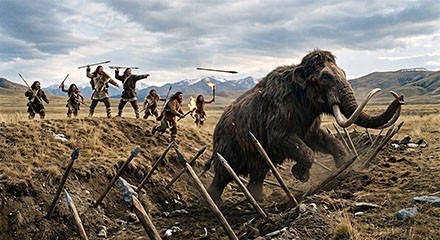
Intriguingly, Kemp identifies an anatomical basis for our innate egalitarianism. Some two million years ago, changes to our shoulder joints allowed for the accurate throwing of projectiles: rocks, spears, and - with a nod to the Biblical giant - slingshot. A big and imposing beast could be brought down by something much smaller. There was a concurrent increase in brain size.
So, if we are innately egalitarian, why do these Goliaths repeatedly arise? For Kemp, they have two pillars: ‘Goliath fuel’ and the ‘dark triad’, each having three elements.
Goliath fuel consists of surplus grain, monopolised weaponry and “caged land”,2 which makes it difficult for people to simply walk away. As Marxists we would recognise the necessity of a food surplus, an armed body of men, and a trapped population for the stratification of society into classes. However, Kemp struggles with the ‘C word’ - I could find no mention of it in the near-600 pages of the book, despite its clear and obvious relevance. A huge and disappointing lacuna.
So what is the ‘dark triad’, the second pillar Kemp identifies? Goliaths, he claims, require rulers who share three personality traits: narcissism, psychopathy and Machiavellianism. Further, “Our corporations and, increasingly, our algorithms, also resemble these kinds of people. They amplify the worst in us.”
So our collective failure to keep in check those among us who are strong in these traits has brought us to where we are today. According to Kemp, that includes Lenin, who, in the pamphlet, Will the Bolsheviks retain state power?, asserts that the “class-conscious workers must lead, but for the work of administration they can enlist the vast mass of the working and oppressed people”. For Kemp, the Russian Revolution was simply the act of one section of the elite replacing another.
He identifies rising and extreme levels of inequality as the internal contradiction that eventually brings these societies down - something we can observe all too clearly today. But, if the fall of Goliath results in freedom and a better life for those at the bottom, should we not welcome this? He concludes not: we live in a highly integrated world of nuclear weapons, climate chaos, artificial intelligence, killer robots and engineered pandemics. Collapse will not be regional and isolated: it will be global and existential.
To his credit, Kemp prescribes ‘radical’ democratisation as a solution to our current malady. However, he remains firmly within the paradigm of capitalist society. We will retain money, but individual wealth should be limited to £10 million! He calls for the use of online voting - a spreading rather than a deepening of ‘democracy,’ something this paper has repeatedly objected to.
Further, while he acknowledges the necessity of socialising the use of violence, he does not follow the logic of that. There is no call for the abolition of the standing army and its replacement with a democratic militia. In the subsection, ‘Democratic control of information and the military’ (chapter 23), he naively calls for the abolition of the US Espionage Act (1917) and greater protection for whistleblowers. Much, much too little.
The book encourages people to “Be a democrat … join a union, join an activist group … advocate for workplace democracy.” All very worthy, but without a party these efforts will be pitiful in their impact. If we are to have any chance of implementing even the limited democratic changes Kemp envisions, we require activists to be organised around a programme which maps our route to the genuine, radical democratisation of society - a communist party, I would argue.
Without that, I fear Kemp’s prediction will come to pass: “I think it’s unlikely [we will avoid collapse]. We’re dealing with a 5,000‑year process that is going to be very difficult to reverse.”3