
30.07.2026
No bans, no coalitions
There are calls to end the ‘firewall’ against the AfD, there are calls to ban it too. Carla Roberts says we need independent working class politics and our own ‘firewall’ against coalitions with bourgeois parties
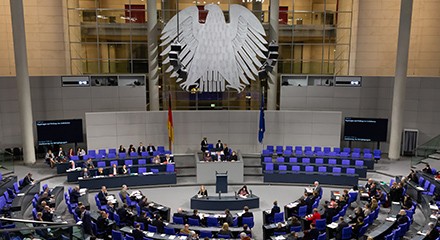
Alternative für Deutschland stands to the right of the establishment parties, though not quite so far to the right as they vociferously claim. Nonetheless, the entire Bundestag establishment rejects - for the moment - “any cooperation” with the AfD, up to and including forming any local, regional or national coalitions. This has been extended to also mean that AfD representatives are not allowed to take up positions usually reserved for the main opposition party, like participation in parliamentary bodies or committees.
Hence, having come second in the 2025 general elections with 20.8%, behind the conservative Christian Democratic Union on 28.5%, the AfD should be able to appoint the deputy parliamentary speaker, for example - but such proposals have been consistently voted down by all other parties. Which means that very few AfD politicians have been put to the test anywhere, where no doubt they would quickly be found wanting.
But that firewall is now crumbling - chiefly because it does not work: the AfD has been leading in the polls for many months, currently on 28%, way ahead of the CDU at 20%, the Greens at 14%, and the Social Democratic Party and Die Linke, both at 12%.1 The results of three forthcoming regional elections in September will increase the pressure on the firewall - in all three, the AfD is predicted to win - and overwhelmingly so, particularly in the two eastern German regions of Saxony-Anhalt (41%, according to the polls) and Mecklenburg-Western Pomerania (38%).
Regional government minister Michael Kretschmer, who runs the eastern state of Saxony and is also the deputy federal chairman of the CDU, is one of a number of politicians who have called on his party to drop the firewall and reverse its 2018 ‘resolution on incompatibility’ (Unvereinbarkeitsbeschluss), which rules out “any coalitions or forms of cooperation” with the AfD - and, funnily enough, Die Linke too, despite the fact that the left is a dedicated upholder of the ‘firewall’ (more below).
Particularly in the east, it has become almost impossible for the mainstream parties not to cooperate with the AfD, particularly given how unpopular the national ruling ‘grand coalition’ of the CDU and SPD is. It has led to some very unstable regional coalitions, as basically all other parties have to get together to stop the AfD from taking office. This crisis of the ruling coalition has just been massively exacerbated by the bizarre resignation of the gay leader of the CDU fraction in the Bundestag, Jens Spahn. He is on the hard right of the party, always keen to flout his Catholicism and reactionary social views, including his support for the ongoing German ban on surrogacy. And then he went to the USA to employ a surrogate to have a child. Well! It took a while for the German media to pick up on the outright hypocrisy, but they eventually did and Spahn had to step down. This latest scandal will have convinced even more voters that none of the establishment parties are worth a dime.
The most infamous policy of the AfD is the pledge to “remigrate” the estimated 250,000 people who are in the country “illegally” - a provocative phrase, but not actually all that different to what the current ‘grand coalition’ advocates. While shouting about ‘AfD fascists’, most political parties in Germany have moved rapidly to the right over the last couple of years, adopting policies to further restrict asylum rules, while promising to radically reduce migration - all in order to try and stop the rise of the AfD.
Greens and BSW
To no avail - unsurprising really, as the establishment parties have proven that the AfD is in fact ‘right’ about the issue. The Green Party too jumped on the anti-foreigner bandwagon, ditto the BSW (Bündnis Sahra Wagenknecht), which split from Die Linke in 2023. Die Linke was the only party that ‘stood still’ on the issue, which massively helped to turn round its fortunes - it stood at barely 3% in the polls at the beginning of 2025.
The issue of migration is, in reality, just a reflection of a much bigger problem. The state of international capitalism and the stagnating EU economy is hitting Germany particularly hard, because, in addition to higher interest rates and declining exports, it remains Ukraine’s biggest financial supporter in Europe. Germany might still be the third largest economy after the USA and China, but it is in “technical recession”2 (defined as two consecutive quarters of declining gross domestic product).
The billions of euros spent on the Ukraine war have made the dire post-Covid economic situation 10 times worse. German industry has suffered greatly from the CIA-directed sabotage of Nord Stream 1 and 2, which supplied the country with much-needed cheap energy. Instead, energy prices have more than doubled - a situation now made worse by the Iran war. The once mighty German car industry is crumbling. Unemployment stands at 6.4%, inflation at just under 3%. The cost-of-living crisis is hitting many people very hard.
And this national picture does not even capture how much worse things are in the east: the “economic strength” there stands at just 78% of the levels of the west3 - that more than 35 years after reunification (which in reality was an annexation and is very much perceived as such, even among young people). This is a fertile ground for the rise of rightwing populism, irrationality and fear of ‘the other’. Unsurprisingly, the AfD does best in the east, where a majority of people also oppose the ongoing financial support for the Ukraine war (unlike in the west, where most people agree with it).4
Incredibly, the AfD is the only party in the German parliament that will even mention that the Nord Stream pipelines were blown up at the behest of the CIA in order to damage Russia’s economy - and it remains the only party that demands that the pipelines be repaired and reactivated. All the others explicitly reject this and the official “goal” of energy policy remains “independence” from fossil fuels from Russia (they’re okay with fossil fuels from elsewhere!). Die Linke has, as always, a mealy-mouthed position of opposing the war and arms exports, but also of “supporting Ukraine”. The party merely demands an “investigation” into the pipeline explosions.
It stands to reason that the AfD’s call to immediately end all German support for the Ukraine war is part of its ongoing success in the polls - as are its demands that Germany should withdraw from the EU (‘Dexit’) and that the euro is abolished. We have seen the same arguments in Britain, of course: the EU is a billionaire’s club, etc. Instead, the AfD wants German billionaires to run German capitalism. Nevertheless, just like Reform, it has managed to present itself as the party for the ‘little people’ - those left behind.
In other words, the AfD is today the main German opposition party in the real sense of the word. It opposes what the government does and is being opposed by all other parties, who have joined the said ‘firewall’. There are regular demonstrations against the AfD, in which all the other parties march together, arms linked: a rogue’s gallery of the entire establishment.
Die Linke
Although Die Linke is a victim of the CDU’s “double firewall”, it proudly supports this establishment alliance against the AfD. Needless to say, it would love to show it can be relied upon to “take government responsibility” and has done so a number of times at a regional level - with the predictable result that its attempt to manage a stagnant capitalism meant it ended up enforcing cuts and closures and was soon enough punished by its supporters. It links any potential participation in national government to ‘red lines’ - but these have shifted quite dramatically over the years, in an attempt to show it can be relied upon to govern.
It continues to peddle the illusion that here could be a ‘two-state solution’ in the Middle East and, while it agreed a resolution at its recent conference that describes the policy towards Palestinians as “genocide”, the same resolution also states that it is “committed to the right of the state of Israel to exist. As a protective space for Jews, the state of Israel has a special historical and current significance.”
Even more self-defeating: just like the Greens, it calls on the state to ban the AfD - and backs this up with its reclassification as a “proven rightwing extremist endeavour” by the vile Bundesamt für Verfassungsschutz intelligence agency. Until 2013, this ‘Office for the Protection of the Constitution’ used to officially monitor Die Linke for exactly the same reasons - “extremism”. No matter - here is Heidi Reichinnek, chair of the Die Linke parliamentary fraction in the Bundestag, commenting breathlessly:
There can be no doubt that the AfD poses the greatest threat to our democracy and our country. Everyone who has advocated - or continues to advocate - the normalisation of the AfD is thereby empowering rightwing extremists and endangering democracy. We must now join forces and use every tool available to our resilient democracy to protect it.5
Jan van Aken, national chair of Die Linke, admits: “I used to oppose a ban, because a ban obviously cannot eradicate the ideology from people’s minds,” he writes in the same press statement, calling them “fascists” in the process. “But when we look at how openly the AfD seeks to abolish democracy, we should not hand them our sharpest weapon - democracy itself.”
Where to begin with this utter nonsense? Banning a party that is supported by up to 40% of the population in some East German federal states is clearly a ridiculous idea and a non-starter. And is the AfD really “the greatest threat” today? What about war? The climate catastrophe? Capitalism itself?
Are 28% of the entire German population really “fascists” or in support of a “fascist party”? While there are a fair number of eccentrics and rightwing nut jobs in the AfD, it is clearly not a “fascist party”. There are no fascist gangs roaming the streets. The AfD does not organise hit squads to break up meetings of trade unionists or communists (not that there are many). In fact, most AfD supporters and voters tend to be rather quiet about their affiliation - so overwhelming is the establishment’s ongoing taboo.
At least on paper, Die Linke commits itself to “overcoming capitalism” and fighting for “democratic socialism” (whatever that means). We would have thought that “overcoming capitalism” goes hand in hand with “overcoming” the German constitution and what passes as ‘democracy’. There have only been two successful bans of political parties in German post-war history: in 1952, the Sozialistische Reichspartei was banned as the successor party of the Nazi party. And in 1956, it was the turn of the ‘official’ Kommunistische Partei Deutschlands. Why? Because it wanted to “abolish the German constitution”. And quite right too.
By standing firmly on the existing constitution, Die Linke exposes itself as utterly inadequate for building a real, radical alternative that is so desperately needed. Surely, a wide swathe of AfD supporters could be won over to a programme that presents a real alternative to this rotten system, unlike the cheap anti-migrant rhetoric of the AfD. But, by calling for a ban, Die Linke shows that it does not believe it could win the battle of ideas.
-
www.wahlrecht.de/umfragen.↩︎
-
www.tagesschau.de/wirtschaft/konjunktur/diw-wirtschaftsprognose-100.html.↩︎
-
www.iwkoeln.de/presse/pressemitteilungen/klaus-heiner-roehl-warum-der-osten-hinter-dem-westen-zurueckbleibt.html.↩︎
-
www.ndr.de/ndrfragt/ndrfragt-mehrheit-gegen-gebietsabtretungen-im-ukraine-krieg,ukraine-2558.html.↩︎
-
www.die-linke.de/start/presse/detail/news/afd-verbotsverfahren-jetzt-auf-den-weg-bringen.↩︎