
04.06.2026
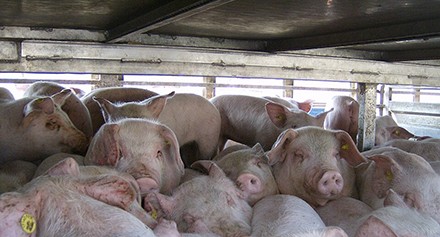
Humans and other animals
Can carnivorous capitalism be ended through moral appeals or alternative technology, or does it require something more fundamental? Jon Hochschartner explores the relationship between the exploitation of animals and the Marxist theory of base and superstructure
For some years, I have been interested in the Marxist concepts of base and superstructure - specifically what they suggest is necessary to achieve animal liberation, and, as a result, where animal activists should be focusing their efforts. I have come to believe protein alternatives, which are identical in taste and cheaper to produce than slaughtered meat, are likely a precondition of widespread animal liberation. Consequently, my activism has been focused on securing public funding for cultivated-meat research.
For those who do not know, the new protein is grown from livestock cells, without slaughter. The technology exists to create cultivated meat, but, for now, it is too expensive to mass-produce. My hope is that, as the base of society changes, as cellular agriculture becomes more efficient than incumbent practices, the superstructure will change as well, allowing broader swathes of the population to accept the ethical case against non-human exploitation.
Still, I am not an academic and a lot of theoretical discussion is over my head. I was curious how others interpreted the ideas of base and superstructure in the context of animal liberation. So I set out to interview various relevant thinkers on the subject. I am incredibly grateful to everyone who took the time to answer my questions - all the quotations below are from those interviews.
While I do not agree with all of the arguments made here, I hope the different perspectives will spark further discussion of what I believe to be an important topic.
Marco Maurizi
Marco Maurizi has taught philosophy and history at the Lombardo Radice Institute and has held seminars in modern and contemporary philosophy at the University of Rome Tor Vergata. His research develops a materialist critique of nature, focusing on the historical and social conditions of domination and the human-animal relationship. His book, Beyond nature: animal liberation, Marxism and critical theory, has contributed to the international debate on Marxism and anti-speciesism, and his works have been translated into several languages.
“If we take the base/superstructure relation seriously, then animal exploitation cannot be understood primarily as an ethical failure or a cultural residue, but as structurally embedded in the mode of production,” Maurizi said. “The use of animals is not an accidental feature of capitalism (or pre-capitalist class societies), but part of the material organisation of labour, food systems, and value extraction. This has two main consequences.”
First, Maurizi did not believe animal liberation could be achieved by ethical argument or individual consumer choices alone. He thought these might have some impact, but this would always be limited, so long as the economic base remained the same. Despite minor and precarious cultural shifts, animals would continue to be exploited, because conditions of the system required it.
Second, strategy must therefore “prioritise interventions at the level of the material organisation of production,” Maurizi said. He added:
This does not mean waiting for a total systemic rupture, but it does mean orienting struggles toward transforming the economic structures that sustain animal exploitation. For example, this implies confronting industrial agriculture as a system of labour exploitation and ecological destruction, linking animal liberation to struggles over land use, food systems and workers’ control, and challenging the commodification of living beings as such.
Therefore, he argued, animal liberation should be seen as part of a wider socialist transformation, not as a movement disconnected from others. Otherwise, Maurizi thought animal activists risked engaging in “ethical idealism”, which would allow the base of society to remain unchanged and accomplish little.
“At the same time, the base/superstructure relation should not be read in a mechanically deterministic way,” he said:
Superstructural struggles (ideological, cultural, legal) can play a real role in destabilising the existing order, especially when they articulate contradictions already present in the base, for instance the ecological unsustainability of animal agriculture. The key is that these struggles become effective when they connect to material conflicts, rather than remaining purely discursive.
Maurizi argued that animal activists should deprioritise consumer-focused strategies and ethical argument. Rather, in his view, they should ally with the labour and environmental movements and focus more on the economic support of non-human exploitation, like subsidies and supply chains:
More generally, let me add that the distinction between base and superstructure remains important, insofar as it helps to move the discussion beyond the ethical abstraction typical of bourgeois movementism and the empirical immediacy of certain anarchist tendencies; however, once this theoretical impasse is overcome, it should itself be problematised. The later Marx no longer relies on these early conceptual pairs in the same way, but rather attempts to reformulate social analysis in terms of totality/universalism vs parts/particularism, and materialism vs idealism. At present, however, the level of debate on these questions remains too underdeveloped for this shift to be widely operative.
Emilia A Leese
Emilia A Leese is an author, rewilder and podcast host exploring the intersections of ethics, food and our relationship with the natural world. After a 20-year career as a corporate finance lawyer, she now channels her strategic insight into vegan advocacy and ecological restoration, the latter with the award-winning Birchfield Highlands. Leese is co-author of Think like a vegan: embracing ethics in a plant-powered world and hosts a podcast of the same name. She said:
If you take the base (economic structures like capitalism) as largely determining the superstructure (laws, culture and ideology), then achieving animal liberation requires first dismantling the capitalist base commodifying animals for profit. Consequently, animal activists should prioritise anti-capitalist strategies, such as building a broad, class-conscious, anti-speciesist vegan movement challenging animal agriculture as a core pillar of the economic system … This means integrating anti-speciesist veganism into a revolutionary ecological framework, treating animal liberation not as a separate moral issue, but as essential to any genuine struggle against capitalist exploitation.
John Sanbonmatsu
John Sanbonmatsu is professor of philosophy at Worcester Polytechnic Institute in Massachusetts, where he teaches courses in ethics, political theory, existentialism and other topics. He is the author of The omnivore’s deception: what we get wrong about meat, animals and ourselves. Sanbonmatsu is creator and curator of the CleanMeat-Hoax.com website, which raises concerns about cultivated meat technology. His writing has appeared in Christian Science Monitor, CounterPunch, Huffington Post, and St Louis Post-Dispatch, among other places. He said:
Capitalism is not just a system for producing material stuff: it is a total way of producing life. As such, the ideas, practices, and beliefs we find dominant in society are in some way given to us by the economic system. Because the latter is organised exclusively around the production of commodities for private profit, we find that cultural beliefs and norms, worldviews, philosophies, religions, and so on, mirror the economic ‘base’ or substructure. We thus grow up with the idea that capitalism is the best system, that free markets lead to free ideas, that anyone can become rich if they set their mind to it, that the state (government) is a ‘neutral’ or disinterested umpire (rather than an institution that serves the wealthy class), and so on. Not to understand this fundamental relation between the production system and our beliefs and values is not to understand society. And without a proper understanding of society, one cannot hope to change it.
Unfortunately, he believed most animal activists do not understand how speciesism is reinforced by capitalism. Under the current economic system, animals become commodities or raw materials of commodities. Further, Sanbonmatsu argued, animal activists tell themselves stories about animal liberation which are influenced by capitalist mythology. He cited common activist beliefs, such as how individual diet change or private philanthropy can achieve non-human freedom, to support his view:
There is no prospect whatsoever that animals can be liberated under a system of general degradation, exploitation and cruelty, in which most of the human race is itself enslaved to a system of forced, meaningless and ecologically destructive labour; in which nature is commodified and destroyed; and in which every incentive for changing our values and way of life run the wrong way. Animal liberation therefore implies the abolition of capitalism as a mode of production, just as an ethical form of democratic socialism necessarily implies animal justice.
Vasile Stănescu
Vasile Stănescu is an associate professor in the department of communication at Mercer University. He is the co-founder of the North American Association for Critical Animal Studies and previously served as co-senior editor of the Critical animal studies book series published by Brill/Rodopi. More information about his research and podcast is available at winforanimals.org. Stănescu said:
I take base and superstructure seriously, but not as a simple one-way model. The economic base matters enormously: animal advocates should focus far more on ending the material supports that keep meat artificially cheap. But the superstructure matters as well, because those material arrangements only work when meat already carries cultural meaning as a sign of prosperity, status and a proper standard of living.
For example, he asked, what was the problem factory farming was invented to solve? Stănescu believed part of the answer was that it was used to ‘buy off’ the proletariat with low-cost meat. Workers received this instead of the higher wages their unions were demanding. He stated:
But here is the interesting part: the idea that meat, as a symbol, represents wealth itself operates at the level of the superstructure. In other words, the only reason the base strategy of making meat cheaper worked as a way of buying off the working class was because of a superstructural idea: meat itself signified wealth. The material strategy only worked because the symbol already had power.
Troy Vettese
Troy Vettese is an environmental historian and post-doctoral fellow at the University of California, Berkeley. He is the co-author of Half-earth socialism: a plan to save the future from extinction, climate change and pandemics. Vettese’s writing has appeared in Jacobin, Bookforum, n+1, The Guardian and Boston Review. He wrote:
I think one should ask, why is capitalist society so carnivorous? If we think through rather basic processes of mechanisation, it becomes clear that certain foods offer more opportunities for relative surplus-value creation - namely factory farmed meat and grains: hence the strange capitalist diet of meat and processed carbohydrates. What people should be eating - organic legumes, vegetables, etc, that are grown nearby - offer fewer opportunities for mechanisation, hence capital is stuck, relying largely on labour rather than fixed capital.
To counter capital’s carnivorous tendencies, Vettese argued vegan food needed to be subsidised at scale. He believed animal activists should support meat-packing unions and anti-trust measures as part of an effort to limit capital’s drive to mechanise production further by deskilling labour and achieving economies of scale.
Katherine Perlo
Katherine Perlo PhD is the author of Kinship and killing: the animal in world religions and various journal articles - the most recent being ‘What is the animal class?’ in Politics and Animals. She is a long-standing vegan and animal-rights campaigner. She said:
Early humans, and today some humans in harsh climates, had to - or thought they had to - kill animals. This generated a whole mythical/religious/moralistic/social superstructure applied back onto the base, in such matters as, for example, rebirth (still attributed to slaughtered animals in Tibet’s harsh climate), divine dominionism and the place of women. And, having got used to killing animals out of necessity, humans went on to do so by agriculture, as it was easier. The process might be summed up as: humans killed animals out of actual or apparent need (base), and then they made excuses for it (superstructure).
Perlo believed this ideological subterfuge was necessary because humans felt guilty about their exploitation of animals. She suggested activists should focus on addressing the moral superstructure by highlighting our common sentience with animals, and not being intimidated by accusations of sentimentality or anthropomorphism. Perlo likened god to a spin doctor of human supremacy and argued in favour of adopting a sort of interspecies ‘golden rule’. She wrote:
As fellow sentient beings, [animals] merit every consideration that we in theory give to fellow humans. All our superstructural morality, western and eastern alike, rests on the altruism derived from common sentience - but, until recently, only from that shared with fellow humans, with the help of the spin-doctor in the superstructure. Time for him to step down onto the base, recognise common sentience as the source of all morality, and join campaigners in urging the public to ‘go vegan’.
Renzo Llorente
Renzo Llorente teaches philosophy at Saint Louis University-Madrid. He is the author of The political theory of Che Guevara and Beyond the pale: exercises in provocation, as well as many articles on political philosophy, ethics and Latin American philosophy. He is also the translator and editor of The Marxism of Manuel Sacristán: from communism to the new social movements. His new book, The political thought of Fidel Castro, will be published soon. Llorente asked:
Is animal liberation possible within capitalism - that is to say, within a system based on capitalist relations of production? I would argue that the answer to this question is ‘no’, in part because I believe that true, or complete, animal liberation requires true, or complete, human emancipation: just as capitalism disfigures and vitiates humans’ relationships with their fellow humans, so too it disfigures and vitiates their relationships with non-human animals.
In the long term, he argued, animal activists should seek to achieve social control of the means of production, which would allow nonhuman-exploitation industries to be radically transformed. With the removal of an individual profit motive, Llorente believed at least one reason to use animals would disappear as well. Further, he suggested the liberation of human beings from capitalism would change us, perhaps leading to a new relationship with our fellow creatures. Llorente added:
As for the short term, or as regards more immediate objectives, animal-rights activists should focus on superstructural questions - our moral and religious ideas regarding animals, as well as the laws and political beliefs that govern our treatment of them. This proposal will only seem inconsistent with a Marxist approach to social transformation if we forget that, as Engels reminds us in some well-known remarks, the superstructure can ‘react back’ upon - ie, shape the development of - the forces and relations of production. In short, changes in people’s moral and religious ideas, and the laws that apply to our treatment of animals, may lead to changes in the uses and development of the forces of production (and, thereby, to changes in the relations of production).
Jon Hochschartner is the author of a number of books, including The animals’ freedom fighter: a biography of Ronnie Lee, founder of the Animal Liberation Front. He blogs at SlaughterFreeAmerica.Substack.com