
14.05.2026
What could have been done?
People, their accumulated class traditions, their militant organisations, their ability to produce and sustain a whole body of strong, capable, far-sighted leaders - that is what makes history. Jack Conrad concludes his series of articles on the 1926 General Strike
When writing history, Marxists quite rightly strive to do more than detail ‘what happened’. There is also ‘why what happened happened’ and, perhaps more importantly, ‘what could have happened’. That is most decidedly the case when it comes to modern history. After all, here we are dealing with the struggles of the working class and our organisations, leaders, political parties, trends, factions, etc.
Needless to say, we are primarily interested in drawing out lessons with a view to revolutionary practice, Marx’s celebrated 11th thesis on Feuerbach setting the paradigm: “The philosophers have only interpreted the world in various ways; the point, however, is to change it.”1
For good reason, cadets at West Point and Sandhurst study ancient military campaigns: the Battle of Cannae, where Hannibal triumphed over much bigger Roman forces; Alexander the Great’s logistics, combined arms tactics and speed of manoeuvre; the battles of Salamis and Marathon during the Greco-Persian war; Julius Caesar’s Siege of Alesia, where he employed circumvallation. Despite the vast technological changes since then, there are many repeating patterns, challenges and available solutions.
When, for example, we study the October Revolution, we do so not in order to make the banal statement that victory was inevitable, because the revolution was victorious. That tells us absolutely nothing. Study is for the purpose of illuminating the past, that almost goes without saying; but, especially with us, there is also illuminating the path to the future. The same goes for analysis of the vastly more numerous valuable defeats suffered by our class, including historic turning points such as the 1871 Paris Commune, the 1905 Russian Revolution, the 1918-19 German Revolution, and, of course, the 1926 General Strike in Britain. Defeat was not inevitable. Other outcomes were achievable. Hence my series of articles.2
There is a very useful cottage industry dealing with the nine days at a local level: Hackney, Stoke, Bradford, Newcastle, Glasgow, etc. Readers will discover all manner of wonderful little details. However, it is the larger picture - the national and the international - that primarily interests us. Why? Because here, and here alone, at the level of high politics, lies the possibility of working class self-liberation.
Such a goal can never be achieved if we act only under conditions where success is absolutely guaranteed - a recipe for resignation, sitting on the sidelines and permanent submission. Knowledge about the momentary balance of class forces is usually partial, sketchy … sometimes it is radically wrong. Often too we are forced into making a stand under circumstances not of our choosing, where we have our backs against the wall, where the enemy is demanding surrender. Do we resist? Or do we give in? Even if underlying objective conditions are favourable, events are driven forward by hope or held back by fear. In a word, the subjective factor always plays a vital role. History is not predestination. It relies on people, above all their accumulated class traditions, their militant organisations and their ability to produce and sustain a whole body of strong, capable, far-sighted leaders.
In that light, we ask ourselves what the Communist Party should have done in 1926 to change what became a strategic defeat into something else. After all, the General Strike did not occur in an historic epoch where socialism was materially impossible. True, given bureaucratic inertia and a Tory government determined to defeat the enemy within, 1926 was far more like our stillborn 1905 than our failed October 1917. Note, Lenin famously called 1905 the “dress rehearsal” or the “general rehearsal” for October 1917. But was it inevitable that our 1926 dress rehearsal had to end in such a disastrous flop? Definitely not.
As the reader will already have gathered over this series, this writer agrees with those in the 1920s, including Leon Trotsky, who stressed the necessity of building the CPGB and therefore the need for a clear understanding of the ‘official’ lefts in the Labour Party and the trade union movement.
Left reformism can never be a force for socialist revolution, because it is organically tied to the pro-state right and therefore the existing state-constitutional formation. Indeed left reformism often boasts of its commitment to the nation, parliament and the rule of law. Its ‘national socialism’ comes via the existing state and is therefore anti-socialism.
United front
Nonetheless, the CPGB was quite correct to fight for a united front with ‘official’ lefts in the National Minority Movement. Here was a way - based on an agreed advanced programme3 - to reach out to the considerable numbers who were under the spell of the likes of Alf Purcell, George Hicks and Alonzo Swales. But such unity should never have involved the CPGB in buttering up ‘official’ lefts and giving them an unearned Bolshevik reputation. These 1926 trade union tops were the Sharon Grahams, the Mick Lynchs, the Arthur Scargills of their day … only considerably to the left. Therefore, the CPGB had to combine unity with criticism. If that criticism meant Purcell, Hicks and Swales breaking from the NMM, then that would have been a price worth paying.
Understandably then, united fronts are usually time-limited. They are a balancing act, a tactic which involves unity with ‘official’ lefts around an agreement to defend, or advance, the immediate vital interests of the working class. Whether negotiated from above or secured from below, the united front offers the communists the possibility of winning the majority: that being our overriding objective. So the united front is a competitive alliance.
There, should, therefore, have been no thought, no toleration of any tendency towards organisationally or politically blurring the distinction between the communists and the ‘official’ lefts: only the Communist Party can “defend the interests of the proletariat as a whole”.4 So the ‘official’ left leaders cannot be treated as if they are quasi-communist, halfway near us, cothinkers, etc. They were being set up in order to expose them.
Naturally, there had to be something in the NMM for the ‘official’ lefts too. It could not be a one-way street that just benefited the communists. The ‘official’ left wanted to be seen as defending, or advancing, the interests of the working class … and thereby maintain their established positions. So, to the extent that within united fronts communists grow their influence, the ‘official’ lefts will be looking more and more for an excuse to bail out.
Open criticism
The CPGB should have been aware, therefore, that such leaders would not only split at some point. They would probably buckle when put to any serious test. More than that, however: the CPGB needed to openly and fearlessly say that in front of the entire working class.
Doubtless honest, necessary, pointed criticism would have been met with indignant, pained, furious outcries from the likes of Purcell, Hicks and Swales. They would strenuously argue that the main task lay in opposing the Tory common enemy; that the CPGB was playing into the hands of the Labour right by attacking them and was thereby inadvertently performing a service for the capitalist class. That unless the communists put their divisive culture of confrontation behind them, learnt to temper their criticisms, present them in a polite, respectful manner, then Purcell, Hicks and Swales would have no choice but to turn their backs on the communists.
The 1926 CPGB certainly feared any such outcome. After all, the loss of such important ‘official’ lefts risked isolating communists from the mass of the working class. JT Murphy, representing the CPGB in Moscow, even wanted to stop Soviet trade unions calling Purcell, Hicks, Swales, etc, “traitors”. Unmistakable signs of opportunism … called out by Comintern (including Joseph Stalin).
Yet the fact of the matter is that ‘official’ left leaders are always prone to sell out. Not simply because of their individual weaknesses, quirks and foibles. Rather it is their social position. The trade union bureaucracy is a privileged social caste that specialises in selling the commodity, labour-power, and which thereby acts as an intermediary between labour and capital. In the last analysis that means even the most leftwing trade union general secretary or president has more in common with the class-collaborationist right than with the working class taken as a whole. Only by subordinating the general secretaries and presidents to the collective discipline of a Communist Party can that link with the right be broken: ie, left trade union officials had to become communists, or be replaced by communists, who in either case agree to abide by the norms and provisions of democratic centralism.
Needless to say, being clear about ‘official’ left leaders does not mean denouncing rank-and-file workers who follow them - that would be self-defeating leftism. On the contrary, the CPGB should have done everything to link itself with, merge with, the militant minority - in the mid-1920s some one million strong - and win their trust, confidence and loyalty. From there it was more than conceivable to convert the moderate majority into a militant majority. The pace, the intensity, the scope of the class struggle ultimately deciding all such matters.
Obviously, in 1925 that meant preparing the working class for the General Strike. Crucially the CPGB needed an appropriate political strategy. That had to centre on what Marx and Engels called the struggle to “win the battle for democracy”.5 A programme that targeted Britain’s lack of democracy - eg, the 1924 rigged election that brought the Tories to power; the monarchy; the established Church of England; the unelected House of Lords; the MI5 and MI6 peddlers of the forged the ‘Zinoviev letter’; the dictatorship in the armed forces; the supposedly neutral BBC, the inferior legal status of women; the division and continued oppression of Ireland … and Britain’s rule over a vast colonial empire, whose population numbered many hundreds of millions.6 In other words, the banner of democracy had to be taken away from the hypocritical hands of Stanley Baldwin, Winston Churchill, David Lloyd George, Ramsay MacDonald and Philip Snowden.
What alternative should the CPGB have advocated to the quasi-democratic monarchical system? A fully democratic federal republic, which to be real has to be defended by the armed people - a strategic salient that opens the way for popular control to be extended to the point where the principle of profit is superseded by the principle of need.
Not for nothing did Frederick Engels say that the demand for the republic cannot “possibly be passed by”. Indeed he called the “democratic republic” the specific form of working class rule, unapologetically naming it “the dictatorship of the proletariat”.7
With that in mind, the 1926 CPGB ought to have had its immediate sights set on a revolutionary provisional government. Not, therefore, ‘All power to the TUC’ - too fearful, too bureaucratic, too lethargic. No, instead of that it should have been temporary power to the councils of action (or anything else that carried sufficient popular legitimacy). Such a revolutionary government would sweep away the old regime, but pledge itself to oversee elections to a constituent assembly, in which communists would fight for extreme democracy. In other words, the coming General Strike had to be politicised constitutionally from the side of the workers, not just from the side of Baldwin-Churchill-Chamberlain.
Party change
The CPGB itself needed radical change. It had to make the transition from a party of revolutionary propaganda to a party of revolutionary action.
The General Strike posed the question of power. It was at the very least a pre-revolutionary situation. All the classic tell-tale signs were there. Baldwin’s government was willing to risk the collapse of social peace because of its determination to inflict a strategic defeat on the working class. That caused divisions within establishment circles. Eg, Randall Davidson, archbishop of Canterbury - accused by the Tories of sympathising with the miners - wanted to read a “conciliatory appeal” on the BBC.8 General manager John Reith banned him forthwith from the airwaves - censorship taken into the very heart of respectable society.
Indeed it is no exaggeration to say that there were deep fault lines above. While Baldwin talked moderately, Churchill hankered after an elected dictatorship, which would wield the big stick not only against the working class, but against the splits and divisions within the ruling class. He was, at the time, an open admirer of Benito Mussolini and fascist Italy. Meanwhile, Lloyd George and MacDonald readied themselves to form a harmonising provisional government appointed by George V. The middle classes were polarised between the counterrevolutionary Organisation for the Maintenance of Supplies and siding with the striking workers. As for the workers themselves, they were quite prepared to bring the country to a shuddering halt in an attempt to impose their ‘proletarian economics’ on the capitalist class - first and foremost the coal owners.
That meant the ruling class could no longer rule in the old way and the organised working class was ready to fight - albeit, to begin with, only with the strike weapon. Faced with such an opportunity, the CPGB should have done everything to ensure that the General Strike became a real “festival of the oppressed and exploited”.9
Our party ought to have, at every turn of events, put forward slogans one step in advance of the masses, so as to facilitate the ‘direct and decisive path’ of the struggle for power. That, in the first instance, meant a ruthless upping of the tempo of its work, and boldly and imaginatively using the nine-month stand-off that began with Red Friday to make strategic, logistical and tactical preparations. Not for an immediate frontal assault - that would have been suicidal: rather for challenging, undermining, delegitimising and eventually replacing the post-1688 constitution and the monarchical-prime ministerial state. That should have been the battle plan.
One of the CPGB’s most talented worker-intellectuals, TA Jackson, was convinced that May 1926 could have been/should have been the beginning of the British revolution. In the second volume of his unpublished autobiography, he says:
It is my considered opinion, in the light of after-happenings, that if the workers of Britain had been equipped with a leadership at all equivalent to their splendid courage, resolution and sense of solidarity, May Day 1926 would have been the opening day of proletarian revolution. Unhappily, history shows us by many examples that, if such a chance is missed, it takes long and many years before it can be induced to return.10
No doubt he was referring to the inadequacies of the Labour Party and the TUC. Not us. The CPGB lacked programmatic clarity; it also suffered from what can only be called organisational amateurism.
The fact that the CPGB’s Workers’ Daily came out once, only to be halted by the blinkered printers’ unions, says more about the communists than it does about the printers. There should have been a network of secret party presses ready in case of government banning, to say nothing of sectional stupidity. Less than 15 years later, this was done.
Douglas Hyde - an unstable CPGB middle-ranking cadre, who bizarrely turned Catholic in the late 1940s - describes, in his apostatical, but nevertheless fascinating, book I believe, the preparations made for the underground printing and distribution of the Daily Worker in 1939-40 - in case “legal facility should be denied us”.11 He says a “duplicate CPGB organisation was created from top to bottom, with a shadow leadership at every level”.12 Hyde goes on to tell how he was instructed to go semi-underground in order to get “printing presses and printworkers ready in all parts of the country”. In that way, although the CPGB might be banned, we could “say illegally what could not be said legally”.13
It is more than worthwhile providing a few relevant details from Hyde. Having rented a “big warehouse” in Acton, he installed “two or three linotype machines, a large flat-bed press, one or two smaller ones, a considerable variety of types and a mass of printing paraphernalia”.14 Besides that, Hyde established other underground printing shops in and around London: one in the East End, one in North London and two in Surrey. Newsprint was stored in a dozen counties.
Given the technology of the day, typesetting was a big difficulty. Papers were made up using hot lead, not our neat PCs and laptops. Six typesetting centres were organised, including one in the basement of a large house in “select Kensington” owned by a titled family. Both footman and housekeeper were CPGB members and they made sure that every Sunday “two printworkers employed in a government print works” could prepare things “in readiness for publishing an illegal revolutionary paper”.15 Similar work was done by Hyde in several other cities, including Manchester and Glasgow.
Did nothing
If the CPGB could carry out such impressive measures in 1939-40, when most of its top figures were already entertaining notions of a reformist road to socialism, then it should have done better in 1926. Of course, it did not do better. Nor did it do worse. To all intents and purposes it did nothing. It was ridiculous that in 1926 the CPGB had to rely on a little duplicated news sheet during the course of what was a historic mass strike. It shows that our party leadership did not regard its paper as its most precious asset - the CPGB’s main weapon. If our leaders - primarily the skeleton central executive committee under acting general secretary Bob Stewart - had been not just committed, but serious revolutionaries, they would have done everything to establish a catacomb of illegal presses.
A high-quality Workers’ Daily that was illegal, but free, would of itself have had an enormous impact. An illegal communist daily that damned not only the Baldwin government, but every denial of democracy within Britain and the British empire, and therefore called for a constituent assembly and (provisional) power to the councils of action, would, in spite of narrow sectionalism and government bans, have caught the attention of the entire population. Even those of a moderate opinion could only but give the CPGB grudging respect.
An illegal communist daily that was fearlessly exposing the passivity of the left reformists and fighting for a mass Communist Party would have sent the TUC right wing into an apoplexy, but would have produced many, many thousands of recruits.
An illegal communist daily, armed with a democratic programme, that was laying the groundwork for an armed uprising to overthrow the anti-democratic Tory regime not least by encouraging the Workers’ Defence Corps to put up effective, concerted, overwhelming physical resistance to police and special constable attacks - that would surely have produced an entirely different outcome, compared to the TUC-led damp squib.
So too would actions designed to disrupt, intimidate and stop OMS scabs. To begin with, that would have meant equipping and training the Workers’ Defence Corps in the use of heavy walking sticks, pickaxe handles, iron bars and the like. But also a stated readiness and willingness to up the ante. There were many soldiers and sailors who were more than sympathetic to the strikers. Rifles and pistols could therefore be easily obtained.
Charles Dukes of the Municipal Workers testifies:
Every day that the strike proceeded, the control and the authority of that dispute was passing out of the hands of responsible executives into the hands of men who had no authority, no control, no responsibility, and was wrecking the movement from one end to the other.16
He was, of course, talking about the communists and their growing influence. That is why he and his ilk sabotaged, collapsed the whole thing after just nine days.
What that posed was the necessity of building, having in place, an alternative leadership before and during the General Strike. CPGB members - especially those on the leadership - should not have waited for revolution to somehow happen by itself, as if TUC intransigence could lead to ‘All power’ falling from the sky. Revolutionary situations arise but revolution has to be made. In 1926 we had a chance to go from a revolutionary situation to making a revolution. Not by naming a date or attempting some sort of minoritarian putsch: but by fully securing leadership over the militant minority and then fighting to win a militant majority.
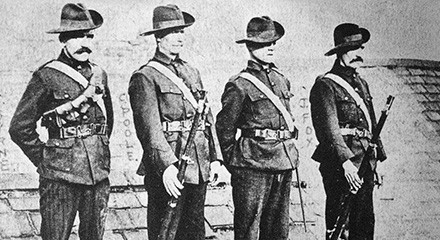
The CPGB could have done well by drawing lessons - positive and negative - from James Connolly and his Irish Citizen Army. Ireland being not only close culturally, geographically and politically but till 1922 an integral part of the United Kingdom. Thirteen years before the General Strike, Connolly helped form the Irish Citizen Army alongside James Larkin and Jack White. This was during the Dublin lockout and was designed to help fend off the violent attacks launched on the workers by the police and scabs. Women drilled alongside men and the ICA greatly boosted morale. The ICA began armed only with hurley-sticks and wooden shafts (‘shoed’ with a cylinders of metal). The police became noticeably less aggressive.
Staging a limited uprising in the midst of general apathy, of course, amounted to revolutionary suicide. Connolly surely knew it in Easter 1916. But to have sent a contingent of 50 tooled-up CPGB comrades and supporters to occupy the Stephen’s House HQ of the hated OMS would have set the situation aflame. So would a mass invasion of the stock exchange. Mainly staffed by middle and upper class volunteers, it would have been a pushover. The government, note, took emergency measures to keep the stock exchange open to reassure markets that for Britain PLC the General Strike was business as usual. A red flag proudly flying over Paternoster Square would have sent an entirely different message.
The same goes if police stations had been successfully stormed and arrested strikers freed. Armouries holding rifles and ammunition would have been ready for our crowbars too. The Workers’ Defence Corps would thereby obtain standard-issue weaponry (it should be added that many workers who served in World War I kept their revolvers as ‘souvenirs’).
Lessons should have also been taken on board from 1905 Moscow. The government was freely and arrogantly moving goods. What about barricades surrounding the London, Glasgow, Liverpool and Hull docks to stop them? The CPGB had enough influence on sufficient local councils of action to make that ‘official’. Mass defiance involving the whole community, not just striking trade unionists, could have been organised. A rent and rates strike would have been a good idea too, along with mass squats of empty properties. The same goes for securing voluntary contributions from local shops and businesses that were given permission to continue operating by the councils of action. In return they would have been provided with protection by the Workers’ Defence Corps.
Calculus
Insurrection is a “calculus”, said Engels, with “very indefinite magnitudes, the value of which may change every day”. “You must,” he went on, “surprise your antagonists”; you must with every day prepare new successes: “rally those vacillating elements to your side which always follow the strongest impulse, and which always look out for the safer side; force your enemies to retreat.”17
If the police tried to break through the barricades with a mass baton charge, they could have been met with a “surprise”. Perhaps a barrage of Molotov cocktails and homemade bombs launched from the building ranged above them. Perhaps hit-and-run attacks by armed fighting squads that take out sergeants and inspectors, but then instantly disappear into the nearby maze of houses and back yards.
If the army was then used in combination with the police, all the better. As a seasoned military commander, chief of staff Sir George Milne was unenthusiastic about the deployment of his troops against the civilian population. Ostentatiously moving tanks and armoured cars through city centres, soldiers standing guard over buses and trains, billeting units in parks - that was one thing. Ordering them to apply lethal force against strikers and their supporters - that was another matter entirely. For the top brass the danger was well understood: a debilitating split in the ranks.
However, their difficulty would be our opportunity. Soldiers’ councils of action, soldiers protecting the General Strike, soldiers obeying our orders, not those of Sir George Milne. The nucleus of a Red Army. The contagion would have readily spread to the fleet too and seen sailors taking over their ships and running up the red flag (as they did in 1919 and 1931).
The TUC right would have furiously denounced the CPGB - guaranteed. No doubt various ‘official’ lefts would have wobbled, recoiled in fear and unconsciously repeated the post-1905 words of the Menshevik leader, Georgi Plekhanov: “They should not have taken up arms.”18 Good. If we were in tune with the fast-developing capabilities, ambitions and hopes of the militant minority, the flow of events could have cascaded in our direction.
The ‘official’ lefts would thereby face a stark choice: stay true to the NMM’s aims and objects - ie, “To organise the working masses of Great Britain for the overthrow of capitalism, the emancipation of the workers from their oppressors and exploiters, and the establishment of the Socialist Commonwealth.”19 That, or they renege, and therefore lose the militant minority to the CPGB.
India, Jamaica, Egypt and other unwilling members of the British empire might well have given the domestic crisis an international dimension with bids for freedom. Ireland should definitely have been encouraged to renew the civil war against neo-colonial partition. Coordination provided by Comintern would, of course, be vital. Our slogan would have been plain and simple: national self-determination.
What the results would have been if the CPGB had fought like Bolsheviks in 1926 is impossible to tell. But I think we can say three things for certain.
First, communists in Britain would have been able to look back and say: we are proud of our tradition; we did our utmost; we gave our all to liberate the working class, using every opportunity history provided; we did not simply wait upon events.
Second, the communist tradition would have become altogether deeper, wider and richer.
Third, subsequent British and world history would have been different - very different.
-
K Marx and F Engels CW Vol 5, Moscow 1976, p8.↩︎
-
This being the last of 13 articles, the first being ‘Approaches to the General Strike’ Weekly Worker January 22 2026 (weeklyworker.co.uk/worker/1569/approaches-to-the-general-strike).↩︎
-
See www.marxists.org/history/international/comintern/sections/britain/subject/minority/nmm.htm. It is worth putting on record that it was our members and supporters who took the initiative in getting the NMM programme reprinted by the Camden Miners’ Supports Group during the 1984-85 miners’ Great Strike.↩︎
-
J Riddell (ed and trans) Towards the united front: proceedings of the Fourth Congress of the Communist International, 1922 Chicago IL 2012, p1158.↩︎
-
K Marx and F Engels CW Vol 6, New York NY 1976, p504.↩︎
-
India had already undergone what Rajani Palme Dutt described as the “second great wave of struggle” in 1919-22 (the “first wave” being 1905-10). The “third wave” could, conceivably, have begun in 1925 or 1926 … not have had to wait till 1930 (R Palme Dutt India today London 1940, p298ff).↩︎
-
K Marx and F Engels CW Vol 27, London 1990, p227.↩︎
-
GKA Bell Randall Davidson, Archbishop of Canterbury Vol 2, Oxford 1935, p1306.↩︎
-
VI Lenin CW Vol 9, Moscow 1977, p113.↩︎
-
Quoted in M Woodhouse, B Pearce Essays on the history of communism in Britain London 1975, p144. This taken from TA Jackson Solo trumpet Vol 2, an unpublished, partially completed, autobiography. The manuscript is held by the Marx Memorial Library.↩︎
-
D Hyde I believed: the autobiography of a former British communist London 1950, p90.↩︎
-
Ibid p91.↩︎
-
Ibid p99.↩︎
-
Ibid p99.↩︎
-
Ibid p101.↩︎
-
TUC General Council Report of proceedings of a Special Conference of Executives London 1927, p58.↩︎
-
K Marx and F Engels CW Vol 11, London 1979, p86.↩︎
-
Quoted by VI Lenin CW Vol 12, Moscow 1977, p108.↩︎
-
www.marxists.org/history/international/comintern/sections/britain/subject/minority/nmm.htm.↩︎