
19.03.2026
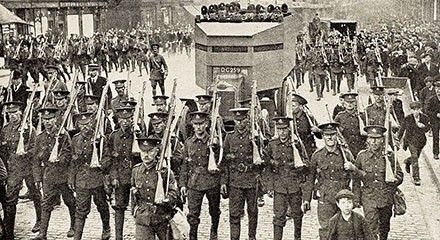
Black Friday betrayal
Marking the centenary of the 1926 General Strike, Jack Conrad charts the delayed birth of the CPGB, the return of the Great Unrest, the collapse of the Triple Alliance and Lenin’s thoughts on the councils of action
Meeting over July 31-August 1 1920, what became known as the CPGB’s First Congress represented the culmination of a needlessly prolonged process of rapprochement. The aim was clear: emulate the Russian, the Bolshevik model. There had to be a revolution-making party.
Initially, two main organisation were involved: the somewhat bigger British Socialist Party and the somewhat smaller Scottish-based Socialist Labour Party. However, after the SLP membership - in a cynically arranged referendum - voted for unity, but against even the notion of considering Labour Party affiliation, its leadership majority expelled the leadership pro-unity minority. Fusion had to be on their terms and their terms alone.
Comrades such as Tom Bell, Arthur MacManus and William Paul proceeded to form themselves into the Communist Unity Group. Its April 1920 conference in Nottingham voted to fully commit to merger (there were 22 delegates). As for the SLP, it withdrew from negotiations and effectively committed suicide as an organisation (publication of The Socialist ceased in December 1922, though it formally wound up only in 1980!).1
Others, it should be stressed, rallied to the CPGB besides its BSP and CUG core components: ie, from the Independent Labour Party, Workers’ Socialist Federation, Guild Communists and more than a good few local groups besides. Indeed, from the early 1920s onwards, the best, the most advanced, working class activists were to be found in the CPGB.
Nowadays, of course, most comrades on the left fail to see the significance of the CPGB and how it was formed. Not only is there the “the enormous condescension of posterity”.2 Some are positively hostile: eg, RS21’s Vik Chechi-Ribeiro.3 Ever ready to parrot Trotsky’s rather shallow criticisms of the CPGB’s shortcomings in 1926, they are sadly incapable of recognising that its formation and subsequent gravitational pull are actually highly relevant, when it comes to the debilitating problems we face today.
Prehistory
Before 1920 what passed for the Marxist left in Britain was divided into rival confessional sects - they usually loathed each other with a passion, but only rarely, if ever, engaged in public polemics. Sounds familiar, doesn’t it? Each constituted their own little thought-world and tried to address the mass of the working class as if none of the others existed. Some were within the Labour Party, some without - the rump SLP and Sylvia Pankhurst’s WSF making it into a principle to be without. Again, it sounds familiar. The BSP sort of (re)affiliated in 1916 - that after the wrongheaded decision to pull out of the Labour Party in 1900-01 (the Socialist Democratic Federation - ie, the early BSP - having two automatic seats on its national executive). Labour being, at the time, basically a united front of the entire organised working class.
All the ostensibly Marxist groups were, needless to say, organisationally weak, theoretically muddled and often laboured under autocratic leaders: eg, in the case of the BSP, Henry Meyer Hyndman. The Tony Cliff, the Gerry Healy, the Ted Grant, the Peter Taaffe of his day. Hyndman’s Marxism was of the pedagogical kind: essentially he thought strikes were a diversion from the need to educate the masses in the ABCs of socialism (that even while his own comrades, such as Ben Tillett and Tom Mann, headed titanic industrial disputes). But - and it should be emphasised - being more than a competent writer, he made a good, logical and popular case for socialism: eg, England for all (1881).
Hyndman financed and tried to run the SDF/BSP as a personal fiefdom. In fact there was some considerable degree of genuine democracy and room for real debate. Branches had a wide degree of autonomy too. Nonetheless, Hyndman and his English nationalism dominated. True, he opposed the Boer war, but blamed it on “a gang of millionaire mine-owners, chiefly foreign Jews” (the cause of some considerable open criticism in the party’s paper, Justice4).
With August 1914, however, he collapsed into the sort of social-imperialism that characterised the Alliance for Workers’ Liberty, Anti-Capitalist Resistance, RS21, Workers Power, etc, with the February 2022 Russo-Ukraine war. Hyndman lost control to the anti-war majority - organised around the unofficial paper, The Call - at the BSP’s Easter 1916 conference … only to walk. He formed the fittingly named National Socialist Party.
The merger of the BSP and CUG produced far more than the sum of its parts. Not in terms of the much exaggerated membership rolls, true. No, to date, the CPGB remains the highest organisational achievement of the working class movement in Britain (not least because of its affiliation to the Third International).
A salient fact that goes unrecognised by the streets and strikes left. Typically their confessional sect is presented as the sole guardian of the flame and is therefore the party - even if only in embryo. Given our altogether dire circumstances, hope - the greatest of evils precisely because it perpetuates such nonsense - is found in the fundamentally false perspectives of Leon Trotsky’s 1938 Transitional programme. The so-called ‘transitional method’ promises the small group that it will rise to glory tomorrow, if it tails this, that or the other mundane grievance, cause or movement with sufficient enthusiasm and energy today. Ironically, that excuses one irresponsible, and often entirely stupid, split after another … and not only by micro groups, but lone individuals too (hence the innumerable sects of one who equally find hope in their commitment to the ‘transitional method’).
Netting the next batch of, usually fleeting, recruits becomes everything, the ultimate aim nothing. Over recent years that has given us cross-class popular fronts, such as Respect, Stand Up to Racism and the Campaign Against Climate Change. Conveyor belts all. Together being just the latest iteration. Then there are the Labour Party mark two projects: Tusc, Left Unity, Your Party.
Seriously committing to building a mass Communist Party, necessarily beginning with the strong foundations alone provided by an agreed minimum-maximum programme and politically going through the existing left to gain hegemony, seems crazily ambitious nowadays. Instead we have endless short-cut offers and the comfort zones of networkism, campaignism and localism. The result is sadly predictable. The left continues to decay and, in terms of consciousness, the working class is increasingly declassed.
That the CPGB founding congress took place in 1920 was a great achievement, obviously. Arguably though, it could have happened a couple of years earlier. The first soundings had already been made in 1918. Unity was held up because of the petty delays imposed by the leaders of the SLP, WSF, the Shop Stewards’ Committees, etc. Despite the urgings of Lenin and his comrades in Moscow, there was proprietorial foot-dragging, pig-headed sectarianism and a litany of “something nasty in the woodshed” complaints about this or that supposedly traumatic experience with the BSP.
Unity was put off time and time again. That mattered. After all, during the final year of World War I and the two years that followed, class struggles in Britain reached an intensity not witnessed since the days of Chartism. The 1910-14 Great Unrest burst back into life with a vengeance in 1918-20.
A Communist Party would have provided a tremendous boost. Had the CPGB been formed in 1918, it too would have been positively affected. Remember both the Bolsheviks and Mensheviks became mass organisations in 1905. The CPGB would have been forged in the heat and fire of a pre-revolutionary situation. Instead, almost from the outset, it had to cope with the hammer blows of reaction.
Individual CPGB members played an outstanding role in the Hands Off Russia campaign. Nonetheless, it has to be admitted, the CPGB’s main contribution, in the shape of The Communist, was effectively limited to issuing a few revolutionary slogans and giving general advice. Even after the party’s 2nd Congress in January 1921, which brought in the Communist Labour Party, Communist Party (BSCI) and left members of the ILP, the content and style of party work remained propagandist: ie, capitalism=bad, soviets=good.5
Strategic thinking, mass agitation and organisation, organisation, organisation was urgently required. The party had to merge with the militant minority of the working class and establish deep social roots. More than possible.6 The CPGB was certainly not held back due to antagonisms between comrades who came from different traditions. Former BSPers and former SLPers seem to have more or less painlessly fused together in the new, higher CPGB identity.7 No, what held back the early CPGB was the common inheritance of economism.
Essentially that meant leaving trade union militants carrying on as trade union militants and a failure to unite the party around the centrality of winning the battle for democracy: ie, abolish the monarchy, republicanism, a popular militia in place of the standing army, separating church and state, supporting Irish freedom, self-determination for the British empire’s colonies, cancelling German reparation payments, women’s equal rights - and specific demands that would help secure working class leadership of the middle classes and strata.
The early CPGB’s economism went largely uncorrected, not least because of the full-scale offensive launched by the government, bosses and bankers. Incidentally, this resulted in numerous arrests and prison sentences. A whole stratum of weak-willed trade union tops deserted the CPGB and thousands of paper members evaporated into thin air.8
Gold standard
World War I and the abandonment of the gold standard showed that capitalism had entered its declining phase. Essential laws remained, but were overlaid by new determinates. The epoch was, concluded Lenin in his Imperialism, one of “transition from the capitalist system to a higher socio-economic order”.9 Free competition and money gave way to monopoly, militarism and organisation. In a perverted, negative way, capitalism anticipated the socialist future.
Total war demanded massive state intervention and the subordination of short-term profits to the needs of the military machine. Prices and returns were fixed by bureaucratic diktat. Gold reserves were freely used by the state to import strategically vital supplies. The link between gold and the currency had to be abandoned. Hard money became soft money.
In conditions of endemic shortage, inflation pushed prices skyward. At the same time, class peace at home was bought in return for allowing the growth of trade unions and giving basic living standard guarantees. Rationing and subsidies kept people alive. As the war dragged on, however, and bled Europe white, social antagonisms inevitably reached the point of explosion.
Ancient ruling houses were blown away: the Hohenzollerns, Romanovs, Hapsburgs. The Austro-Hungarian empire disintegrated. Borders were redrawn. Poland was born again. Economically, Europe was left a shadow of its former glory. Britain’s industrial and banking supremacy dissolved and never returned. Foreign assets had to be sold off to pay for the carnage. Sterling could no longer operate as the hub of the world economy. Germany was reduced from a creditor to a chronic debtor. France, which had been the world’s lender, lost a staggering fortune with the overthrow of tsarism and the removal of Russia from the capitalist global system. Only the US managed to hang on to the gold standard.
Britain emerged from the war victorious. It too, however, had been transformed from a creditor into a debtor country. Economically, its decline was impossible to hide and was only partially offset by continued military strength and an extensive empire - a position paralleled by the US in the 21st century. Though it does not possess a formal empire, the US runs on a black hole of credit and relies on unmatched military power to ensure its global interests.
Besides being in hock to the US to the tune of £8 billion, Britain faced a drive by Germany - desperate to meet the huge reparations demanded under the Dawes plan - to flood the market with cheap manufactured goods and coal. All that, and a determination to put sterling back on the gold standard, meant collective capital was bent on imposing reduced wages, speed-ups, longer hours and welfare cuts. Indeed, re-establishing the gold standard - partially achieved in 1925 and finally abandoned in 1931 - was synonymous with attacking the working class and the attempt to re-impose the strict disciplines of peak capitalism.
Carrot and stick
With all too recent memories of the Hands Off Russia campaign weighing heavily on minds, the ruling class employed both carrot and stick. The Welsh wizard, David Lloyd George, had been the main advocate of the carrot. Politically, the future of his Liberal Party hung on the doomed project of constructing some kind of radical bourgeois party as an alternative to Labour - ie, a leftish populist party. So the great war leader had to keep on promising a ‘land fit for heroes’.
In February 1919 he persuaded the cabinet to finance a reconstruction programme by “giving a probably quite genuine description of the direct action threat within the labour movement”. At £71 million it was, he claimed, “a cheap insurance against Bolshevism”.10 Again, in January 1920, Lloyd George played on fears of revolution to get his way for populist measures.
Thomas Jones, the deputy cabinet secretary, comments, in his well-known diary, that the “PM did a lot of unsuspected leg-pulling, as he does not believe in the imminence of the revolution”. Clearly, though, he could never have gotten away with that “leg-pulling” unless working class militancy was actually perceived as a pressing threat.11 After all, on a number of occasions - eg, January-February 1919, summer 1920 - the cabinet was preoccupied by the working class danger and negotiating political and economic concessions.
In this context, we can also quote Geoffrey Dawson, editor of The Times. Even before the end of World War I he was urging Lloyd George to call an early election, so as to “re-establish the authority of parliament against attempts to ‘hold up’ the country by unconstitutional methods”. Discontent was “due to sheer Bolshevism and not any genuine industrial grievance”.12
As explained above, British capitalism was in no position to keep on giving. Indeed it had to claw back what had been spent on anti-Bolshevik “insurance” and more. The Bank of England’s imposition of deflation finally wrecked Lloyd George’s reconstruction programme and forced him to take up the stick.
The first battle was with the miners. On March 31 1921 they were locked out because of a refusal to accept swingeing wage cuts and an end to national pay bargaining. Naturally, the miners appealed for strike solidarity from their brothers and sisters in the Triple Alliance (rail and transport unions). However, against the threat of what would have amounted to a general strike the Lloyd George government was now determined to face down the enemy within.
Public opinion had already been prepared through a concerted £100,000 propaganda campaign, and free speech curbed. The cabinet issued “instructions” for the “systematic prosecution” of those making “seditious speeches”. The new Emergency Powers Act was invoked. Troops were brought in from Ireland, Malta and Silesia. Machine-gun posts were installed at pit heads.
The National Union of Railwaymen and Transport Workers’ Federation leaders crumbled. Bureaucratic sectionalism proved stronger than bureaucratic solidarity. On April 15 1921 JH Thomas, NUR general secretary, stood on the steps of Unity House and handed waiting reporters an announcement to the effect that there would be no Triple Alliance strike.
Black Friday, as it became known, had a shattering effect. The Triple Alliance had surrendered, before fighting its Waterloo. Criminally, the miners were deserted. After a bitter 11-week lockout, their Fed ignominiously surrendered. With the miners down, one section after another followed. Shipbuilders, engineers, boilermakers, seamen, cotton workers and agricultural workers all suffered wage reductions. There were accompanying gouging organisational losses too. Trade union membership, which had reached a record 8,340,000 in 1920, nearly halved to 4,250,000 in 1923.
A strategic defeat.
Councils of action
Because we have already met them, because we are going to meet them again, it is more than worth repeating Lenin’s 1920 comments about Britain’s councils of action (specifically, its named Council of Action). Besides equating them with Russia’s soviets, he brings out the elements of dual power, but, also, crucially, the complex relationship between Labourite officialdom and the insurgent communist minority. In other words, both Russia’s soviets and Britain’s councils of action contained within them elements of dual power too. After all, the Labourites, just like the Mensheviks and Socialist Revolutionaries, could become the real power in the land without breaking with their unstated commitment to maintaining capitalism.
The specific background was, of course, Poland. Though the Red Army’s offensive failed to rouse the workers of Warsaw into taking revolutionary action, though the Red Army was soon forced to beat a rapid retreat, Lenin had no hesitation in claiming a “great” victory. Winston Churchill’s murderous demand that “Bolshevism … be strangled in its cradle” remained frustrated.13 The British government was compelled to advise Poland to sue for peace. Soviet Russia had been able to check imperialism’s machinations through proletarian internationalism.
For Lenin, a consummate proletarian politician, the Russo-Polish war should not be viewed simply in military terms. There was far more to it than the advance or retreat of this or that army. It was within the higher field of politics that the Soviet republic had won its real victory: a “victory over the minds and hearts of the masses of the workers”.14 As Lenin was never tired of repeating, the proof of that could be seen all too clearly in the Council of Action in Britain - though living on borrowed time, still the world’s number one imperialist power.
Here are Lenin’s two most interesting comments on the Council of Action. The first set of remarks were made in the course of his keynote speech delivered to the 9th Conference of the Russian Communist Party on September 22 1920. Lenin makes the point that, despite retreat from the “walls of Warsaw”, the whole fight to save the revolution had had a “powerful effect on the revolutionary movement in Europe” - crucially Britain, where, with the Council of Action, the movement had been raised to “an unprecedented level”. With hindsight some might suggest that Lenin was wildly optimistic. But that is to miss the point and fall into the trap of ‘what happened had to happen’ fatalism. Lenin was out to lead the masses in making history. He was not dealing in probabilities, but the revolutionary possibilities contained within a given situation. So the main point we should draw from what he had to say is the soviet-like features and inner logic of the Council of Action.
When the British government presented an ultimatum to us, it transpired that it would first have to consult the British workers. The latter, nine tenths of whose leaders are out-and-out Mensheviks, replied to the ultimatum by forming a Council of Action.
Alarmed by these developments, the British press raised a hullabaloo about what it called this ‘duality of government’. It had every reason to say so. Britain found herself at the same stage of political relationships as Russia after February 1917, when the soviets were obliged to scrutinise every step taken by the bourgeois government. This Council of Action unites all workers, irrespective of party, just like our All-Russia Central Executive Committee of the period when Gotz, Dan and others were running things - a kind of association which runs parallel with the government, and in which the Mensheviks are forced to act in a semi-Bolshevik way.
Just as our Mensheviks finally got confounded and helped win over the masses to our side, the Mensheviks in the Council of Action have been forced by the inexorable course of events to clear the way to the Bolshevik revolution for the worker masses of Britain. According to testimony by competent persons, the British Mensheviks already consider themselves a government, and are prepared to replace the bourgeois government in the near future. This will be the next step in the general process of the British proletarian revolution.
Lenin extended these remarks on the Council of Action, and the “decisive turning point” it represented for Britain, during his speech to the leather workers’ congress a week or so later, on October 2 1920. He was quite clearly wrong in thinking that the “old leaders of the British workers” had undergone some sort of a conversion to communism. But he was right to suggest they could play a centrist, Menshevik role, in the event of the Council of Action finding itself the real power in the land:
When the red troops approached the frontier of Poland, the Red Army’s victorious advance created an unprecedented political crisis. The main feature of this crisis was that, when the British government threatened us with war, and told us that if we advanced any further they would fight us and send their warships against us, the British workers declared that they would not permit this war. Let me tell you that Bolshevism is spreading among the British workers. However, the communists there are just as weak today as we were in March, April and May 1917, when we had one-tenth of the votes at conferences and congresses. At the First All-Russia Congress of Soviets in June 1917, we had no more than 13% of the votes. A similar situation exists in Great Britain: there the Bolsheviks are in an insignificant minority.
But the point is that the British Mensheviks have always been opposed to Bolshevism and direct revolution, and have favoured an alliance with the bourgeoisie. Today, however, the old leaders of the British workers have begun to waver and have changed their minds: they were opposed to the dictatorship of the working class, but now they have come over to our side. They have set up a Council of Action over there in Britain. This is a radical change in British politics. Alongside parliament, which in Great Britain is now elected by almost universal suffrage (since 1918), there has arisen a self-appointed Council of Action which relies on support from the workers’ trade unions with a membership of over six million. When the government wanted to begin a war against Soviet Russia, the workers declared that they would not allow it, and said they would not let the French fight either, because the French depend upon British coal and, should this industry come to a standstill, it would be a severe blow to France.
I repeat, this was a tremendous turning point in British politics. Its significance to Great Britain is as great as the revolution of February 1917 was to us. The revolution of February 1917 overthrew tsarism and set up a bourgeois republic in Russia. There is no republic in Great Britain, but her thoroughly bourgeois monarchy has existed for many centuries. The workers can vote in the parliamentary elections, but all foreign policy is conducted outside parliament, for it is in the province of the cabinet. We have long known that the British government are waging an undercover war on Russia and are helping Yudenich, Kolchak and Denikin. We have often met with statements in the British press to the effect that Great Britain has no right to send a single soldier to Russia.
Who then voted for this measure? What act of parliament authorised war on Russia in the aid of Yudenich and Kolchak? There have been no such acts, and by actions like this Great Britain has violated her own constitution. What then is this Council of Action? Independently of parliament, this Council of Action has presented an ultimatum to the government on behalf of the workers. This is a step towards dictatorship [ie, showing the retreat from majority rule, the Communist Party, perhaps even its central committee - JC] and there is no other way out of the situation. This is taking place in Great Britain, which is an imperialist country with 400 or 500 million people enslaved in her colonies. She is a most important country, which rules the greater part of the population of the earth. The advance on Poland has led to such a turn of affairs that the British Mensheviks have entered into an alliance with the Russian Bolsheviks. That is what this offensive has done.
The whole of the British bourgeois press declared that the Councils of Action meant the soviets. They were right. It did not call itself by that name, but actually that is what it was. It is the same kind of dual power as we had under Kerensky from March 1917 onwards: a time when the provisional government was considered the only government, but actually could do nothing of significance without the Soviet of Workers’ and Peasants’ Deputies; a time when we said of the soviets, ‘Take over all power’. A similar situation has now arisen in Britain, and the Mensheviks on this ‘Council of Action’ have been obliged to adopt an anti-constitutionalist course. This will give you some idea of what our war with Poland has meant.15
-
Bizarrely, in my opinion, there are still those on the left who picture the SLP as “the most radically leftwing organisation of its time, with a very impressive record in industrial organising, as well as commitment to Marxism”. Here I am quoting Counterfire’s Alex Snowdon (www.counterfire.org/article/raising-the-red-flag-marxism-labourism-and-the-roots-of-british-communism-1884-1921-book-review). An old thesis dusted off by Ray Challinor in his vastly overrated The origins of British Bolshevism (1977). In truth, while the SLP contained many fine members, it was a De Leonist sect.↩︎
-
EP Thompson The making of the English working class Harmondsworth 1963, p13.↩︎
-
Eg, writing a review of Tony Collins’ Raising the red flag - an interesting, but left sectarian, account of the “roots of British communism” - RS21’s Vik Chechi-Ribeiro writes: “Those advocating for ‘a party’ - ie, an organisation capable of realising the political independence of the working class - should not try to recreate the formation of the CPGB.” The why goes completely unexplained, showing once again that RS21 is, in fact, an anti-party mélange (revsoc21.uk/2024/11/21/raising-the-red-flag).↩︎
-
The likes of Theodore Rothstein launched scathing attacks on Hyndman’s anti-Semitism. See M Crick The history of the Social Democratic Federation Keel 1994, p159.↩︎
-
The shortcomings of the young CPGB were pointed out by Lenin, in self-confessed “bad English”, in his August 1921 note to Tom Bell: “I am afraid,” said Lenin, “we have till now in England [he was referring to Britain - JC] few, very feeble propagandist societies for communism (inclusive the British Communist Party), but no really mass communist movement.” His main solution was to “start a daily paper of the working class” - not as a business, but as “an economic and political tool of the masses in their struggle” (Quoted in A Hutt The post-war history of the British working class London 1937, pp72-73).↩︎
-
Not the view of James Hinton and Richard Hyman, writing back in mid-1970s, when they were either still in or close to the International Socialists (now SWP). They argued that the early CPGB should have been “concentrating on consolidating a small cadre” … not the “illusory pursuit of growth at any cost” (Trade unions and revolution London 1975, p9). Needless to say, we can ignore the loaded phrase, “at any cost”. Hinton and Hyman, like others from the IS tradition, very much admired the SLP.↩︎
-
J Mcllroy and A Campbell ‘The Socialist Labour Party and the leadership of early British communism’ Critique Vol 48, No4, October 2020.↩︎
-
Among the trade union leaders who left were Albert Purcell (FTAT), George Hicks (Bricklayers), Alonzo Swales (AEU) and Arthur Cook (MFGB). As to party membership, James Klugmann, the ‘official’ antiquarian of the CPGB, estimates that in 1922 it was round about 3,000 (J Klugmann History of the CPGB Vol l, London 1968, p198). Despite that, after the 2nd Congress in 1921, the CPGB reported to the Communist International a membership of 10,000. In his Pioneering days Tom Bell explains how this much-exaggerated figure was arrived at: “Our first census, after the Second Unity Conference, revealed no more than 2,000 to 2,500 members. I found that many names given to us as branches only existed on paper. Even when the Scottish Communist Labour Party came in, though they talked of 4,000 members, I doubt if they brought 200 into the party. It was the same when the ‘left wing’ of the ILP came over. They talked of tens of thousands; in point of fact, they too, only added one or two hundreds. But it was difficult to reach final conclusions: each section protested, insisting on its membership as given. That is why the figure of 10,000 got into the records of the CI as the membership of the CPGB in 1921” (Quoted in J Foster ‘Imperialism and the labour aristocracy’ in J Skelly (ed) The general strike: 1926 London 1976, p197).↩︎
-
VI Lenin CW Vol 22, Moscow 1977, p266.↩︎
-
K Middlemas (ed) Thomas Jones: Whitehall diary Vol 1, Oxford 1969, p80.↩︎
-
Ibid p101.↩︎
-
J Wrench Geoffrey Dawson and our times London 1955, p159.↩︎
-
VI Lenin CW Vol 31, Moscow 1977, p272.↩︎
-
Ibid pp277, 306-08.↩︎