
05.03.2026
Labour on the ropes
After the Green victory in Gorton and Denton, things look grim for Sir Keir Starmer’s Labour government. But class strategy needs to be central, writes Paul Demarty
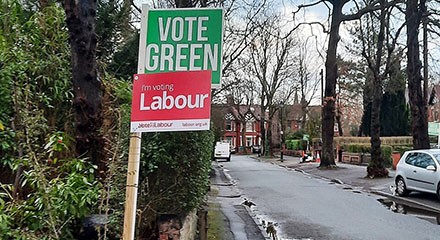
In the end, it was not even close. What was predicted by opinion pollsters to be a tight three-horse race in the Manchester’s Gorton and Denton constituency ended in a thumping victory for Hannah Spencer of the Green Party, with 40% of the vote.
That left a distant second-place finish for Matthew Goodwin of Reform, on 28%, while Labour’s Angeliki Stogia - a local councillor and former lobbyist - wheezed into third, on 25%. Neither the Tories nor Liberal Democrats came anywhere near retaining their deposits. More humiliation for Kemi Badenoch, then; but the real humiliation is for Labour and its embattled leader, Sir Kier Starmer.
As has been widely noted, this is the worst possible result. Ideally, of course, Stogia would have won; a by-election victory at this time, with scandal after scandal assailing the government, would have been quite the tonic. Failing that, a Reform victory with a split Labour/Green vote would have at least backed up the strategy, such as it is, that Starmer adopted from his now-departed henchman, Morgan McSweeney, to turn politics into a straight choice between Starmer and Nigel Farage (‘Vote Green, get Reform’).
Spencer’s convincing win makes all that look a little silly. There was perhaps never a danger of Goodwin sneaking in, given the nature of the seat; and in any case, as it turns out, the Greens were in the better position. The dynamics of by-elections in general - an opportunity for voters to punish unpopular governments without serious consequence - should perhaps have encouraged some caution. It turns out the Greens can win; they can turn out canvassers by the dozen (soon they may even have more members than Labour); and, even allowing for the special circumstances of by-elections, they are presumably now a threat to Labour in its remaining urban strongholds like Manchester and London.
Disaster labour
This is a disaster for Sir Keir, and unfortunately for him, a disaster largely of his own making. He made McSweeney into his Svengali, committing him to entirely cynical and negative campaigning, when it comes to shoring up his left flank. He hired Peter Mandelson as US ambassador. He prevented Manchester mayor Andy Burnham, who would have had a much better chance of winning than the anonymous Stogia, from standing, in order to head off a likely leadership challenge.
It is unsurprising, then, that his response has been simply to robotically repeat all the lines of attack that have been so badly shaken by this result: what else could he say without self-incrimination? He reminds us, alas, of Saddam Hussein’s information minister, insisting on state television that the American invaders were being repelled, even as Abrams tanks rolled by in the background. Absent a miracle in May’s elections, he surely cannot last much longer in No10.
Turning to Reform for a moment, this was not in fact a bad result for it - not that you would know it from the appalling grace shown by Goodwin after his defeat. Reform completely devoured the Tory vote, as noted, further burnishing its own credentials as the ‘real’ party of opposition. It gained, in fact, significantly more votes than Reform and the Tories got together in 2024, on a very similar turnout, suggesting that it did, indeed, manage to grub a fair few votes from Labour. This was not a target seat for Reform: its substantial Muslim population is something of an obstacle, especially if your candidate is a smug, racist charisma-vacuum, whose principal occupation these days is bloviating on GB News.
Yet to listen to Goodwin, you would think Reform had been robbed. “I don’t think the progressives beat us,” he huffed on Friday morning. “I think the progressives were told how to vote and I think what you saw was a coalition of Islamists and woke progressives that came together to dominate the constituency.” This amounted to a new “dangerous sectarianism” in British politics. This line was repeated, bizarrely, by the Tories and even Labour before long.
The evidence for this seems basically to be that the Greens printed a leaflet in Urdu denouncing the slaughter in Gaza - for shame! - and a few unconfirmed reports of “family voting” (basically the paterfamilias ensuring that the wife and kids vote ‘correctly’), hotly denied by the local polling station staff. For all we know, there was some of the latter. It has long been a perfectly routine piece of political chicanery in large cities with significant migrant populations in all countries that have such cities and also hold elections, and would be quite familiar to Boss Tweed of Tammany Hall. As for the Urdu leaflet, this amounts to a complaint that the Greens … campaigned for votes.
If it were just Goodwin, it would not be terrifically interesting: basically an instance of a racist complaining that the electorate includes the people he spends his whole life decrying as a dangerous alien element. The adoption of this attack by Labour and the Tories suggests that this will become another mechanism to delegitimise opposition to the Gaza genocide (and the fresh horrors unfolding in Iran) and keep any disloyalty to Washington, real or perceived, firmly off the electoral menu when the general election rolls around. One to watch.
Class first
The Green victory, in the context of its left shift under new leader Zack Polanski, will be widely welcomed on the wider left. The Socialist Workers Party called for a Green vote, as in the end did both Jeremy Corbyn and Zarah Sultana of Your Party. Many other organisations could be named. But it is not altogether surprising. Given the botched launch of YP, it is the Greens who have been most successful in hoovering up the scattered remnants of Corbynism.
Our organisation did not call for a Green vote - in fact, we called for a Labour vote. Had there been a plausible leftwing candidate, then we would probably have supported them, but there was not (Hugo Wils, of the eccentric left-Zionist Communist League, came last). This comes down in the end to the centrality of class for the communist project - and, while we doubt we could have swayed many votes one way or the other in Gorton and Denton, the class question makes the spate of socialist enthusiasm for the Greens deeply problematic.
The Greens are a petty-bourgeois party. By this we do not mean, in ‘prolier than thou’ fashion, that it is dominated by ‘studenty types’ (who isn’t these days?), but that it is literally a vehicle for small business owners. Where it has gained power municipally, it has governed perfectly in accordance with this background, in the interests of sections of the local petty proprietors. Indeed, despite widely being described as ‘working class’, presumably on the basis that she does manual labour and speaks with a northern accent, Spencer is petty-bourgeois - a self-employed tradeswoman with a not-too-shabby property portfolio on the side. We look forward to her filling out the MPs’ register of interests.
The leftism of Polanski is widely, and adequately, described as “eco-populist”. It would be no surprise to find him pitching it under the name ‘eco-socialism’, and it would not be totally unfair for him to do so - many strange things have gone under that name over the years. ‘Populism’ is better, however, because its basic actors are the elite and the ‘people’ - what the Occupy populist movement used to call ‘the 99%’. That is precisely a class amalgam, which does not distinguish between the class components of the plebs - principally proletariat and the middle classes (including the petty bourgeoisie).
It is perfectly standard Marxism, back to the days of the Second International and beyond, for the proletariat to fight for leadership over the intermediate strata. The shape of such leadership is roughly that we ought to convince these layers that working class rule will be better for them than rule by the big capitalists and landlords, that they will enjoy fuller democracy and a better standard of life, and will not need to fear the wolf at the door. It may further involve strategically justifiable political concessions to the middle classes.
What it cannot do is side with the middle classes where their interests collide with those of the proletariat. It is not in the interests of the petty bourgeoisie, for example, for there to be strict limits to the working day and a high wage-floor. They will have to foot the bill, in the case of their own employees. Nor is it necessarily in the interests of the petty bourgeoisie to socialise the commanding heights of the economy: nationalisation of the banking system will make credit more easily available, sure, but it puts a hard ceiling on success. The American-style story of a company starting in the founder’s garage and growing into a world-bestriding conglomerate is decisively closed off.
When leftwingers tail the likes of Polanski, they make the mistake of forgetting the basics of their own socialist programme. The case of a sentimental pacifist like Corbyn is perhaps different (indeed, given the projects they actually pursue, it is not clear that disunity between the Greens and the right wing of Your Party is at all principled …), but for the SWP - always ready to sing you a song of workers’ self-activity and ‘socialism from below’ - it is a matter of incoherence.
Hard choices
What justifies it explicitly for the SWP, and implicitly for many other organisations, is that the Green Party is where the action is. Newly radicalised layers flock to it; they are inspired and raring to go. They want peace; they want to fight racism; they want a less exploitative and ecologically ruinous economy, and indeed many will quite happily consider themselves socialists on that account. They are our kind of people - at least by instinct.
And, truly, they are! Yet if they are to stay involved in radical politics, they will face political choices; and those will by definition close off certain avenues. For a Marxist, the ‘small is beautiful’ comfort zone of Greenism is essentially a utopia. Climate change itself poses problems of global economic coordination. It is not impossible for some kind of principled socialist organisation to emerge in some way from the Green Party (the Communist manifesto itself was adopted by an organisation that began as a Christian-utopian outfit, after all), but for it to do so will entail splits - and splits along class lines.
Simply following them now because they are popular militates in the opposite direction. One does not want to be disruptive to such a dynamic movement. But the point of Marxist politics is to take a longer view - a strategic perspective that will outlast multiple political cycles, and give us the strength of mind to (for example) pursue a political line to the point of forcing splits, in the interests of firmer and more effective unity in the long run.
The lack of a long view plagues far-left opinion on the Labour Party. It was a truism, in the Tony Blair years and after, that the party had lost any remaining working class character, and should be shunned entirely, in favour of initiatives outside it. With Corbyn’s leadership, that perspective was violently reversed (although the likes of the SWP still kept their people out). Now, with Starmer in charge, we are back to Blair mode. All the way along, Labour has retained the affiliation of the trade unions, and, of course, its name - as Mike Macnair has put it, the shadow of the idea of a workers’ party. We need to approach it strategically, not purely on the basis of vibes.
Labour will probably recover somewhat before the next general election. The threat of Reform, or ‘Reformified’ Toryism, will weigh more heavily under those circumstances. Further fragmentation of vote shares will make things deeply unpredictable under our electoral system. The same fundamental obstacles to independent working class politics will remain.