
26.02.2026
Not just a feudal relic
It is not enough to exploit occasional royal scandals, let alone adopt monarchical socialism, argues Paul Demarty. The left needs to consistently advocate a democratic republic as a matter of basic programmatic principle
Since he was humiliated and stripped of his titles, the disgraced prince, Andrew Mountbatten-Windsor, has been doing his best to keep a low profile. He has been hiding out on the Sandringham Estate in Norfolk, where King Charles had banished him. We assume he was waiting for the latest phase of the Jeffrey Epstein scandal to leak out of the news cycle.
Small chance of that. The release of millions of documents by the American justice department all but assured an unending drip-feed of embarrassment for the men who called Epstein a friend and, sooner or later, something bad was bound to come up with Andrew’s sweaty paw-prints all over it.
Thus the remarkable scenes last week: police banging on the door, to request some hours of his company at the local police station, in the chocolate-boxy market town of Aylsham. We have all seen the now-famous photograph of him sinking into the back car-seat, stony-faced. The red-eye effect of the flash, alas, rather calls to mind the various snaps of Andrew in the company of young women at Epstein’s various soirées.
That is probably not the reason the cops are interested, however. He is being investigated for “misconduct in public office” - the public office in question being his former position as a trade envoy. This particular sinecure was the bright idea of the Tony Blair government - although one man who, apparently, was not so convinced of the wisdom of the plan was Charles, who, according to Mountbatten-Windsor’s biographer, Andrew Lownie, discreetly advised the government that his younger brother would spend his time abroad “playing golf and chasing women”.
So, indeed, it largely proved. On one memorable occasion in 2016, again according to Lownie, Andrew booked out an entire floor of a Bangkok hotel, where he received visits from no less than 40 prostitutes in the space of a few days. He was in town to pay his respects to the recently deceased Thai king - grief can do strange things to a man’s appetite, we suppose. His expenses in the role were consistently lavish, while the ‘benefit’ to the British exchequer remains unclear.
He also, however, fancied himself as a mover and shaker in the global elite. His preferred company was new-money rather than old. His dealings with the Nazarbayev clan in Kazakhstan attracted notice, when a junior member paid Andrew £3 million over the asking price for one of his many houses. He was also chummy with various arms dealers.
His emails with these people, however, remain private - not so those with Epstein. These contain extremely rapid notifications from Andrew to Jeffrey about his schedule on the trade-envoy circuit. In one notable case, in 2011, he forwarded Epstein a secret government document concerning unspecified “investment opportunities” in Helmand, Afghanistan, then under the administration of the British. Some of the profit on these investments would, of course, come from those UK government funds. (Meanwhile, Andrew took great pleasure in squandering on bunga-bunga parties and so forth.)
Needless to say, trade envoys are not supposed to do that. They are bound by the same confidentiality rules - not to say the various official secrets acts - as ordinary civil servants. This is the ‘misconduct’ spoken of by the police, and we shall see if charges arise. Peter Mandelson, whose habit of leaking confidential information had already been discovered, has since also been arrested on suspicion of the same crime. (Both men, needless to say, strenuously deny all allegations against them.)
Now, of course, insofar as trade envoys really are seriously engaged in drumming up business for Britain, some of the more eye-catching items on Andrew’s résumé are just par for the course. Britain has not been terrifically choosy about its trading partners since the end of the empire. Corruption is simply the lubricant that allows this to take place; every splashy announcement is preceded by countless discreet gentlemen’s agreements, and no doubt a little something is creamed off the top by an army of middlemen. Notoriously, the al-Yamamah deal for arms sales to Saudi Arabia was very likely obtained by extensive bribes paid to the Saudi royals and their agents - Blair canned the investigation on national security grounds. There is no reason to suppose it is not representative.
On the whole, though, it is a good idea not to get caught. The key word is ‘discreet’, and history has not produced a less discreet man than Andrew Mountbatten-Windsor for centuries. Even by the standards of his family, Andrew is a bad egg: conceited, mean-spirited, venal, lecherous and, above all, unfathomably stupid. They say you should be nice to everyone on your way up, because you’ll meet them all again on the way back down. Andrew’s disgrace is a perfect illustration: Lownie gleefully hops from interview to interview with stories like his Bangkok funeral entertainments, because there are no end of former flunkies desperate to dish it on their hated old boss. We suspect that the Thames Valley police phone lines are now jammed with such people desperate to make witness statements.
Andrew could never have taken that advice, however, because the concept of ‘the way down’ was foreign to him - of course it was: he was a prince! And they don’t go down in the world. They move up the line of succession until they are removed from it conclusively by Old Father Time. While we remain sceptical, to say the least, that Andrew’s disgrace is a mortal threat to the monarchy - of which more below - what has befallen him now is near unthinkable. He is the first royal to face arrest since Charles I, for whom the whole thing ended famously badly.
Stuart dignity
Charles Stuart, to give him his due, did his best to maintain his royal dignity on the long road to the scaffold. He contemptuously rejected the right of the commoners to put him on trial. On the day of his execution, he put on an extra shirt, so as not to be seen shivering. Royalists, however bruised they were by defeat to the parliamentary army, could take heart from that and regroup, as indeed they did. Andrew’s connection with Epstein has been harder on today’s monarchists. They must face the reality that the institution protected him, again and again, and particularly the late queen, Elizabeth. They had already shielded him from countless sex scandals over the years: what did another one matter?
Not the first
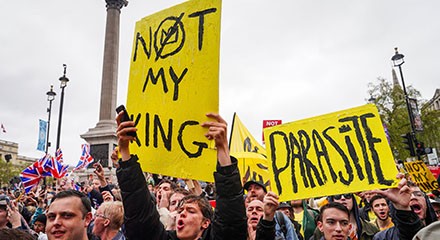
So, we read in opinion polls, the monarchy is viewed with increasing scepticism among the general population, though a plurality still favours retaining it. On the other side, Republic - the principal anti-monarchy campaign group - has taken a victory lap, since it had threatened a private prosecution that maybe prodded the cops into action.
Yet this is hardly the first time the royal family has faced sex scandals, which are as old as the mass media itself. There surely must have been a few financial scandals in there too. And such scandals alone do not bring down load-bearing institutions of the constitutional order: that is the domain of politics.
We wish to emphasise ‘load-bearing’ here. The royal family has its archaisms, but it is a perfectly ‘contemporary’ institution. It is the focus of the loyalty of the armed forces, the civil service and the intelligence apparatuses. Its powers allow governments to act with impunity in what, in theory, ought to be parliamentary matters. It anchors the acceptable range of political opinion in parliament, whose principal actors are, after all, his majesty’s government and his majesty’s loyal opposition.
The republicanism of Republic - which seeks to replace the monarch with an elected president - confronts this load-bearing nature in one way: by trying to keep the overall edifice standing and shaving off the remaining archaisms, such as costumes, religious rituals and vast landholdings at taxpayers’ expense. What would result is a monarchical presidency - more or less the default mode of ‘republican’ government in the advanced capitalist west (though there are exceptions).
For genuine socialists, this is plainly not adequate. We seek a radically democratic form of republic, which entails the overthrow of the constitution as it stands. That includes the army, the Lords, even the civil service - and, of course, the deeply undemocratic norms that govern parliament (but perhaps we will keep the name, as a nod to the heroes of the 1640s).
Yet in reality it is a constant struggle to get the left to take any of this seriously. Of course, during scandals like the present one, we get ‘Abolish the monarchy’ copy flying around. The same when it comes to, say, the death of the late queen. Where else? Where was the republican propaganda, when military sources leaked to the bourgeois press that they would not “stand for” a government led by Jeremy Corbyn? Where is the ongoing appreciation of the monarchy’s structural role in the creaking British ship of state?
ACR monarchists
We are reduced to this republicanism of opportunity, as you might call it, because - except in moments of deep scandal like this one, and the one that followed the death of Diana Spencer in 1997 - the monarchy remains generally popular. Those favouring its abolition make up 20%-25% of the population only. For leftwing organisations focused above all on getting the ball rolling somehow, this makes open republicanism an embarrassment. We can be grateful, perhaps, to the rapidly-degenerating cadre of Anti-Capitalist Resistance, for spelling it out. In the words of Dave Kellaway:
Socialists have correctly not attempted to push a republican position onto broad movements like the Corbyn project, for instance - the 2017 manifesto do [sic] not call for a republic. Given the existing majority for the monarchy, insisting on the broad movement to adopt such a position would not progress the struggle. However, we can raise demands that constitutionally and economically weaken the Royal Family’s hold. Constitutional change should remove the powers the monarch retains, while retaining some ceremonial vestiges. The civil list could be severely cut, too.1
ACR is, to be sure, an organisation unusually afraid of its own shadow. These are the ‘socialists’, after all, that demand that any broad front they join does not talk about socialism, in order not to alienate people. We could ask comrade Kellaway: why not then adopt a restrictionist immigration policy, since the pro-migrant politics of the left are currently deeply unpopular? The answer, I expect, would be that this would cross a red line; but then the red lines are just a bunch of shibboleths (to be discarded when one has made peace with doing so).
It would be better to defend migrant rights, because it is in the interests of the working class to organise native and migrant workers together, not on the basis of some moral hunch; and it would be better to fight for a republic, because the working class can only rule under such arrangements, regardless of the present popularity of the demand. We should not ignore the current state of political opinion, but only because it is necessary to convince people to change their opinions.
Declaring in its public press ACR’s intention to mislead people about its politics is its own, special, Mountbatten-Windsor level of stupidity.