
19.02.2026
Marxist or liberal foreign policy?
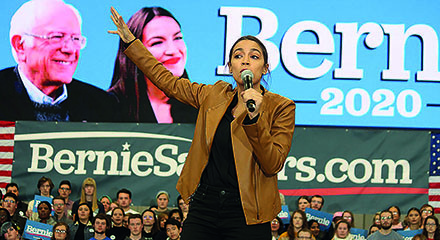
Alexandria Ocasio-Cortez has made a splash at the Munich security conference with a ‘left’ defence of US power, writes Paul Demarty. Can the Democratic Socialists of America hold its elects to account?
It is a strange event on the foreign policy calendar, but the annual Munich Security Conference has long been a bellwether for shifting alignments among the advanced capitalist countries.
First conducted prior to the assassination of John F Kennedy (1963), it has attained a particular salience in the last few years, as a very public occasion for humiliation of the European powers by the rather vulgar Trumpite faithful. Donald Trump’s grievances with Europe are well known: he despises the Europeans for personal disloyalty, and for their parsimoniousness in regard to defence spending (which he expects, not unreasonably, will go in the end to American industry).
Vice-president JD Vance’s speech to last year’s event was received with icy horror by the assembled European dignitaries, while this year’s keynote from the more old-fashioned neocon, Marco Rubio, was met with a standing ovation, but in substance the message was the same: Europe must be capable of ‘self-defence’ - yet all the means of self-defence somehow come with ‘Made in the USA’ stamped on the side!
There are good reasons to be sceptical of the sincerity of the ovation, of course. There can be few among the European elite - even as degraded as it is today - unaware that American interests in Europe are increasingly extractive. Behind the public fawning, no doubt more frank conversations take place between the principal players, which might result in a more defensibly antagonistic European posture some years down the line. Yet the top line remains as it is: Europe is unable to detach from Ukraine and, because of that, is unable to detach from the United States - and, because of that, the US is going to rinse Europe for all it’s worth.
Judgement
This is the necessary context for the speech of Alexandria Ocasio-Cortez at a Munich panel on ‘populism’. It ranged widely, and she made a point of criticising the worsening inequality in various western countries, including in the US. The result is the present foreign policy of her country:
They are looking to withdraw the United States from the entire world, so that we can turn into an age of authoritarianism, of authoritarians, that can carve out the world, where Donald Trump can command the western hemisphere and Latin America as his personal sandbox, where Putin can sabre-rattle around Europe and try to bully our own allies there.
\
For AOC, the objective is a rules-based international order - but for real this time. The old “hypocrisies” were corrosive: “Whether it is kidnapping a foreign head of state, whether it is threatening our allies to colonise Greenland, whether it is looking the other way in a genocide, hypocrisies are vulnerabilities, and they threaten democracies globally.”
While in town, AOC also made time for a chin-wag with various social democratic functionaries - apparently to give them advice on getting the youth excited. She further met with representatives from Die Linke. The SPD junket is more eye-catching, given that august party’s total commitment to Atlanticism (at least in public); Die Linke seems more her style - but, of course, its foreign policy has been completely nerfed in recent years by the opportunism of its leaders and dirty tricks on the part of its substantial antideutsche caucuses.
There is much to object to here, and we will get to it, but one must first ask what AOC is up to. Her political judgment of late has been, let us say, questionable. When Joe Biden’s senility was incontrovertibly revealed by his dismal debate with Donald Trump in June 2024, and a political crisis opened up, she and Bernie Sanders formed a political phalanx around the embattled dotard.
When that failed, and Kamala Harris was parachuted in as the presidential nominee, AOC ran cover for her, claiming utterly risibly that the American government was working itself to death to obtain a ceasefire in Gaza - a proposition that was plainly false then and has only been further disconfirmed since. Her reward for being such a good soldier was to be passed over for a spot on the House Oversight Committee in favour of Gerry Connolly - a septuagenarian nonentity who was already terminally ill with oesophageal cancer and died months later. A more perfect picture of the Democratic Party could hardly be imagined.
Harris herself failed to prevent a return of Trump to the Oval Office, and the general result has been a shift in the Democratic political approach to roughly left populism - albeit a rather uneven shift (as indicated by the Connolly fiasco). AOC, to the credit of her political instincts, started down this road early. Shortly after Trump’s 2024 victory, she noticed that many people in her Congressional district had voted for her and Trump, and she made a big public show of asking them why. This was quite an intelligent move from someone who has historically shown herself vulnerable to liberal denialism about the depth of Trump’s appeal.
Careerism
The Munich speech, then, must be seen in this light: though she has a basically liberal view of politics, she is not stupid, and sees that this view is more radically in question than it has been for some decades. She likely fancies herself as a meaningful force in the next Democratic presidential primary. As of October 2025, she is now old enough to stand (minimum age: 35) - doesn’t time fly? - but she is anyway popular enough for her endorsement to matter. Hobnobbing with the European elite in Munich is an expression of her ambition.
Yet this is not merely a story of greasy-pole climbing in the world of bourgeois politics. AOC remains, so far as we know, a member of the Democratic Socialists of America, now by far the largest American socialist organisation, and likely the largest since the Socialist Party at its 1910s peak. It has a (very brief) programme, which demands a “working class foreign policy”, whose specific points on Israel-Palestine and “ending the US war machine” AOC has repeatedly flouted in congressional votes.
Attempts by the left of the DSA to censure her and other opportunist elected officials have been made, and repeatedly led to bitter squabbles with the right. The rightwing argument is basically pragmatic (or, rather, opportunist): she and similar figures are widely known political celebrities, and therefore they have far greater reach in the public mind than the ‘little people’ of the DSA rank and file. Attacking prominent people publicly associated with the organisation is taken, therefore, to be simply an act of self-harm.
This sort of politics is, to be sure, perfectly traditional within the DSA, which emerged from the fragments of Shachtmanism in the 1970s as the Democratic Socialist Organising Committee, led by Michael Harrington, before fusing with the similarly inclined New American Movement in 1983. Its activity consisted essentially in campaigning for Democratic candidates who were deemed, in Harrington’s words, to sit on “the left wing of the possible”. It maintained an essentially anti-communist outlook in foreign policy inherited from Shachtman, though it did not openly support US interventions, and it was also one of the left groups that maintained support for Israel after the 1967 and Yom Kippur wars.
The jibe usually directed at the DSA in the early years of this century - that it was essentially a retirement home for an older generation of leftwing Jewish intellectuals - was always a little unfair: it was able to recruit some fresh faces over time. But its membership was transformed after Bernie Sanders’ breakthrough presidential nomination campaign in 2016. Though Sanders himself was no spring chicken, the energy of his campaign was decidedly youthful. All these people needed somewhere to go, and Sanders’ arms-length association with the DSA volunteered it as a destination.
Within two years, the membership had increased almost tenfold. The median age of a member dropped, in the same period, from 68 to 33! This growth attracted the existing organisations of the left, especially those too numerically weak to have much impact of their own. The result is an extremely politically heterogeneous organisation, including a great many people who are basically left liberals, along with assorted Trotskyists, Maoists, third worldists and so on. There is even the Marxist Unity Group - a not-insubstantial caucus inspired in part by our own ideas on the centrality of programme and the struggle for democracy.
Class line
There is, therefore, much to fight for, and much fighting to be done. Above all, for serious Marxists, the fight must be for partyism - the transformation of the DSA finally into a party which can stand candidates in its ownname, move to a posture of critical support for other candidates where appropriate, maintain a posture of radical distrust towards the American state and its slaveholders’ constitution, and crucially hold its elected officers’ feet to the fire if they do not carry out the collective will of the organisation.
The alternatives to this are essentially all varieties of liberalism. There is the ‘base-building’ school, which amounts to a variant of Saul Alinsky-style community organising. In the case of the AOC fandom, there is the strategy of thoroughly mediatised populism, driven by the talents of celebrity politicians. The DSA, in both these schemes, essentially devolves into a progressive NGO of professional activists who happen to have a bee in their bonnet about universal healthcare. It would be ‘Sorosism’ without Soros.
Celebrity
There are large-scale theoretical reasons for favouring the Marxist approach, but also more straightforwardly practical objections to the latter. It is to be assumed that ‘base-building’ will pan out like the earlier community organising efforts, and effectively become instruments of local and unaccountable political machines. As for the celebrity-driven approach, the career path of AOC is perfectly illustrative. If you are going to ‘get things done’ and ‘build power’, then you need to be able to get legislation through congress - which, of, course requires support from the wider Democratic caucus; and you get that support by being a good ‘team player’. You get it by signalling, at junkets like the MSC, that you are a safe pair of hands for American statecraft; and by voting through funding for Israel’s Iron Dome, and so forth.
It is this, rather than prioritising economic demands in general politics, that is the real class line here. If the working class is to have power - if it is to be able to rule, in the end - it needs its own institutions of political and cultural activity, under radically democratic control. Such democratic control is incompatible with political careerism. Democracy and discipline are inseparable. Wariness about cutting popular politicians loose is self-defeating: it entails reconciling oneself to a political order designed, top to bottom, to allow capitalist exploitation to go on unimpeded.
It also requires clarity and independence in foreign policy, of course. The soup of platitudes offered by AOC - the fatuous dream of an American imperial state actually playing by the ‘rules’, the Hollywood morality tales of big bad authoritarians - is certainly not it.
Is the DSA to permit its representatives to back the US government’s proxy wars, to arm a genocidal pet army? If so, it should at least have the decency to scrub all references to “working class foreign policy” from its website.