
19.02.2026
Ban fraudulent legislation
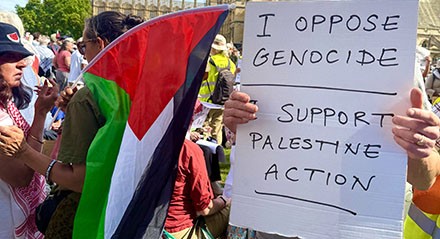
Judges have struck down the government decision to proscribe Palestine Action under terrorism legislation. This is an important victory - but a limited one, argues Mike Macnair. In the name of ‘national security’ the government can, and says it will, appeal
On Friday February 13 the King’s Bench Divisional Court gave judgment in the judicial review of Yvette Cooper’s decision (as home secretary) to proscribe Palestine Action as a terrorist organisation under the Terrorism Act 2001.1
The court (consisting of Dame Victoria Sharp, president of the King’s Bench Division, Mr Justice Swift and Mrs Justice Steyn) struck down the decision on quite limited grounds, but delayed their effect in order to allow the government to decide whether to appeal. (Shabana Mahmood promptly announced that the government will appeal, but this does not yet appear to be a formal decision.2)
In spite of its limits, this judgment is an important victory. But it is a limited victory. It may well be reversed on appeal. The judicial decision has a political background - the extent to which large numbers of people, many elderly, have been willing to expose themselves to arrest to express disapproval of the proscription. The government may decide to appeal in the hope that dragging out the process will allow them to wear down the opposition (a very common practice of governments and corporate lobbyists, assisted by the advertising-funded media as weapons of mass distraction).
The Times first leader on February 14 was headed ‘Blunt instrument’. It urged the government not to appeal, characterising Cooper’s decision to use the Terrorism Act as “impetuous and excessive”, and an “overreach”. It says that Cooper “failed to make the case for treating the group in the same way as dedicated terrorist groups, such as al-Qaeda and Hamas, especially when Iran’s Islamic Revolutionary Guard Corps is exempted from such treatment”.
The Divisional Court decision, as well as the possibility of appeal, mean that the judicial defeat for the ban is absolutely not decisive. I have begun with The Times leader because it indicates that the judicial decision may be a step on the road to the political defeat of the government. This political defeat, the leader observes, would require starting from the proposition that criminal direct action and terrorism are not the same thing, which implies demanding the repeal of the Terrorism Act 2000, which defines “terrorism” as any form of criminal direct action.
Divisional Court
The judgment of the Divisional Court is carefully crafted. The large bulk of it upholds the bulk of the government’s case and, in particular, supports the government’s rhetoric that Palestine Action is engaged in “terrorism”. It hand-waves aside (paras 141-42) the argument made by the UN ‘Special Rapporteur on Human Rights while countering terrorism’ (which intervened in the case) that there is a consensus of international lawyers that Palestine Action’s conduct does not amount to terrorism. In judicial arguments this sort of hand-waving usually indicates that the court is engaged in dodgy reasoning for ulterior motives.
There was no requirement to give Palestine Action an opportunity to make representations before the decision, in contrast to the 2013 UK Supreme Court decision in Bank Mellat v HM Treasury (No2).3 That was, in essence, because the bank was a corporation engaged in commercial operations, while Palestine Action is an unincorporated body engaged in political campaigning, and because its activities ‘threatened’ UK “national security” (paras 48-66).
The argument that the home secretary “failed to have regard to the fact that [Palestine Action] sought to prevent conduct that it (and large sections of the British public) reasonably considered to constitute the aiding and abetting or facilitation of genocide and other serious violations of international law” (para 68 (1)) was to be disregarded, because “it is obvious from the ministerial submissions that, when taking her decision, the home secretary was well aware of the reasons Palestine Action relied on as justifying its campaign of direct action, including damage to property” (para 71). This is not quite hand-waving, but it amounts in effect to refusal to consider the underlying legality of the UK government’s support for the Israeli campaign of ethnic cleansing/genocide; the court delegates this decision to the home secretary.
The decision to quash the proscription is, then, reached on very limited grounds indeed. In essence, what it comes down to is that the home office had published a policy on what criteria it would apply to banning organisations under the Terrorism Act; and that the grounds for the decision adopted by Yvette Cooper included those not contained in that policy (the operational advantages of a ban). Further, these grounds could not justifiably be included, because they would pre-empt the exercise of discretion in favour of banning given to the home secretary by the Act (paras 89-94).
For the court, it is then merely the home secretary’s use of inappropriate grounds - operational advantages, making her decision inconsistent with her previously declared policy and pre-empting the exercise of discretion - that makes her decision to ban “disproportionate”, as an interference with freedom of expression under article 10 of the European Convention on Human Rights and freedom of association under article 11 (paras 97-140). The bulk of the discussion consists of reasserting that Palestine Action is terrorist and rejecting most of the arguments against the government.
I said above that the decision was carefully crafted. The purposes of this crafting are politico-legal: it is clearly designed to leave the government’s options open. On the one hand, if the government chooses to take the advice offered by The Times leader, it could use this decision as an excuse to back down, by simply not appealing it. This option would probably be attractive to police forces, given the extensive waste of police time involved in arresting numerous protestors who hold up “I support Palestine Action” placards. The very limited character of the decision to quash means that the government could still use the rhetoric of calling Palestine Action “terrorist”.
Collapse
Alternatively, if the government chooses to double down, it can appeal. The Divisional Court itself offers the grounds. At para 79 it asserts that the basic discretionary decision to ban or not to ban is for the home secretary, not for the court: “One example is that the home secretary could only comply with her policy by reaching the substantive decision a court would consider to be lawful. Thus, compliance with the policy would collapse into a requirement for compliance with the general law, and to that extent the policy would contract-out the decision-maker’s decision to the court.”
Para 138, which states the conclusion that the ban was disproportionate for the purposes of the European Convention, begins: “Deciding where the balance should be struck in this case is difficult. When striking the balance between issues such as these, the court must permit some latitude to the home secretary, given that she has both political and practical responsibility to secure public safety.”
Either of these points could be taken by an appellate court as grounds to decide for the government without embarrassing the Divisional Court judges. The effect, then, is a minimal decision that appears to defend civil liberties without actually doing so beyond giving the government an opportunity to back down if it chooses.
We need to begin from The Times leader’s point that Yvette Cooper (and, of course, her officials and special advisors) “failed to make the case for treating the group in the same way as dedicated terrorist groups such as al-Qaeda and Hamas”,4 so that “ministers must accept that proscription was a blunt instrument, owing more to a political desire to play to the gallery”; and the argument of counsel for the UN rapporteur “that a ‘consensus’ existed in international law to the effect that the actions of Palestine Action, assessed as amounting to terrorism within the definition at section 1(1) of the 2000 Act, did not in fact amount to terrorism” (para 141). The court discards this argument on the basis that Yvette Cooper “was entitled to rely on the definition of terrorism in the 2000 Act. Indeed, she was required to apply that definition” (para 142).
Back, then, to the definition:
1 Terrorism: interpretation
(1) In this act ‘terrorism’ means the use or threat of action where -
(a) the action falls within subsection (2),
(b) the use or threat is designed to influence the government [F1, or an international governmental organisation] or to intimidate the public or a section of the public, and
(c) the use or threat is made for the purpose of advancing a political, religious [F2, racial] or ideological cause.
(2) Action falls within this subsection if it -
(a) involves serious violence against a person,
(b) involves serious damage to property,
(c) endangers a person’s life, other than that of the person committing the action,
(d) creates a serious risk to the health or safety of the public or a section of the public, or
(e) is designed seriously to interfere with or seriously to disrupt an electronic system.
(3) The use or threat of action falling within subsection (2) which involves the use of firearms or explosives is terrorism, whether or not subsection (1)(b) is satisfied.
(4) In this section -
(a) “action” includes action outside the United Kingdom,
(b) a reference to any person or to property is a reference to any person, or to property, wherever situated,
(c) a reference to the public includes a reference to the public of a country other than the United Kingdom, and
(d) “the government” means the government of the United Kingdom, of a part of the United Kingdom or of a country other than the United Kingdom.
(5) In this act a reference to action taken for the purposes of terrorism includes a reference to action taken for the benefit of a proscribed organisation.
Back in 2005 I pointed out that this definition is unwarrantably broad (when the Blair government proposed to use it as the basis of internment powers):
If the new powers [then proposed] are anything like the 2001 Act, the definition of ‘terrorism’ will be taken from the Terrorism Act 2000, section 1. This has two aspects.
The first is that “the use or threat [of action] is designed to influence the government or to intimidate the public or a section of the public”, and “is made for the purpose of advancing a political, religious or ideological cause”.
The second is that the “action” (a) involves serious violence against a person, (b) involves serious damage to property, (c) endangers a person's life, other than that of the person committing the action, (d) creates a serious risk to the health or safety of the public or a section of the public, or (e) is designed seriously to interfere with or seriously to disrupt an electronic system”.
This definition is far broader than the ordinary usage of ‘terrorism’. It certainly includes threats like those made against the staging of Behtzi (Weekly Worker January 6 2005). Going further, the ‘serious damage to property’ category includes a range of things that have happened in hard-fought strikes. “Endangers a person’s life” is capable of covering strike action by workers in emergency services, as it “creates a serious risk to the health or safety of the public or a section of the public”. This could also cover the go-slow protests of the fuel protestors in 2000. Subhead (e) covers any form of political ‘hacking’.5
The definition is - precisely - about “a political desire to play to the gallery” by defining terrorism so broadly as to catch most forms of ‘direct action’ and most effective forms of trade union action. It was in essence fraudulent when passed in 2000.
We need to understand this fraud as the other side of the coin of Peter Mandelson and his relations with Jeffrey Epstein, and the latest revelations about Labour Together. This is, that the Blair leadership of the Labour Party embraced the culture of political corruption. In doing so, they blocked any lawful and peaceful road to combatting corruption; and thereby threw up powerful incentives to ‘minority direct action’ projects. To protect the bribe-payers it was now necessary to block the road of unlawful protest; and this they sought to do by fraudulently labelling it as ‘terrorism’.
In ancient Athenian law the graphē paranomōn criminalised proposing unconstitutional legislation.6 In our own history, the Act for the abolition of Star Chamber 1641 criminalised any attempt to set up a similar court; the Habeas Corpus Act 1679 criminalised what the GW Bush administration called “extraordinary rendition”. I do not suggest copying any of these procedures, but it is arguable that perhaps we should criminalise proposing, or being concerned in drafting, fraudulent legislation - like the Terrorism Act 2000!
-
www.judiciary.uk/wp-content/uploads/2026/02/R-Ammori-v-SSHD-OPEN-Judgment-final.pdf.↩︎
-
www.bbc.co.uk/news/live/c8x90q9nyzyt (February 13, 10:29).↩︎
-
UKSC 39 (2013).↩︎
-
Arguably a mis-description of Hamas, but we can leave this issue aside.↩︎
-
‘From Belmarsh to Rangoon’ Weekly Worker February 3 2005 (weeklyworker.co.uk/worker/562/from-belmarsh-to-rangoon - unfortunately, the formatting is lost).↩︎
-
Lots of controversial literature, but Wikipedia offers a convenient summary: en.wikipedia.org/wiki/Graphe_paranomon.↩︎