
05.02.2026
General strikes and insurrection
Marking the centenary of the 1926 General Strike, Jack Conrad looks at Russia’s 1905 ‘dress rehearsal’. Following Bloody Sunday, the revolution took the form of mass demonstrations, general strikes, peasant uprisings, the formation of soviets and armed barricade fighting
Russia’s first revolution started on January 9 1905 - a cold and terrible Sunday.1 Partially through stupidity, partially through premeditated plan, tsarist troops were ordered to open fire on the huge march led by the Orthodox priest (and Okhrana dupe) Gregory Apollonovich Gapon. Pushed on by disgust with the futile Russo-Japanese war, economic deprivation and, beginning with the giant Putilov factory, a series of strikes in St Petersburg, he had intended submitting a half-humble and, because of socialist agitation, a half-threatening petition to the ‘little father’ in his Winter Palace.
Signed by some 135,000 working people, it listed a whole gamut of economic grievances, but included high politics too: workshops open to “draughts, rain and snow”, excessive overtime, the eight-hour day, the withdrawal of the navy from abroad, land reform, separation of church and state and, crucially, convening a constituent assembly elected by “universal, secret and equal suffrage” - “our principle request”. In its final peroration the famous petition ominously stated that there were only “two paths”: one leading to “liberty and happiness, the other to the tomb”.2 Tsarism horrifically proved it was the path to the tomb. In the hail of bullets hundreds of men, women and children died, thousands more were injured.3
Gapon all of a sudden found himself world-famous. From afar his mix of Ezekiel and Marx made him appear to be some sort of new age prophet. After he smuggled himself out of Russia, Gapon was commissioned by publishers Chapman and Hall to write his life story - for a “very considerable sum”.4 It went through repeated editions. Georgy Plekhanov and Vladimir Lenin welcomed him, when he came to Switzerland; Peter Kropopkin and Rudolph Rocker, when he came to London. The Second International’s Bureau in Brussels even published his appeal calling for an end to the “chaos of divisions and conflicts that disrupt the socialist camp” in Russia (he was close to the Socialist Revolutionaries). Interestingly, Karl Kautsky - he became something of an honorary Bolshevik - strongly objected. What does “Pope Gapon” know about socialism, let alone the basis for socialist unity?5 It is worth adding, after he returned to Russia, in late 1905, Gapon was executed by three members of the SR’s combat organisation - he had revealed his links with the secret police.
Gapon was never going to be anything more than a historical footnote. Even while his “halo of indignation” dazzled progressive opinion in the west and his “pastor’s curses” rained down on tsar Nicholas II’s head, the two big factions of Russian social democracy, the Bolsheviks and Mensheviks, had already won the ear of the urban masses.6 Soon they were to exert a decisive influence.
Rolling strikes
January 9 provoked popular outrage and, spreading out from St Petersburg, a rolling series of strikes: Moscow, Warsaw, Lodz, Kiev, Baku, Finland, the Baltic states … nationwide. One million workers took part, without any guiding strategy - in many cases without advancing any clear demands. Stopping, starting, “obedient only to the instinct of solidarity”, for almost two months the “strike ruled the land”.7
Of course, Gapon did not create this extraordinary revolutionary energy: he merely served to unleash what had been latent at least since the 1880s. In fact, Bloody Sunday destroyed all Gapon’s plans, exposed them as totally inadequate, totally illusory. You cannot peacefully persuade an absolute monarchy to usher in a democratic republic: no matter how many signatures you collect, no matter how many you mobilise onto the streets, no matter how many you get to take strike action.
Unsurprisingly, Lenin suffered from no such misconceptions. From his Swiss exile, writing in late January 1905, he celebrated events in Russia as being of “the greatest historical importance”. Workers in every country will find inspiration and be spurred on. Because of January 9, Russia’s workers had been propelled into the global vanguard. They had, Lenin proclaimed, “received a momentous lesson in civil war; the revolutionary education of the proletariat made more progress in one day than it could have made in months and years of drab, humdrum, wretched existence”.
Lenin called upon his fellow social democrats in Russia to spread the news about the St Petersburg events. He called for “revolutionary committees” in every factory, every city, every village. Above all, Lenin called for the “arming of the people” - that is the “immediate task of the revolutionary moment.” Only an armed people could defend the strikes from police and army attack. Only an armed people could split the police and army and bring them over to the side of the revolution - a revolution which, having overthrown tsarism, proclaims the “immediate convocation of a Constituent Assembly”.8
A spontaneous general strike wave such as January and February 1905 could only but exhaust itself. No strike pay, no state benefits, no accumulated personal savings. Nor, without the hegemony provided by the party, is there any ability to think collectively in strategic terms. Therefore, no positive culmination.
The revolutionary situation, however, continued unabated. Breaking out here as peasant revolt, there as sailors’ mutiny, and in every city as street demonstrations and clashes with police and troops, the decisive moment was coming. The October general strike was the herald. Beginning as an economic strike at Sytin’s print works in Moscow and spreading to bakers, tobacco workers, furniture makers, metal workers, tram drivers, and railway workers, things quickly fanned out nationally. Just as quickly it became unmistakably political: ‘Down with the tsar’s government’, ‘Long live the democratic republic’. At its height there were some two million out on strike. Strike committees came together, at Menshevik initiative, to establish workers’ councils or soviets - organs of struggle - and, as Lenin was soon to appreciate, “embryonic forms of a new revolutionary authority”.9 St Petersburg and Moscow being the most important.
What was unconscious had, like the human embryo, become conscious nine months after conception. The religious banners and anthems were gone and replaced by red flags and singing the Workers’ Marseillaise. Now, there were no illusions in the tsar. Now, the revolution looked, not to the liberal bourgeoisie as allies, but the peasant masses. Now, the call for general strike was combined with preparation for armed uprising. Responsibility for this qualitative shift rested primarily with the RSDLP’s Bolshevik wing.
To organise and make effective the sudden release of revolutionary energy, Lenin had quite rightly, almost straightaway, demanded the opening up of the party and mass recruitment, especially of young workers. That did not mean rejecting as wrong ideas of building the revolutionary party outlined in his celebrated 1902 pamphlet What is to be done? The party would still be built and directed top-down. But now centralism was to be complemented and completed with mass initiative and democracy from below. Soon the party - first the Mensheviks, shortly afterwards the Bolsheviks - adopted the term ‘democratic centralism’. Perhaps a borrowing from Germany where the SDP rejected the previous model of directly elected ‘labour dictators’ and sought to exert control over Reichstag and other such deputies.10 Democratic centralism had nothing whatsoever to do with imposing some suffocating conformity and silencing awkward minorities: rather elections at every level, unity in action and accountability.
The fact of the matter is that objective circumstances had radically changed. The enemy’s defences had been breached, its forces were in disarray and those of the workers in rapid advance. Tsarism could no longer rule in the old way. With every month that passed the party grew in leaps and bounds.11 Exiles returned from Britain, Switzerland, France and Siberia as popular heroes. The tsar’s October manifesto was a watershed moment: it promised civil liberties, freedom of assembly, made provision for indirect elections to the duma and somewhat relaxed censorship laws. Enough for mainstream liberal opinion. Nicholas II feared for the collapse of his regime.
Subsequently, the Mensheviks legally published the daily Nachalo in St Petersburg (Leon Trotsky contributed). Other Menshevik papers included Rassavet and Voprosy Dnya. The Bolsheviks had Novaya Zhizn (Maxim Gorky helped out with the finances). Circulation ranged from between 50,000 to 80,000. Lenin took over as editor when he returned from Switzerland in November 1905. Despite the liberalisation of censorship, 15 of its 27 issues were confiscated before it was finally suppressed in December 1905.
Bolshevik strategy
Let us take the argument forward by going back to the actual theoretical foundations of the Bolshevik programme. From the outset - yes, since the Emancipation of Labour Group was established in 1883 - Russian Marxists (eg, Georgy Plekhanov, Vera Zasulich and Pavel Axelrod) were agreed: the country was not yet ripe for socialism - if by that one meant working class rule, leaving behind commodity production and the transition to the communist principle of ‘From each according to their ability, to each according to their need’. The autocratic state, lack of capitalist development, domination of the economy by a woefully backward peasant agriculture - all that explains why the coming Russian revolution was conceived by all Marxists (Trotsky being no exception) as having two stages: the first, anti-tsarist, anti-feudal and democratic; the second, working class and socialist.
It was the anarchists and narodniks, and following them the SRs, who raised the slogan of socialist revolution - what exactly they meant by ‘socialism’ being a moot point. Either way, the call for a socialist revolution earned Lenin’s withering scorn. In 1905 he writes: “Only the most ignorant people can ignore the bourgeois nature of the democratic revolution which is now taking place.”12 Note, the SRs, formed in 1902, advocated a programme that included the “expropriation of capitalist property and the reorganisation of production and the entire social system on socialist foundations”13 - in truth a utopian peasant socialism. Yet, though attracting a very considerable popular base, above all in rural areas, the SRs placed their hopes - well, at least initially - not, as might be expected, on waging a protracted guerrilla struggle, but on individual terrorism and the assassination of tsarist officials.
What of the Mensheviks? They were committed to a theory of stages which inevitably resulted in tailism. According to the Mensheviks, the overthrow of tsarism had to be crowned by the class rule of the bourgeoisie and, in the best-case scenario, a western-style parliamentary constitution. It should be added that the ‘Menshevik’ label united an amorphous collection of factions, groups and trends - there were, for example, sceptics on the left, such as Jules Martov, who had no faith in the bourgeoisie playing its ascribed “revolutionary role” nor in its democratic credentials.14 Nevertheless, in step with the growth of capitalism, there is working class growth too. Eventually the peasantry is eclipsed in population terms. The working class becomes the majority. Only then does socialism come onto the agenda - a Menshevik proposition which owes more to sociology than Marxism.
No to power
Hence, in the midst of the 1905 revolution, the Mensheviks agreed (specifically in a conference resolution of April-May), that the working class and its party “must not aim at seizing or sharing power in the provisional government, but must remain the party of the extreme revolutionary opposition”.15 So, for mainstream Menshevik thinking, the immediate task of the working class was to align itself with the liberal bourgeoisie and edge, push or lift its party or parties into their predetermined position as leaders of the anti-tsarist revolution.
Participation in a revolutionary government was explicitly ruled out (obviously subject to a violent reversal after the collapse of tsarism in 1917). Why non-participation? Firstly, if the working class succumbed to the temptation of power, it would cause the bourgeoisie to “recoil from the revolution and diminish its sweep”.16 Secondly, without an already established European socialism, the working class party in Russia would be unable to meet the economic demands of its social base. Failure to deliver far-going changes would produce demoralisation, confusion and defeat.
If the anti-tsarist revolution proved successful, the workers’ party should, argued the Mensheviks, exit the centre stage, so as to allow the bourgeoisie to assume power. Obeying the ‘laws of history’, the workers’ party would then patiently wait in the wings until capitalism had carried out its preordained historic mission of developing the forces of production. Hence, for the Mensheviks, there had to be two, necessarily distinct, revolutions - the one separated from the other by a definite historical period.
What of the Bolsheviks? Lenin presented their strategy of “uninterrupted revolution” most fully in the pamphlet, Two tactics of social democracy.17 Written in Geneva over June-July, it was first published in Switzerland and then smuggled into Russia. There were multiple editions: eg, the Moscow committee of the RSDLP(B) printed 10,000 copies. This was a seminal work that mapped out the strategy which allowed the Bolsheviks first to lead the “whole people” for a democratic republic (eg, October 1917), and then “all the toilers and exploited” for socialism.18 The Bolshevik version of permanent revolution.
Incidentally, too often comrades who should know better identify permanent revolution exclusively with the name, Leon Trotsky. Of course, the phrase long predates him, going back to the “literature of the French Revolution”.19 From there it spread far and wide, becoming a common “programmatic slogan” of European radicals, socialists and communists, including Karl Marx and Frederick Engels.20 And, as Hal Draper helpfully explains, for Marx the word ‘permanent’ in ‘permanent revolution’ describes a situation where there is “more than one stage or phase” in the revolutionary process. He usefully adds that the expression “retains its specifically French and Latin meaning”. It does not mean perpetual or never-ending. It is employed by Marx to convey the idea of “continuity, uninterrupted”.21
Bearing this in mind, consider Lenin: “We stand for uninterrupted revolution. We shall not stop halfway.”22 He wants to take the anti-tsarist revolution to the socialist stage through a process that does not halt at some artificial boundary. No, the Bolsheviks will take the revolution forward both from below and above.
While not including socialist measures in their minimum programme - shared, of course, in its first, 1903, form with the Mensheviks - Lenin and the Bolsheviks were resolutely opposed to handing power to the bourgeoisie, as the Mensheviks insisted. The bourgeoisie in Russia was both cowardly and treacherous. Despite occasional leftish posturings, their parties sought a compromise with tsarism, not a people’s revolution against tsarism. Their ideal was a constitutional monarchy. Russia therefore had no Cromwell, no Washington, no Robespierre. The only force capable of scoring a decisive victory over tsarism and pushing through the most radical changes objective circumstances permitted was the proletariat … in alliance with the peasant masses.
So, whereas for the Mensheviks the ‘vital forces’ of the coming revolution were the working class, the urban middle classes and the capitalist bourgeoisie (a minority bloc of three classes), for the Bolsheviks it was the working class and the peasantry (a majority bloc of two classes).
Naturally, because Russia was overwhelmingly a peasant country, the Bolsheviks paid particular attention to their agrarian programme and securing proletarian hegemony over the rural masses. To neatly illustrate the point, there are far more references to the condition of peasants than the condition of workers in Lenin’s Collected works. In fact, for the Bolsheviks, peasant interests set the limit on how far the revolution could go. Landlord power could certainly be destroyed and the land nationalised and given, according to their wishes, to the peasants. This ‘black redistribution’ was, of course, not a socialist measure. It would uproot Russia’s semi-feudal social relationships and allow capitalism in the countryside to develop along an “American path”.
Hybrid regime
The fact of the matter is that the Bolsheviks were determined that the anti-tsarist revolution would see the fulfilment of the party’s entire minimum programme. Such a hugely advanced package, centred on the democratic republic, could only be delivered by establishing a revolutionary government, which embodied the interests of the great mass of the population. Lenin used a famous algebraic formulation to capture the essence of the majoritarian regime envisaged by the Bolsheviks: the democratic (majority) dictatorship (decisive rule) of the proletariat and peasantry. Such a hybrid regime could not abolish classes and bring full liberation for the working class. That was impossible. Economically Russia would have to progress capitalistically - albeit under the armed rule of the working class and peasants. That meant the continuation of wage-labour, albeit with workers taking over abandoned factories, the nationalisation of banks, etc.23
How long was the hybrid regime going to last? Lenin admitted the possibility of a return of the Bolsheviks to being a party of extreme opposition. Given that the worker-peasant regime was going to be committed to implementing the full minimum programme of the RSDLP, we surely must conclude that it was expected to be relatively long-lasting. Why? Far from it being envisaged as a mere prelude to the bourgeoisie assuming power - as bonehead leftists argue today - in reality the party of the militant working class was committed to its bloc of two classes winning elections to a constituent assembly and from that salient of power acting in the most decisive manner to spread the flame of revolution to Europe.
Lenin seems to have seriously contemplated war for the “purpose” of “taking” the revolution into Europe. One of his key slogans was for a “revolutionary army”.24 Depending on their success in furthering the world socialist revolution, the Bolsheviks looked towards a purely working class government in Russia and embarking on specifically socialist tasks. Before that, though, because the tasks of the worker-peasant government included eliminating every last vestige of tsarism, enacting sweeping land reform, putting in place full democratic rights, defeating bourgeois counterrevolution … and maybe even fighting a revolutionary war in Europe, that explains why such a regime would have been expected to last not a few brief months, but years.
Socialist Europe
My main argument, is, though, that the Bolsheviks were not committed to handing political power to the bourgeoisie, as the Mensheviks were. Of course, for the Bolsheviks, the international dimension was crucial. The revolutionary dictatorship of the proletariat and peasantry in Russia could not survive for any extended period in isolation. It would - it had to - “rouse Europe” to carry through the “socialist revolution”.25 The United Socialist States of Europe would then, in turn, help Russia move in the direction of socialism (which requires definite material conditions in terms of the development of the productive forces). And a revolution uniting Europe and half of Asia had a realistic chance of successfully spreading to every corner of the globe.
Inevitably, there would, within Russia, be a differentiation between the proletarianised rural masses and the emerging class of capitalist farmers. But not necessarily a specifically socialist revolution: ie, the violent overthrow of the state. Put another way, for the Bolsheviks there would not necessarily be a democratic stage and then a socialist stage at the level of regime.
Democratic and socialist tasks are categorically distinct, premised as they are on different material, social and political conditions. But particular aspects can evolve and assume dominance. The revolution could, given favourable internal and external conditions, proceed uninterruptedly from democratic to socialist tasks through the proletariat fighting not only from below, but from above: ie, using state power. The revolutionary democratic dictatorship of the proletariat and peasantry thereby peacefully grows over into the dictatorship (rule) of the working class. As the size, organisation and consciousness of the urban and rural working class grew, so would the strength of the workers’ party. The necessity of a coalition government would at some point disappear. The tasks of the maximum programme then decidedly come onto the agenda.
With weapons
There is theory … and then there is life itself. With October’s general strike, preparation for insurrection became a matter of urgent necessity. That meant practically arming the people. The Mensheviks objected: “We have to arm the workers, not with weapons, but first with the burning consciousness of the necessity of arming themselves.”
The Bolsheviks gave an excellent answer: “You regard Russian workers as little children, you want to ‘arm them with consciousness’; but that time has passed. They have the consciousness; now they need to be armed with rifles to strike at the tsar and the bourgeoisie.”26 Yes, only an armed people could defend themselves and their new won freedoms. Only an armed people could look to the future with confidence.
Political strikes had once more broken out across the country. Soviets began to arm workers and students. However, the tsarist state made its pre-emptive strike. Police surrounded the Imperial Free Economic Society HQ, where the St Petersburg soviet met, and arrested between 250 and 300 delegates, including its chair, Leon Trotsky, and executive committee. In response the remaining revolutionary leadership in St Petersburg issued a call for a general strike. While there were walk-outs, the strikes in St Petersburg soon subsided. Class confidence had been deflated.
The revolutionary centre shifted to Moscow. Its Bolshevik-led soviet had been getting ready for months. Workplace meetings had declared for an uprising. Fraternisation with the local garrison produced a soldiers’ soviet. Party cells were established in the army, weapons illegally imported from abroad, workers instructed in their use. Fighting detachments were formed ... things were ready.
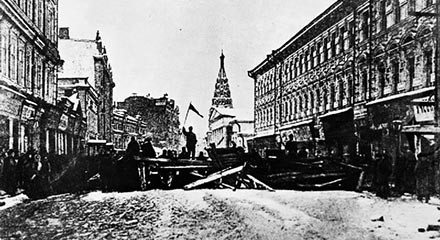
Though members of Moscow’s Bolshevik committee were likewise rounded up, the decision was made not to hold back. On December 7 the insurrection began. Key buildings were seized. Barricades webbed the city. Fighters stood not waiting behind them, but used barricades to block main roads and establish liberated zones. Operating in groups of three or four, guerrillas would attack police and army soldiers and quickly disappear into nearby buildings. Against enormous odds, but with the active support of its proletarian population, a couple of thousand guerrillas broke the grip of tsarism in Moscow for nine splendid days.27
Other uprisings broke out in Krasnoyarsk, Motovilikha, Novorossisk, Sormovo, Sevastopol, Kronstadt, the Donbas, Georgia, Finland and Latvia. The Moscow garrison vacillated. Sadly nothing more. Having concluded a humiliating loser’s peace with Japan, the tsarist government managed to bring in substantial reinforcements. They were free of Bolshevik contamination. Officers gave instructions to spare no bullets and take no prisoners. Artillery was used to smash and blast barricades and buildings. Morale among the population began to wane. The guerrillas fought on. But, without St Petersburg, lacking an authoritative directing centre, the uprising faltered and began to break apart into a series of disconnected defensive actions. The initiative was lost - a fatal weakness. Moscow was crushed. Other outposts of the revolution soon followed.
There are, however, defeats which are more valuable than victories - December 1905 being one such instance. Marxism learns. Instead of fetishising particular forms of struggle - ie, economic strikes and street demonstrations - there is concrete analysis and innovative tactical flexibility. So, while it was always right for both the First and the Second International to reject the general strike as a social panacea - that is, the idea that capitalism can be overthrown in one fell swoop through the ‘holy month’ - social democracy gave primacy to elections as providing the best means to build the party. A ‘state within the state’ that patiently awaits its revolutionary moment. Nonetheless, as an auxiliary tactic, social democracy took up the political general strike, not least as a means to effect the extension of popular suffrage (Belgium in 1891 and 1893 being well known examples on the left, but not, however, the SDP’s planned “strike for suffrage reform” in Prussia on the eve of World War I28).
The Bolsheviks were no less creative. Having been rendered totally antiquated in the 19th century due to the army’s much improved artillery pieces, they reinvented the barricade as a means of struggle. Moscow “proved”, in Lenin’s words, that the “open armed struggle of the people is possible even against modern troops”.29 Above all, though, the Bolsheviks successfully used the political general strike as a means of readying the working class for armed insurrection.
-
Before February 1 1918 the Julian calendar was in use in Russia. This is 13 days behind the Gregorian calendar. Therefore January 9 in the Russia of 1905 corresponds to January 22, according to the calendar we use.↩︎
-
www.marxists.org/history/ussr/events/1905/workers-petition.htm.↩︎
-
Exact figures are impossible to arrive at because the tsarist authorities did their best to suppress them. The dead were secretly buried. Certainly though, the number of dead ran into the hundreds; the number of wounded into the thousands.↩︎
-
G Gapon The story of my life New York NY 1906.↩︎
-
K Kautsky ‘Gapon and socialism’ The International Socialist Review May 1905, Vol 5, No11.↩︎
-
L Trotsky 1905, Harmondsworth 1973, p93.↩︎
-
Ibid p98.↩︎
-
VI Lenin CW Vol 8, Moscow 1977, pp97, 99.↩︎
-
VI Lenin CW Vol 10, Moscow 1977, p155.↩︎
-
See B Lewis ‘Sources, streams and confluence’ Weekly Worker August 25 2016.↩︎
-
On the eve of the revolution, in January 1905, the Bolsheviks consisted of no more than 8,400 members. By the spring of 1906 membership of the reunited Russian Social Democratic Labour Party stood at 48,000, of whom 34,000 were Bolsheviks and 14,000 Mensheviks. In October of that year membership exceeded 70,000 and in 1907 the figures given at the London congress show that there were 84,000 members (that did not include the Bund, and the Polish and Lettish sections). The Bolsheviks were still the largest trend, with 46,000 supporters, compared to the Mensheviks’ 38,000 (figures quoted in M Liebman Leninism under Lenin London 1980, p47).
L Trotsky 1905 Harmondsworth 1973, p98.↩︎
-
VI Lenin CW Vol 9, Moscow 1977, pp28-29.↩︎
-
Z Galili The Menshevik leaders in the Russian Revolution: social realties and political strategy Princeton NJ 1989, p36.↩︎
-
Quoted in VI Lenin CW Vol 9 Moscow 1977, p245.↩︎
-
Ibid p128.↩︎
-
Ibid pp15-130.↩︎
-
Ibid pp114.↩︎
-
“Kautsky describes the policy of the sans-culottes in 1793-94 as one of ‘Revolution in Permanenz’” - quoted in RB Day and D Gaido (eds) Witnesses to permanent revolution Leiden 2009, p537.↩︎
-
H Draper Karl Marx’s theory of revolution Vol 2, New York 1978, p204.↩︎
-
Ibid p201. Marx’s most famous use of ‘permanent revolution’ can be found in his 1850 ‘Address of the Central Authority of the Communist League’, K Marx and F Engels CW Vol 10, New York 1978, pp277-87.↩︎
-
VI Lenin CW Vol 9, Moscow 1977, p237.↩︎
-
See VI Lenin CW Vol 8, Moscow 1977, p208.↩︎
-
VI Lenin CW Vol 9 Moscow 1977, p128.↩︎
-
Ibid p82.↩︎
-
Quoted in G Zinoviev History of the Bolshevik Party London 1973, p123.↩︎
-
James Connolly was particularly impressed by how Moscow had advanced barricade tactics. Writing in May 1915, he wrote how it was “wise” that, unlike the French revolutionaries of an earlier time, the Russians did not “man the barricades”, but used surprise tactics - attacking only when the enemy was in “range of their inferior weapons” (J Connolly Selected Writings, London 1988, p226).↩︎
-
The only serious study that I am aware of is Jens-Uwe Guettel’s ‘Reform, revolution and the “original catastrophe”: political change in Prussia and Germany on the eve of the First World War’. Thanks to Mike Macnair.↩︎
-
VI Lenin CW Vol 10, Moscow 1977, p152.↩︎