
29.01.2026
History repeating itself
Once protected by the US, Kurdish fighters have withdrawn to Kobane and Al Hasakah, but face annihilation. They no longer serve America’s strategic interests. Trump is backing the former terrorist Ahmad al-Sharaa. Esen Uslu pleads for lessons to be learnt
A year ago, paramilitary forces from the Hayat Tahrir al-Sham (HTS) marched from Idlib province into Aleppo and Damascus. They found the seat of power had been vacated. Bashar al-Assad fled to Moscow and Ahmad al-Sharaa was installed as the Syrian interim president.
He was quickly transformed from a ‘terrorist’ with a fat bounty on his head into a well-dressed ‘statesman’ accepted by the west. No-one, including himself, thought he would survive for long, but his backers - including the Gulf States, Turkey and the US - ensured he stayed in power. He continued the suppression of minorities, such as the Alevis and Druze, while acquiescing to Israel’s occupation of more territory adjacent to the Golan Heights - Mount Hermon and Al-Quneitra, along the UN buffer zone between Israel and Syria.
The Kurdish People’s Defence Units (YPG), which formed a coalition with Sunni Arab tribes called the Syrian Democratic Forces (SDF), had been in control of territory from the Euphrates to the Iraqi border. The SDF has had the backing of the US military presence in the region since 2019. It kept activists from the Islamic State of Iraq and Sham (Isis) and their relatives in prisons and guarded camps. The SDF also controlled some territory adjacent to the west bank of the Euphrates, just south of Aleppo.
HTS forces, as well as groups attached to Turkish regime, tried to dislodge the SDF, but failed after intense fighting and US intervention. However, in the March of last year, the SDF and the HTS government signed a ‘memorandum of understanding’, which paved the way for an uneasy ceasefire.
The Turkish regime under president Recep Tayyip Erdoğan was unhappy, and pressurised its HTS client, into confronting the Kurds. Turkey used its influence in the region to encourage Sunni Arab tribal forces to separate from the Kurds too. Turkey has also prevented the implementation of the measures agreed upon in the ‘memorandum of understanding’, such as the participation of SDF forces as separate units in the Syrian army.
After a year of hesitant probing and delaying negotiations, the HTS government felt that it was ready to attack the Kurds. The SDF coalition collapsed, and HTS forces quickly overcame Kurdish pockets in Aleppo. They then marched south along the west bank of the Euphrates, clearing SDF-held territory and river crossings. As SDF forces continued to retreat, HTS forces crossed the river and occupied the cities of Deir al-Zor and Raqqa. They then headed north towards YPG strongholds in Kobane and Al Hasakah.
As the HTS forces advanced rapidly, Tammy Bruce, the US deputy representative at the United Nations, made the shift in the Trump administration’s policy crystal-clear. Addressing to the UN Security Council she said this:
The United States has long supported efforts to defeat Isis and promote stability in Syria, including through Operation Inherent Resolve and our partnership with the Syrian Democratic Forces, or SDF, whose sacrifices have been instrumental in achieving enduring gains against terrorism.
Now the situation has fundamentally changed. The new Syrian government joined the global coalition to defeat Isis in late 2025, pivoting to cooperation with the United States on counterterrorism. Damascus is now both willing and positioned to take over security responsibilities, including control of Isis detention facilities and camps.
We are working with the Syrian government and the SDF to reintegrate north-east Syria in a dignified manner that leads to a Syria at peace with itself and its neighbours.
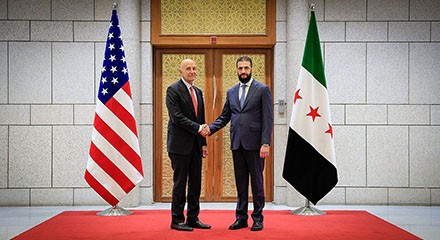
We commend both sides on reaching a four-day ceasefire that will allow them each to work out the modalities of the January 18 agreement between Syrian president Ahmed al-Sharaa and SDF commander Mazloum Abdi.
President al-Sharaa has affirmed that Kurds are an integral part of Syria, and integration of Kurds into the new Syrian state offers full citizenship rights, including for those previously stateless, recognition as an integral part of Syria, constitutional protections for Kurdish language and culture, and participation in governance.
While risks remain, this integration, supported by US diplomacy, represents the strongest chance yet for Kurds to secure enduring rights and security within a recognised Syrian nation-state.
The YPG and the wider Kurdish freedom movement facing annihilation, has withdrawn its forces to Kobane and Al Hasakah to fight for its survival. Its diplomatic and public relations efforts are ongoing, but the international alignment seems to be against them. The small Russian contingent in the vicinity of Al Hasakah, especially those at Qamishli airport, have hastily abandoned their positions, transporting their military personnel and equipment to the Khmeimim airbase on the Mediterranean coast.
A tentative two-week ceasefire was declared to allow US forces to take Isis members from the prisons and camps that the SDF could no longer manage, and has moved them to Iraq.
End oppression
The imminent danger is great, but international solidarity is growing. In Turkey’s Kurdish cities and towns we are witnessing demonstrations and marches. The government has moved to forbid ‘unlawful gatherings’ - one person was killed in the Mersin province, when a demonstration was dispersed. The so-called ‘Peace and Democracy Process’, which has dragged on for almost a year without any tangible action by the Turkish parliament, is still ongoing. Meanwhile, the Ankara government coalition insists that the Syrian Kurds give up arms and surrenders to HTS forces, claiming them to be the legitimate Syrian army. A precondition if the peace the process in Turkey is to continue.
The oppressed cannot free themselves from the pressures they face unless they exploit the contradictions between the oppressors. It is the right and duty of the oppressed to do so and Kurds cannot be blamed for exercising this right. There should be no objection to the Kurdish movement taking advantage of the contradiction between the US and Turkey, but, in order to do so, it requires a specific programme, strategy, tactics and organisational efforts. Otherwise, they will simply be used by the oppressors. In this respect the Kurdish freedom movement should be criticised: the role of Iraq’s Kurdish leader Masoud Barzani as a mediator is creating false hopes.
At the same time, it is sending messages to Israel pleading for help. The Kurdish movement must understand this: asking for help from the Zionist state - a racist state and the most aggressive proponent of imperialist policies - is tantamount to suicide. Yet these requests are increasing alongside Barzani’s growing influence. In this way the Kurdish movement will invite the hostility of the Persian, Turkish and Arab masses. This will further intensify the isolation of the Kurdish movement within the region and among the global south. Those who support the Kurds as an oppressed people are those who have been standing against Israel’s massacres and supporting the Palestinians.
The YPG also needs to apologise to the Alevis specifically. On the day the Alevis were massacred in western Syria, Mazlum Abdi, the commander of the SDF, was in Damascus shaking hands with president al-Sharaa. This caused a major rift among the Alevis and other minorities. Abdi did this with the intention of fending off US pressure first and then protecting the Alevis later. But it was the wrong thing to do.
Something similar happened in 2013. Assuming that the Alevis knew about the Kurdish movement, Abdullah Öcalan, the founder leader of the Kurdistan Workers Party (PKK), spoke positively of the strategic alliance the Ottoman sultan, Selim I, formed with the Kurdish principalities in the 16th century. In return for loyal military support they were granted considerable local autonomy. However, understandably this alliance talk caused consternation among the Alevis. They remember Selim as the murderer of 40,000 Alevis. Öcalan was trying to break down the prejudices of Muslims and Turks and create a rapprochement with them, but it failed miserably. After that, the Alevis remained largely unenthusiastic about the peace process and Öcalan then tried to make amends.
The same thing has now happened again. Therefore, an apology is necessary as the first step in making amends once again.