
15.01.2026
Their days were numbered
Deindustrialisation and reliance on commodity exports makes any independent economic policy impossible, argues Michael Roberts. Certainly the unpopularity of the Maduro regime was closely linked to the falling price of oil
Within hours of the US military strikes on Venezuela and the capture of its president, Nicolás Maduro, Donald Trump proclaimed that “very large United States oil companies would go in, spend billions of dollars, fix the badly broken infrastructure and start making money for the country”. Trump did not conceal the fact that a major reason for the attack and kidnapping of Maduro was putting the US in control of Venezuela’s vast oil reserves, described as “our oil” by Trump.
Venezuela holds the world’s largest oil reserves - about 303 billion barrels, or 17% of global reserves - surpassing OPEC+ leader Saudi Arabia, according to the London-based Energy Institute. But, despite its vast reserves, Venezuela’s crude output remains far below capacity. Production, which once peaked at 3.5 million barrels per day in the 1970s (over 7% of global output), fell below 2 million during the 2010s and averaged just 1.1 million last year.
The US itself is now the world’s biggest producer thanks to the so-called ‘shale revolution’ in the 2000s. But that has meant the world is increasingly awash in oil, as supply outstrips global demand growth, which is slowing due to crawling economic expansion in most major economies, and to the gradual switch to renewables for energy production. Indeed, at the time of the attack on Venezuela, the price of benchmark Brent crude was close to five-year lows at about $60 a barrel.
Trump may be telling the global oil majors that he is running Venezuela now and they can pitch to invest and make ‘piles of money’, but the oil companies may be less sure of that. Former Chevron executive Ali Moshiri is making a pitch to raise $2 billion to take over multiple Venezuelan assets. But this is a punt and the likes of Chevron itself, which already has a licence from the US to drill and produce Venezuelan oil, may not be so gung-ho.
The cost of restoring Venezuela’s oil production will not be cheap, as the industry has a dilapidated drilling infrastructure and the oil extracted is ‘extra-heavy’. Extracting this heavy oil requires drilling lots of relatively short-lived wells - a process quite similar to US shale oil production - then mixing the sludge with lighter oil or naphtha, so it can flow through pipelines before being exported and refined. Producing heavy oil requires advanced techniques, such as steam injection and blending with lighter crudes to make it marketable. Also, the country’s reserves are mostly concentrated in the Orinoco Belt - a vast, remote region in the eastern part of the country, stretching across roughly 55,000 square kilometres.
Moreover, the oil glut has already started to hit profits on further exploration and extraction. The US shale industry’s cumulative losses in the 2010s reached close to half a trillion dollars.1 Everything depends on the ‘break-even price’, which has been estimated at an average of about $60 per barrel for American shale.2 All this is occurring against a backdrop of global oil supply growing faster than demand, with the International Energy Agency projecting global supply increases of 3 million barrels a day in 2025 and a further 2.4 million in 2026, against demand increases of only 830,000 barrels in 2025 and 860,000 in 2026.3 Jorge León from Rystad Energy estimates that roughly doubling production to 2 million barrels by the early 2030s would cost $115 billion - some three times ExxonMobil’s and Chevron’s combined capital expenditure last year. Could Exxon and Chevron make that profitable in the current world supply-and-demand balance for oil - especially as such heavy oil would need to be sold below the benchmark price?
However, there are other factors behind Trump’s move against Venezuela. The new National Security Strategy makes it clear: the Monroe doctrine of the 1820s is back on steroids.4 Back then, president James Monroe declared that European nations must not interfere or try to control Latin America, as this was now the ‘sphere of influence’ for the United States of America. Now under Trump, globalisation has given way to ‘Making America Great Again’ by firmly establishing Latin America as US imperialism’s backyard.
That means no country can be allowed to resist US policy and interests. ‘Friendly regimes’ must be installed to enable both privileged American use of resources and the ability to deny them to competitors. That means growing Chinese influence and investment in the region must be blocked - while Venezuelan oil made up just 300,000 of the 11.3 million barrels China imported each day in 2025, according to the Oxford Institute of Energy Studies, companies from the People’s Republic had gained a foothold in Venezuela’s oil-drilling industry.
Back in 2024 at the time of the disputed re-election of Maduro, I pointed out that Venezuelan capitalism was tied closely to the profitability of the energy sector, which was in a death spiral after the collapse of oil prices after 2010 and US sanctions.5
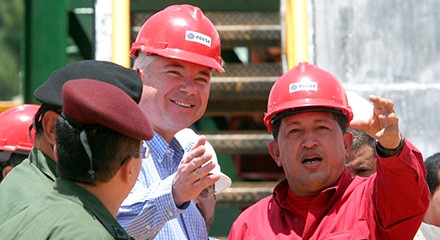
The gains for the working class achieved under president Hugo Chávez in the 2000s were only possible because oil prices reached their zenith. But then commodity prices, including oil, dropped. That more or less coincided with Chávez’s death. The Maduro government lost the support of its working class base, as hyperinflation destroyed living standards. Maduro increasingly relied not on the support of the working class, but on the armed forces, which had special privileges. The military could buy in exclusive markets (for example, on military bases), had privileged access to loans and purchases of cars and apartments, and received substantial salary increases. They also exploited exchange controls and subsidies: for example, selling cheap gasoline purchased in neighbouring countries with huge profits.
The tragedy of Venezuela is that everything depended on the oil price; there was little or no development of the non-oil sectors, which anyway were in the hands of private companies. There was no independent national plan of investment controlled by the state. Given US sanctions on top of that and the continual subversion of the government, the Chávista revolution’s days were numbered.
This is a lesson for all of Latin America. Deindustrialisation since the 1980s and increasing reliance on commodity exports subject all these economies to the volatile swings of commodity prices (agricultural, metals and oil). That makes it impossible for any independent economic policy, given the weakness of domestic capitalists and economies under the shadow of American imperialism.
Michael Roberts blogs at thenextrecession.wordpress.com