
18.12.2025
Release the hunger strikers
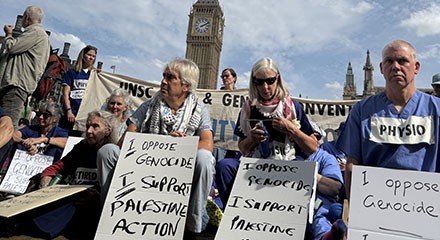
Palestine Action has been proscribed as a terrorist organisation. Now it is illegal to even chant ‘From the river to the sea’ or call for a ‘global intifada’. Government ministers, says Yassamine Mather, are determined to criminalise the entire solidarity movement
Six of the original eight remand prisoners are still on a coordinated hunger strike, some are already in a life-threatening condition. They are protesting against being held without trial and against the government’s proscription of Palestine Action, famous, not least for its ‘red paint’ protest actions. In total there are now 33 pro-Palestine protesters on remand.
All this has triggered a national debate on the misuse of ‘terrorism’ laws, the right to protest and the UK’s arms trade with Israel. And, of course, the health of the hunger strikers is deteriorating rapidly, with doctors warning of an imminent risk of death.
The original eight are:
- Kamran Ahmed (HMP Pentonville, approximately six weeks): he has lost over 10kg, has dangerously high ketone levels and mouth ulcerations.
- Amu Gib (HMP Bronzefield, approximately five weeks): lost over 10kg, has severe exhaustion and muscle twitches.
- Qesser Zuhrah (HMP Bronzefield, approximately five weeks): has lost considerable weight, has difficulty walking and her pulse is never below 100bpm. She collapsed in her cell and the authorities refused to admit an ambulance into the prison. Zarah Sultana has been outside the prison since Wednesday.
- Jon Cink (HMP Bronzefield, approximately five weeks): he barely sleeps, has lost 10kg, has deteriorating vision and life-threatening ketone levels. He decided to begin taking food on December 17.
- Heba Muraisi (HMP New Hall, approximately five weeks): he is struggling to stay alive after catching a cold.
- Teuta ‘T’ Hoxha (approximately four weeks).
- Lewie Chiaramello (approximately two weeks).
- Muhammad Umer Khalid (after a week without food, he ended his hunger strike on December 17).
Five hungers strikers have been hospitalised and Dr James Smith, an NHS emergency doctor in contact with the families, warns that after six to eight weeks on hunger strike, there is “a very, very high risk of death”. Apart from the symptoms listed above, other symptoms include dizziness, chest tightness, memory loss and, obviously, an inability to walk normally.1
Let us not forget that these prisoners have been locked up for nearly a year and have never been convicted of any crime. Their trial dates are still many months away. Their demands include:
- Immediate bail.
- The right to a fair trial.
- The de-proscription of Palestine Action (outlawed as a terrorist group in July 2025).
- The closure of all Elbit Systems sites in the UK (more on this below)
- An end to prison censorship (withholding of letters, phone calls, etc).
Proscription
On July 5 2025, the UK government proscribed Palestine Action under the Terrorism Act 2000, even though it has never advocated violence against anyone. But this proscription makes membership or support for the group a criminal offence punishable by up to 14 years in prison.
The proscription is under historic judicial review in the high court. Lawyers argue it unlawfully violates the rights to freedom of expression and assembly (ECHR Articles 10 and 11) and over 2,000 people have reportedly been arrested simply for expressing support for Palestine Action since the ban.
The insistence of the government and the Crown Prosecution Service that the proscription is both ‘lawful’ and ‘necessary’ is apparently based on “disturbing information” about the group’s ‘criminal’ campaign. But even organisations like Amnesty International have condemned the “misuse of terrorism powers” and “excessively long periods of pre-trial detention”. Lawyers for the prisoners have warned justice secretary David Lammy that there is a “real and increasingly likely potential that young British citizens will die in prison, having never even been convicted of an offence”.2
The hunger strikers were all arrested for protests that targeted Israel’s suppliers of arms and weaponry. These include the ‘Filton 24’, four of whom took part in a protest action in August 2024 against an Elbit Systems facility in Filton, Bristol, where activists allegedly sprayed red paint and caused other damage. Other were arrested for the June 2025 protest at the RAF Brize Norton base in Oxfordshire, where they allegedly caused severe damage to military aircraft destined for Israel.
The reason why Elbit systems was targeted and is mentioned in the prisoners demands is very clear: it is Israel’s largest privately owned arms manufacturer and a central component of the country’s military-industrial complex. Its ties to the Israeli state are extensive and the two cooperate on a number of levels.
The company is a key supplier to the Israel Defence Forces, covering land, air, naval, cyber and intelligence technologies. Its products are designed and upgraded in close cooperation with the IDF and often tested by real combat use. The company is eager to promote this operational experience as a selling point in global markets.
Elbit also plays a major role in Israel’s security infrastructure, including surveillance systems and barrier technologies used around Gaza and across the West Bank. The bulk of its research and development takes place inside Israel itself. Its work on drones, electronic warfare, C4I systems and armoured platforms underpins Israel’s military action, which has seen the slaughter of tens of thousands.
Elbit’s expansion
The Zionist regime’s close political and military relationships with states such as the UK, the US and Australia facilitates Elbit’s expansion abroad. The company typically enters foreign markets through buying or partnering with domestic firms, as in the UK case of Instro Precision, in what are known as offset arrangements. International subsidiaries promise jobs, technology transfer and local investment, making arms deals more acceptable to governments and parliament.
These close links to Israel at a time of genocide are precisely why Elbit’s UK facilities have become targets of sustained protest, particularly by a number of Palestine campaigns and the movement for boycott, divestment and sanctions (BDS). Introducing and exporting weapons from the UK helps rebrand or sanitise this technology, separating it from the realities of Israeli military practices. For Palestine Action, disruption of Elbit’s UK operations is also one way of putting pressure on the British state to bring a halt to military cooperation with Israel.
The situation in Israel and Palestine has, of course, drawn significant domestic and international attention. Over the last few months anti-war activists who support the prisoners have held weekly demonstrations and protests in London and other major cities. In late November, the campaign group, Defend Our Juries, organised demonstrations in 10 locations, including Bristol, Manchester and Birmingham. Over the last few months, those arrested for supporting Palestine Action include an 83-year-old in Liverpool and a very elderly priest, Reverend Sue Parfitt, who was arrested in Parliament Square on July 5 2025. In fact 97 people in their 70s were arrested at the Parliament Square protest on August 9, as well as 15 octogenarians at the same demonstration. All this in the name of ‘national security’.
Your Party MPs Jeremy Corbyn and Zarah Sultana, as well as Green Party deputy leader Mothin Ali, have visited the hunger strikers. According to The Guardian, more than 50 MPs and peers have written to justice secretary David Lammy urging him to meet with MPs representing the hunger strikers and their loved ones, or their lawyers, “and act to prevent a catastrophe”.3
Last week, speaker Lindsay Hoyle told Labour MP John McDonnell, who has written to Lammy about the hunger strikers, that it was “totally unacceptable” for ministers to fail to respond to correspondence. Yet Lammy refuses to address the issue, and most of the British media remain silent on the subject.
When it comes to international solidarity, Palestinian prisoners who were recently released by Israel have sent messages of support, calling the hunger strikers “brothers and comrades”. Activist Jakhi McCray in Brooklyn is undertaking a solidarity fast, while recently freed Lebanese militant Georges Abdallah has expressed support. Supporters of Palestine Action have organised protests outside UK diplomatic offices in various countries, holding demonstrations at British embassies and consulates to draw international attention to the hunger strike. And now 147 leading medical professionals have signed a letter describing the hunger strikes as causing an “imminent risk to their health and life” and a “medical emergency”.
Historic parallels
The current Palestine Action hunger strike has drawn parallels to the 1981 H-Block hunger strike by Irish Republican prisoners, which represents “the largest coordinated prison hunger strike in UK history”.4 The 1981 action saw Irish republican prisoners demanding recognition from Britain as political prisoners.
Today, two current hunger strikers are, as I write, on day 45 - one day less than Martin Hurson lasted before becoming the sixth of 10 IRA hunger strikers to die in 1982. Both hunger strikes resulted in government silence and inaction - Thatcher’s government allowed 10 men to die, before quietly conceding to many of their demands. But, of course, the denial of political status to delegitimise a movement is not new. In the 1970s, the British government’s policy was explicitly described as a long-term strategy of “criminalisation” to alter public perception of the conflict in Northern Ireland.
Today, human rights organisations like Liberty warn that the “extremely broad” UK definition of ‘terrorism’ risks being used disproportionately against protestors, creating uncertainty about what constitutes an offence. In view of what is now happening, that is a gross understatement.
According to The Guardian, “Palestine Action became the first direct-action protest group to be banned under the Terrorism Act”, placing it in the same category as Islamic State, al-Qaeda and the far-right group, National Action.5
Camille Marquis Bissonnette notes that “counterterror legislation has shown, since September 2001, to be a slippery tool when it comes to human rights protection”. The latest act provides “full discretion to states in their definition and application” of what constitutes ‘terrorism’.
This proscription clearly illustrates the use of ‘counter-terrorism’ legislation to stifle specific viewpoints on Palestine - especially given the significant divide between public opinion and the government’s stance. The use of the Terrorism Act establishes a model for targeting various forms of political dissent under the guise of ‘security’ during times of crisis.
-
www.aljazeera.com/news/2025/12/15/increasingly-likely-potential-of-palestine-action-hunger-strikers-dying.↩︎
-
www.theguardian.com/uk-news/2025/dec/16/palestine-action-hunger-strikers-may-die-without-lammy-intervention-lawyers-say.↩︎
-
truthout.org/articles/palestine-solidarity-activists-are-holding-historic-hunger-strike-in-uk-prisons.↩︎
-
www.theguardian.com/politics/2025/jul/04/ban-on-palestine-action-to-take-effect-after-legal-challenge-fails.↩︎