
18.12.2025
Notes on the war
While Ukraine is on the backfoot diplomatically and militarily, the lines of trenches and strongpoints remain essentially static. Perfect conditions for fraternisation and an unofficial Christmas ceasefire, argues Jack Conrad
Donald Trump is determined to force Volodymyr Zelensky and Ukraine into agreeing his 28-point peace plan. What were once red lines are to be junked. No regaining every inch of lost territory. No departure of every single Russian soldier. No Nato membership.
Indeed Ukraine is being told to limit its army to 600,000, relocate its European fighter jets to Poland, concede what territory Russia holds in Kherson and Zaporizhzhia, withdraw from its 20% of Donbas and accept some sort of free economic zone. On top of all that, Zelensky is expected to allow presidential and Rada elections (overdue, because of the war), which he and his party could easily lose. We are told that Trump expects Ukrainian acquiescence by Christmas.1 If not, dire consequences will follow.
With few cards to play, Zelensky has been doing his best to agree, but disagree. He says he supports elections and would put a Ukrainian withdrawal from Donbas to a national referendum. How the question is worded would doubtless play a role. To ask ‘Do you support dismembering the country?’ is to invite rejection. But recommending a ‘demilitarised buffer zone’ might just do the trick. Whatever the wording, one could, though, easily imagine the Ukrainian-Ukrainian population rejecting what will be branded, not least by the far right, as national betrayal. Who knows what would happen then? Regime collapse, an Azov coup, a show trial of Zelensky and his corrupt cronies?
But none of that is really the point here. Zelensky is trying to put Ukraine in a position where it is seen, in American eyes, to be doing the right thing. He wants Vladimir Putin and the Russian Federation to be the problem, when it comes to securing peace, not Ukraine.
What Trump is attempting with Ukraine is best understood by putting it into the context of the recently published National Security Strategy (November 2025).2 This is the latest and fullest statement of what “putting America first in everything” means, when it comes to foreign policy. The Trump administration has unceremoniously dumped the post-World War II so-called law-based international order. Liberals are outraged. Shorn of the Trumpite braggadocio, what is being re-established is the ‘might is right’ transactional politics of 19th century imperialism. American hegemony will take a new/old form: territorial ambition, naked force, protectionism, resource control, colonies.
NSS promises to assert a “Trump corollary” to the Munroe doctrine: America will be “pre-eminent” in the western hemisphere. That means Latin America, Canada and Greenland too (though the latter is not mentioned). Prior approaches to China are rejected as deluded. American trade with China must be “rebalanced” and allies such as Europe, Japan, Mexico, Canada and South Korea are expected to cooperate in achieving that aim (ie, reversing the “inexorable” rise of China).
NSS repudiates the interventionist policy of strong-arming other countries into adopting “democratic or other social change that differs widely from their traditions and histories”. According to The Economist, that is welcome news for “Russia, China and the monarchies of the Middle East”.3 Yet, when it comes to Europe, NSS bluntly declares that “our goal should be to help Europe correct its current trajectory”. It stresses America’s “sentimental attachment” to Europe, especially “Britain and Ireland”, but ominously warns that “European states cannot reform themselves if they are trapped in political crisis”.
“American diplomacy” will therefore “continue to stand up” for what NSS calls “genuine democracy, freedom of expression, and unapologetic celebrations of European nations’ individual character and history”. In other words, America will “promote” the growing influence of “patriotic European parties”: unmistakably Reform UK, AfD, National Rally, Brotherhood of Italy, Vox, etc.
When applied to Ukraine, NSS draws conclusions that mainstream conservatives, liberals and social-imperialists call “appeasement”,4 the “spirit of 1938”5 or “end the war by giving Putin everything he wants”.6 Such types cannot think about today’s Russia outside the Third Reich box. Anyway, NSS envisages an “expeditious cessation” of the war in Ukraine to prevent further escalation. Evidently, Trump is wagering on cleaving Russia away from the embrace of China by offering an expanded sphere of influence and a revived G8, even establishing a G5 … the US, China, Japan, India and, flatteringly, Russia. (Why flatteringly? Because despite its 150 million population and nuclear weapons, economically it ranks roughly on a par with Italy and Canada.)
Cold war
Meanwhile, this winter is set be a real trial for Ukraine, not least its civilian population. Once again Russia is “weaponising” the cold.7 Thousands of drones and missiles have been targeted on Ukraine’s power stations, electricity grid sub-stations and storage facilities. While a good number, around 80%, are intercepted, enough get through to cause considerable damage.
In a country where winter temperatures regularly stay below zero - and in the east and north-east they can go down to as much as -20°C - demand on what is already a strained power grid will be substantial. Even during the summer months shops and restaurants regularly have to resort to diesel generators. This winter has already seen prolonged power cuts, affecting hundreds of thousands of people, many lasting more than 36 hours. For the infirm, elderly and sick, killer conditions.8
Russia has upgraded its main Shahed-type attack drone, doubling the size of its warhead and increasing its range and speed (this is the suicide drone originally developed in and supplied by Iran). Production in Russia is now at a level over “five times higher than a year ago and set to more than double”. In June 2024, around 330 drones of this type were launched against targets in Ukraine. A year later, the figure was “over 5,400”.9
Russia has also significantly expanding production of ballistic and cruise missiles. A Ukrainian military intelligence estimate suggests that Russia may have increased its output of ballistic missiles by “66% in the past year”.10 This poses a very serious challenge for Ukraine’s air defences. The availability of anti-missile missiles is limited. Moreover, an American Patriot missile system is vastly more expensive than a Russian-produced ballistic missile (then there is the little matter of whether or not Trump will allow continued resupply)11.
Perhaps the calculation in the Kremlin is that civilian morale will be slowly ground down to the point of collapse and thereby force a surrender. Unlikely, in my opinion. After all, Ukrainian nationalism has deep roots, which will not be destroyed no matter how many drones and missiles Russia launches. Nonetheless, power cuts are not only a form of psychological warfare. Emergency repairs for the energy sector are hugely costly, and constant outages disrupt domestic heating, water supplies and industrial (eg, arms) production too.
Power war
Not that the weakness of Ukraine’s energy sector should be exaggerated. During Soviet times it was deliberately grown oversized to help cope with bureaucratic socialism’s inefficiencies, low productivity and chronic shortages. Before the Russian invasion around 50% of its energy requirements were met by four nuclear power plants. It still stands at some 50% - or 7.7GW - one of the highest percentages in the world.12 However, since the beginning of the war electricity generation in Ukraine has dropped by about a third - a figure in no small measure accounted for by the loss of the Zaporizhzhia nuclear power plant to the Russian army (Zaporizhzhia, Europe’s largest NPP, is now in ‘cold shutdown’).
Fear of triggering a nuclear disaster has meant, so far, that the three remaining operating nuclear power plants have largely been left untouched - though not their substations and electricity switch yards, which feed power into the grid. There has, moreover, been a drive towards decentralisation and diversification: solar panels, wind turbines, small gas modular turbines, old coal plants recommissioned, etc. That meant that, during the June-September 2025 period, Ukraine became a “net electricity exporter”.13 But it was massive electricity imports from the EU that saved Ukraine from a winter shutdown in 2024-25. Using the ENSO-E system, 4.4GW were transmitted from Europe - a 5.5-fold increase from the previous year.14 Zelensky says it will be the same this winter.15
Of course, Ukraine is conducting its own drone and missile war against Russia. Instead of the energy infrastructure, it is oil and gas refineries. With western targeting support, more than 50% of them have reportedly been hit more than once.16 Ukraine has also targeted fuel depots, pumping stations and other logistical hubs. Prices have risen, exports scaled back and refining capacity reduced (reportedly by some 20%17).
Trench war
Russian forces continue to advance on, or in, Vovchansk, Siversk, Pokrovsk and Hulyaipole, albeit at a snail’s pace. However, in Kupyansk, Russian troops are surrounded. The 100-200 who remain have to be supplied by drones.18 Despite that, Vladimir Putin could triumphantly announce early this month that Pokrovsk had finally been taken - that after a 20-month campaign (with, he did not admit, huge losses in men and materiel). Ukraine, note, insists that its forces still control the north of the city.
Once it was claimed that capturing Pokrovsk, because of its E-50 highway and rail line, would mark a strategic defeat for Ukraine. Logistical supply lines feeding the rest of the Donetsk front would be lost and allow Russia to rapidly advance on Dnipro. Always a dubious proposition.
Now, though, Ukraine has its ‘fortress belt’, running 31 miles through western Donetsk. The ‘hawkish’ Institute for the Study of War, reports that Ukraine has “spent the last 11 years pouring time, money and effort into reinforcing the fortress belt and establishing significant industrial and defensive infrastructure”. There are strongpoints, bunkers, trenches, minefields, dragon’s teeth, anti-tank ditches and razor wire.
Ukraine’s fortress belt is not the only problem Russia faces. There is topography too: “The terrain is fairly defensible, particularly the Chasiv Yar height which has been underpinning the Ukrainian line,” says Nick Reynolds of the Royal United Services Institute.19
It is a similar story along the whole 600-mile long line of conflict. Both sides have chosen defensible positions, established strong points, dug ditches, poured concrete and planted mines. No wonder Russian advances have proved so costly. Attacks by large formations amount to slaughter. For a few yards of sod, thousands die. Instead, Russian generals have turned to infiltration by small groups of two or three men. They exploit natural defensive gaps, use the cover provided by fog and rain, hide in woods, even crawl through disused gas and oil pipelines. Having established a sufficiently strong force, they strike from the rear.
The defensive lines of the Ukraine war are remarkably similar to those of World War I. Having been forced onto the defensive in 1915, the Germans responded by fortifying their front: trenches, barbed wire, machine guns, concrete bunkers. To have any hope of breaching such awesome defences required the delivery, via rail and lorry, of huge quantities of artillery shells, prolonged bombardments and then hugely costly infantry assaults (artillery conquered and infantry held any territorial gains).
Trotsky, at the time, it should be noted, devoted several articles to trench warfare, including ‘The trenches’ (September 1915) and ‘Fortresses or trenches?’ (October 1915). He dismissed the walls, moats and battlements of old fortresses as totally anachronistic - artillery quickly reduced them to rubble. Hence, Trotsky declared, “trenches” had triumphed, and to such an extent that both militarists and pacifists worshipped them.20 Deluded pacifists imagined that state borders protected by trenches could finally abolish war.
Fortress war
However, on the western front fortress warfare continued, albeit in a different form. German chief of staff Erich von Falkenhayn promulgated a military doctrine that allowed for no retreat. As with a fortress under siege, the “standard response” was that any breach of the defences had to be met with swift counterattacks, no matter what the cost.21
Given that German forces had behind them a thousand square miles of captured French territory, such a doctrine was militarily unnecessary, but ensured that the final outcome ultimately depended on who could produce the most armaments and who could sustain the greatest losses in human life.
Certainly, as a “temporary sanctuary”, trenches served as “decisive boundaries, the smallest crossing of which by either side is paid for with numerous victims”. But conditions in the trenches were terrible. Trotsky called them “disgusting dumps”. Alike German, Austrian, Italian, French and British troops found themselves crouching in mud, water and filth. They thought not about the grand plans of monarchs, ministers and generals. Nor did they think about killing the enemy. No, their overriding concern was getting a crust to eat - that, and survival. Trotsky quotes testimony from men at the front about how they would enter into a silent agreement not to fire upon each other.22
Given the vantage of hindsight, it is now crystal-clear that the decision by Russia’s high command to withdraw from Kherson, Izyum, Lyman and the environs of Kharkiv in the autumn of 2022 was no rout, as claimed by a jubilant Zelensky - but, yes, a repositioning, a reset, to secure their forces behind the strongest, most advantageous defensive positions.
True, a hyperbolic storm of protest blasted out from Chechnya’s warlord, Ramzan Kadyrov, and Yevgeny Prigozhin of Wagner. Defence minister Sergei Shoigu and top military commanders were branded cowards, traitors and incompetents, who deserved to be stripped of medals and sent barefoot into battle. Given that Russia had banned any criticism of the conduct of the Ukraine war by making it illegal to “discredit the armed forces”, such language was highly significant. The Wagner coup happened a few months later, in June 2023, and shook the whole of Russia. Vladimir Putin was humiliated, but survived, and - surprise, surprise - successfully won a fifth presidential term in March 2024.
That aside, strategically, it is now obvious that the Russian high command took a German turn in 2022-23. Instead of pursuing the quixotic aim of “de-Nazifying” Ukraine (a euphemism for decapitating the Kyiv regime), Putin was forced to settle on keeping what Russia has got in Ukraine and pursuing a war of attrition. The final outcome will therefore depend on who can produce, or secure, the most artillery shells, drones, missiles and sustain the greatest losses ... and on which side cracks first.
Drone war
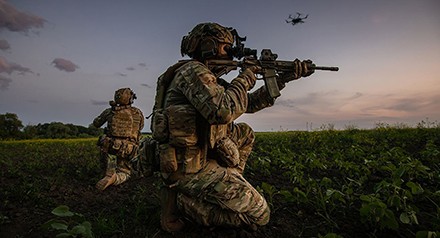
Of course, Ukraine is no rerun of the western front. There are drones, drones, drones. Battlefield skies are thick with them.
Some are tiny and come equipped with nano night-vision cameras or thermal detectors for reconnaissance purposes; others carry large-calibre machine guns or serve as launch platforms for rockets. Some are modified hobbyist drones and are directed by soldiers wearing VR goggles. Some lie on the ground, waiting for passing men and vehicles before exploding. Some are one-way suicide drones. Some carry significant payloads to supply frontline troops with much needed water, food and munitions. Some are preprogrammed, others controlled by radio signal or impossible to jam fibre-optic cable. And drones hunt drones. There are drones which target drone pilots too.23
Drones have created a 15-mile-wide ‘kill zone’ along the front line. Trenches therefore go unmanned. The wounded are left to die in no-man’s land, so risky is it to rescue them. Moving supplies to fighting troops by lorry has become almost impossible. Even using armoured vehicles is to invite a deadly drone strike. Fixed artillery positions have had to be abandoned too. Easy targets.
Rotating troops has become hellishly difficult. According to a report in Politico, “Most soldiers currently die during rotation.” They are forced to spend weeks at the front and when they are due for rotation they have to duck and dive for three or four miles due to the drone threat before being picked up by a waiting car. “That creates a problem with morale.”24 And morale matters. It is far more important than all those Leopard II tanks, F-16s and Storm Shadows put together. As Napoleon Bonaparte famously remarked, “In war, three-quarters turns on personal character and relations; the balance of manpower and materials counts only for the remaining quarter.”25
Wounded soldiers face their own particular nightmare. Sometimes they have to wait for days before getting any kind of proper treatment. Getting them to a medically equipped armoured personnel carrier means hobbling, crawling or being carried the same three or four miles. No wonder so many die. Not that they are safe anywhere near the front line. Drones hover above tracks and roads. Ukraine has, as a result, even turned to robotic surgery and virtual treatment by doctors. And, of course, drones deliver medical equipment, drugs and PPE to the front line.
Ironically, Ukraine’s surging production of drones relies heavily (80%) on Chinese components (navigation systems, chips, magnets and composites). Eg, Ukraine’s Motor-G plant, Europe’s largest producer of drone motors, turns out about 100,000 units per month. “But it still buys its high-grade magnets and copper wire from China.”26 Not surprisingly, because it is such good business, the same pattern applies to Russia’s drones. Roughly 80% of Russia’s drone electronics, motors, fibre optic cables, etc, come from companies of “Chinese origin”, often via Russian fronts (operating under the cover of producing refrigeration units).27
Kill war
Bunkers, trench warfare and static front lines allow for - and encourage - fraternisation. Ordinary soldiers, especially those in non-elite units, dread the prospect on being ordered over the top. The chances of death are exceedingly high. Meanwhile, they endlessly wait and wait and do their best to reduce the discomfort, suffering, boredom and dangers. There is an obvious interest in not being sacrificed in useless military operations. Rank-and-file soldiers and their NCOs frequently take a common stand against the non-combatant officer class safely located in distant command posts. Men in the trenches bond, form a close-knit community. Staff officers are, with very few exceptions, held in utter contempt: out of touch, arrogant, corrupt and determined to save their children from the meat grinder.
Away from the most active fronts, with their cannon fodder, suicide missions and terrible injuries, there is ‘live and let live’.28 If you do not shoot us when we are bucketing out our waterlogged bunker, we will not shoot you when you are bucketing out your waterlogged bunker. The same even goes for drone operators. Some develop a definite fellow feeling for potential victims. While they readily slaughter mass waves, they are often reluctant to end the life of lone grunts or the obviously injured. There is compassion, sympathy, for fellow “pawns”.29 A tacit, always illicit, truce is observed - the antithesis of the official ‘kill, kill, kill’ doctrine. Veterans always instruct newcomers in the arts of ‘not kill’ as well as ‘kill’.
There grows a recognition of mutual plight. The poor buggers on the other side endure the same cold, the same mud, the same infestations of rats, mice and lice as we do. They get to know their neighbours in the nearby bunkers and trenches not only through the drones buzzing constantly overhead, the shells whizzing in and the night raids. They hear the agonised screams, the curses, the familiar songs and the messages shouted in a closely related language (many Ukrainians are bilingual). They will even smell what the other side is cooking. Fellow feeling, empathy, easily develops - as was the case with the rightly celebrated Christmas 1914 in World War I.
This, argues Tony Ashworth, saw “neither the first nor the last instances of ‘live and let live’”.30 Perhaps things began with coinciding mealtimes, perhaps it was night sentries not firing upon each other. Whatever the exact case, on Christmas Day 1914 German troops began setting up Christmas trees above their parapets, lighting candles and singing carols. The Tommies joined in.
A few brave souls ventured out of their trenches. They were met not with a hail of bullets. Instead, others joined them. Smiles, handshakes and hugs followed. Soon thousands were exchanging little gifts. On the British side packets of good cigarettes, on the German side good chocolate. Football matches are reported to have been played: with an improbable 3:2 average score in “favour of the Germans”!31 And such events were far from isolated. They happened here and there, dotted across at least half of the British-controlled western front. Some 100,000 were involved. Naturally, the internationalist left - not least Lenin and the Bolsheviks - welcomed all such acts of fraternisation.
There can be no argument that one of the key preconditions for this and other spontaneous examples of fraternisation lies in the mass anti-war propaganda and agitation conducted by the parties of the Socialist (Second) International.
Nevertheless, it is also worth pointing out that, while most British frontline troops came from a working class (ie, Labourite) background, that was not the case with German forces. Most came from rural areas and therefore peasant stock. They were not natural social democrats. However, the trenches themselves, the commonality imposed by life on the front line, the technology of industrial warfare - proletarianised them.
The dangers of fraternisation were already all too apparent to the officer class. On December 5 1914, general Sir Horace Smith-Dorrien, commander of one of the two corps which made up the British Expeditionary Force, issued these orders:
It is during this period that the greatest danger to the morale of troops exists. Experience of this and of every other war proves undoubtedly that troops in trenches in close proximity to the enemy slide very easily, if permitted to do so, into a ‘live and let live’ theory of life. Understandings - amounting almost to an unofficial armistice - grow up between our troops and the enemy, with a view to making life easier, until the sole object of war becomes obscured and officers and men sink into a military lethargy, from which it is difficult to arouse them when the moment for great sacrifices again arises. The attitude of our troops can be readily understood and to a certain extent commands sympathy. So long as they know that no general advance is intended, they fail to see any object in understanding small enterprises of no permanent utility, certain to result in some loss of life, and likely to provoke reprisals.
Such an attitude is, however, most dangerous, for it discourages initiative in commanders and destroys the offensive spirit in all ranks. The corps commander therefore directs divisional commanders to impress on subordinate commanders the absolute necessity of encouraging offensive spirit, while on the defensive, by every means in their power. Friendly intercourse with the enemy, unofficial armistices (eg, ‘We won’t fire if you don’t’, etc), however tempting and amusing they may be, are absolutely prohibited.32
But such orders were, of course, powerless to stop fraternisation. In subsequent years sentries were posted with instructions to shoot anyone tempted to repeat the 1914 Christmas truce.
A similar story could be told about French and German, Italian and Austrian, and Russian and German troops. High commands on both sides issued instructions forbidding the slightest manifestation of fraternisation. Those who disobeyed were to be treated as traitors. Nonetheless, life on the front line creates a tendency towards fraternisation, even if it is at the level of ‘live and let live’.
Today’s war
The same is true with the Ukraine war. Anything smacking of fraternisation horrifies Volodymyr Zelensky and Vladimir Putin alike. Not surprisingly, therefore, the authorities on both sides impose harsh media censorship and restrict access to the front line. Ukraine has three colour zones: red is completely out of bounds and yellow is accessible to accredited journalists only if they are accompanied by press officers from the defence ministry; green zones are open to every journalist who has received special military accreditation, “which can be a long-winded process”.33
The claim is that such measures are imposed to counter disinformation. Total and absolute nonsense. No, it is obvious that both sides fear honest, objective, truthful reporting: the appalling conditions in the bunkers, the squandering of human life in pointless military operations, the hostile feelings of rank-and-file soldiers towards their politicians and generals … and their fellow feeling for the grunts on the other side.
Not something the social-imperialists want to hear. Instead of promoting fraternisation, the Alliance for Workers’ Liberty, Ukraine Solidarity Campaign, Anticapitalist Resistance, the RS21 right wing and their like deny the self-evident truth that the Ukraine war began with the CIA-directed 2014 Maidan Square coup. After that, Ukrainian-Russians were denied elementary rights and were treated as enemies within. Intolerance, bigotry and murder squads ruled. Breakaway republics, doubtless backed by Moscow, were inevitable. Around 14,000, mainly Russian-Ukrainians, died in what amounted to a civil war in the Donbas.
Despite that, the social-imperialists urge on Ukraine’s oligarkhiya regime to complete victory, oppose any talk of ceasefires, and brand Donald Trump’s peace plan as a rerun of 1938 appeasement. For these traitors to socialism - and, whatever their centrist apologists say, that is exactly what they are - it is ‘Kill, kill, kill’.
-
news.sky.com/story/trumps-28-point-ukraine-peace-plan-in-full-including-land-kyiv-must-hand-to-russia-and-when-elections-must-be-held-13473491.↩︎
-
www.whitehouse.gov/wp-content/uploads/2025/12/2025-National-Security-Strategy.pdf.↩︎
-
The Economist December 5 2025.↩︎
-
The Independent November 22 2025.↩︎
-
C Carly ‘Don’t call this a “Peace Plan”’ Foreign Policy November 24 2025.↩︎
-
J Denham ‘End the war? By giving Putin what he wants?’ Solidarity December 3 2025 The author has taken the liberty of removing the question mark when quoting Denham.↩︎
-
www.cbc.ca/news/world/ukraine-russia-attacks-peace-talks-9.7014857.↩︎
-
ukraine.ohchr.org/en/Increasing-attacks-on-Ukraine-s-energy-infrastructure-place-civilians-at-risk-UN-human-rights-monitors-warn.↩︎
-
www.chathamhouse.org/2025/11/ukraines-best-defence-against-putins-energy-war-more-attacks-russias-oil-refining-sector.↩︎
-
Ibid.↩︎
-
Patriot missile systems, which include radar, logistics, etc support, come in at a cool $2.37 to $2.5 billion each. A single Patriot missile is estimated to cost around $4-$10 million. Not that Russian ballistic missiles are cheap: a Kinzhal hypersonic missile costs around $10-$15 million each.↩︎
-
www.iea.org/reports/ukraines-energy-security/a-pre-winter-assessment.↩︎
-
Ibid.↩︎
-
energy.ec.europa.eu/news/2-years-ukraine-and-moldova-synchronised-electricity-grids-eu-2024-03-15_en.↩︎
-
www.ukrinform.net/rubric-economy/4046973-zelensky-after-one-or-two-more-attacks-ukraine-may-need-to-import-electricity.html.↩︎
-
www.chathamhouse.org/2025/11/ukraines-best-defence-against-putins-energy-war-more-attacks-russias-oil-refining-sector.↩︎
-
www.rferl.org/a/ukrainian-drone-strike-russia-kazakh-oil-exports/33612902.html.↩︎
-
understandingwar.org/research/russia-ukraine/russian-offensive-campaign-assessment-december-14-2025.↩︎
-
Mistranslated by Isaac Deutscher as “French” in The prophet armed: Trotsky: 1879-1921 Oxford 1979, p228n - see ID Thatcher Leon Trotsky and World War One: August 1914-March 1917 Glasgow 1993, p34n.↩︎
-
A Jones The art of war in the western world London 1988, p456.↩︎
-
ID Thatcher Leon Trotsky and World War One: August 1914-March 1917 Glasgow 1993, p27-28.↩︎
-
S Brown and L Chiu ‘Military drones in Ukraine - a beginners’ guide’ Kyiv Post October 25 2025.↩︎
-
www.politico.eu/article/surviving-the-killzone-how-drones-erased-frontline-and-changed-war-in-ukraine.↩︎
-
E Knowles (ed) The Oxford dictionary of quotations Oxford 1999, p538.↩︎
-
www.politico.com/newsletters/global-security/2025/10/08/ukraines-made-in-china-problem-00596483.↩︎
-
The term can also be rendered as ‘rest and let rest’ or ‘let sleeping dogs lie’. During World War I such tacit truces developed into a widespread, unofficial, culture of minimising death, violence and suffering - see T Ashworth Trench warfare 1914-1918: the live and let system London 2000, p18.↩︎
-
www.mentalhealthjournal.org/articles/remote-warfare-with-intimate-consequences-psychological-stress-in-service-member-and-veteran-remotely-piloted-aircraft-rpa-personnel.html.↩︎
-
T Ashworth Trench warfare 1914-1918: the live and let live system London 2000, p24.↩︎
-
Quoted in A Richards The true story of the Christmas truce: British and German accounts of the First World War Barnsley 2001.↩︎
-
www.opendemocracy.net/en/odr/ukraine-journalists-media-restrictions-self-censorship.↩︎