
04.12.2025
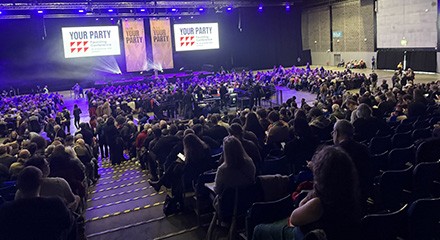
Ideas, unity, action
Yassamine Mather reports on the fringe meetings organised by the Socialist Unity Platform. The aim was not to paper over differences but to present them, explore them and debate them. Needless to say, this was not just a top table event. Each session involved plenty of contributions from the floor
There is a famous Persian proverb which essentially translates: “If God or destiny wills it, even the enemy can become the cause of something good.” In some ways, inadvertently, Jeremy Corbyn and the bureaucrats who were trying to stitch up the Your Party conference have achieved something many of us never thought we would see: a degree of real unity among the various groups of the radical left in Britain. Of course, it was a temporary tactical alliance and had its own problems, but, we can build on this, as we will all face the expected witch-hunt in YP.
The Socialist Unity Platform was formed after a series of discussions convened by the Democratic Socialists of Your Party, who believe that unity between socialist groups and organisations can build the power needed to intervene effectively.
This process began with discussions at The World Transformed event in October, where a united proposal was put forward by various YP platforms and factions. The DSYP built on this success by broadening unity negotiations, issuing open invitations to groups across the British left and to YP proto-branches.
I attended several of the pre-conference meetings. Members of the following groups and organisations were present at some of these Socialist Unity Platform meetings: the Bolshevik Tendency, Campaign for a Mass Workers Party, Communist Party of Great Britain, Democratic Bloc, Democratic and Socialist Network, Democratic Socialists of Your Party, Greater Manchester Left Caucus, Haringey Socialist Alliance, Marxist Strategy, Merseyside Pensioners Alliance, Platform for a Democratic Party, Sheffield Left, Socialist Alternative, Socialist Workers Party, Spartacist League, Counterfire and the Trans Liberation Group, as well as individuals from YP proto-branches.
I must stress that this was not any kind of alliance, but merely a short-term series of coordinating meetings. Contrary to some media reports, SUP had no intention of disrupting the Liverpool conference. Our aim was always to oppose the standing orders and, when that failed, to ensure that as many speakers from the left as possible could get to the microphone. Given the speakers from the SWP, SPEW, SocAlt, Counterfire and the CPGB who addressed conference, that alone can be considered a victory.
Nevertheless, the SUP organising committee achieved a major success by planning the details of a nine-hour fringe meeting held on Saturday November 29. Its positive aspect was that a range of different views were presented, although the early sessions were sparsely attended, because, to our surprise, many comrades from left groups and parties were sortitioned and ended up inside the conference hall.
If I am not mistaken, the fringe meeting required a great deal of effort to organise, and I do not think it would have happened without SUP comrades’ tireless work in reconciling conflicting proposals for subjects and speakers.
One issue - retrospectively a diversion - was the suggestion to livestream the conference inside the fringe meeting. This was inappropriate from the start: comrades cannot both listen to speakers and follow a livestream. Technically we managed it, but in practice many comrades - including some organisers - ended up sitting in the corridor with laptops and phones, following the livestream instead of attending the fringe.
Artificial Intelligence
The first session was on ‘Digital democracy, crowd-editing and the problems with one member, one vote for leadership elections’. In this session Charlie Porter (DemSocs), patcon (of Metagov - “the laboratory for digital governance”) and I spoke.
Advocating the AI tool, Pol.is, patcon distinguished it from typical “AI-assisted deliberation” tools that analyse a “soup of words”. Instead, Pol.is captures people’s reactions to individual ideas, creating a visual map of participants. This reveals subgroups and “boundaries”, helping to uncover “deep points of agreement” underlying disagreements. His core thesis is that “making these social and opinion-based boundaries visible is essential for productive group dialogue”.
I criticised what we know of the AI tool used by YP to summarise assembly transcripts, highlighting a “lack of transparency” - its workings being a ‘black box’ requiring blind trust. I echoed Inácio Vieira’s comments about the use of arbitrary metrics like “90% agreement”, which appeared to us a deceptive gimmick. Broadening the critique, I argued that such tools have an inherent bias, favouring the tech-savvy. They oversimplify debates and “cannot replicate the essential, dynamic process of live debate”. As a result, they are “fundamentally unsuited for core political debates” involving radical ideology, and for Marxists “real meetings where ideas are contested and debated remain irreplaceable”.
Charlie Porter (Democratic Socialists) offered a structural critique, arguing that digital tools create only a “veneer of mass engagement”, while being exclusionary. He warned that they “undermine real political building” focused on local branches. A major danger is the creation of “hyperleaders” - charismatic, unaccountable figures, who gain direct digital mandates, entrenching separation from the base. This leads to “party fiefdoms” controlled by “party lords”. He argued these tools are “a poor substitute for in-person, branch-based democracy” and risk creating a “shallow, centralised, leader-focused party structure”.
Climate
The session on climate change and eco-socialism opened with Chris Saltmarsh of Ecosocialist Horizons and Tim Head from Organising for Popular Power. Chris explained why there was a need for this newly formed tendency to address the party’s failure to treat the climate crisis as central to its politics and strategy. He argued that climate and socialism are inseparable: socialism cannot be built on a collapsing ecological foundation, and the climate crisis cannot be solved under capitalism, which is structurally incapable of a rapid, planned transition. Eco-socialism is therefore essential rather than optional.
Chris outlined a dual strategy: a short-term tactical transition, focused on rapid decarbonisation, state action to discipline capital, and a combination of electoral interventions with strong grassroots movements; and a long-term eco-socialist transformation, aimed at democratising the economy, reconciling production with planetary limits, and going beyond decarbonisation to address the question of wider ecological breakdown. He described the climate crisis as the defining contradiction of our era, already passing tipping points and threatening the conditions for socialism.
He closed by posing three strategic dilemmas for YP: how to balance urgent climate timelines with slow party-building; how central climate politics should be when voters prioritise cost-of-living issues; and how to win major concessions from the capitalist state, while simultaneously building the power to defend them. Overall, the intervention positioned eco-socialism as a necessary framework for the left’s future strategy.
The second speaker, Tim Head, was critical of ‘electoralism’ - the idea that winning elections is a sufficient strategy for change. He argued that, while elections are necessary, they are not sufficient for achieving socialist or climate goals, advocating a focus on grassroots organising. Comrade Head added that real power comes from building a strong social base and popular power through mass-movement organisation, rather than relying primarily on electing politicians. This point was illustrated by the example of a small number of Green MPs being a “limited victory” in his view.
Quotas
The next session was titled ‘Should we call for quotas?’, with Steve Owen (Democratic Socialists) speaking in favour and Mike Macnair (Communist Platform) against.
Steve made a case for using quotas and specific measures to boost diversity in socialist leadership. He argued that quotas for women, racial and sexual minorities, and trans people are an important tool to address the chronic underrepresentation of oppressed groups in leftwing party leadership - a political problem, not just a numerical one. Quotas serve two purposes: they ensure that leadership bodies more accurately reflect the working class; and they force factions within the party to seriously develop their politics on oppression and liberation by recruiting, supporting and listening to comrades from underrepresented groups.
Responding to objections, he rejected the claim that quotas are “undemocratic”, arguing that socialist democracy is about collective representation and principled politics, not individual popularity. He acknowledged the risk that bureaucracies might misuse quotas for tokenism, but insisted this danger can be prevented through strong democratic structures, such as open factions, proportional voting systems and free debate. Overall, quotas were presented as both necessary and politically enriching for a socialist party.
Mike Macnair argued against the use of formal quotas, drawing on his lengthy experience in the International Marxist Group, which used a slate system with a nominating commission that was tasked with balancing genders and promoting racial minorities. He acknowledged this was a membership choice, but the point is more complex. Comrade Macnair argued that effective leadership often emerges from comrades from oppressed groups pushing themselves forward - a trend visible throughout history.
He argued that the solution to underrepresentation is not quotas, but politics and political campaigning. Conversely, he warned that quota systems are frequently used by bureaucracies to maintain control, something he witnessed in the IMG, where slates ensured representation of those loyal to the apparatus. This bureaucratic manipulation is not unique: one could mention the US New Communist Movement, which fractured over “competing oppressions”, and the large Italian group, Lotta Continua, which tore itself apart over similar “intersectionality” policies without a clear political line.
Comrade Macnair also cited a practical example: a union branch that once elected an all-women executive to promote feminism. It failed because the women elected had the same political disagreements as the wider membership, and it did not substantially change their work. As far as he was concerned, successful campaigning - such as against the Thatcher government’s anti-homosexual Section 28 - was built on political action, not quotas. The underlying danger, he stressed, is that the principle behind quotas carries a dynamic of sectionalism and splintering.
In conclusion, comrade Macnair argued that promoting women or black comrades into leadership is not a bad idea. The argument for quotas was often about challenging old-guard trade unionists to promote feminism, and in a larger pool you naturally find more diverse individuals. The point is, however, that, while we certainly want to promote such comrades, the primary mechanism must be political struggle and clear programmatic unity, not a system that risks internal division and bureaucratic cooptation.
Middle East
The next session was on Palestine and wars in the Middle East. I was one of the speakers; the other was the pro-Palestine activist, Ryan Belhadj.
Comrade Belhadj rooted his contribution in his work with the Palestine movement in Manchester, arguing that the struggle has been central to the formation of YP and offers essential lessons for the UK left. He stressed that the Palestine movement provides a model of effective extra-parliamentary action - such as shutting down arms factories and driving divestment - that must inform broader class struggle. Internationalism, he argued, is non-negotiable: British workers’ liberation is tied to global liberation, and any left politics confined to domestic issues is doomed, given that UK capitalism relies on the “spoils of colonialism”. He explained how Zionism was a blueprint for modern repression, meaning that solidarity with Palestine is a defensive fight for all oppressed people.
Comrade Belhadj also insisted that the Palestine movement is the main catalyst for current possibilities of left unity, which must include not only parties and factions, but also grassroots social movements. He warned against both external state repression, such as anti-terror legislation, and internal compromises with bourgeois Palestinian authorities that undermine revolutionary forces. Ultimately, he argued that real power comes not from electoral gains, but from building militant, community-rooted movements, capable of forcing change.
I tried to address the ongoing situation in the region, stressing that, while Hamas is not currently fighting, Israel’s relentless bombings continue every single day, making this a brutally one-sided conflict. The so-called sponsors of any peace process - the US, Qatar, Egypt - are no friends of the Palestinians, whose plight remains extremely dangerous. Slightly increased food aid is a pathetic measure of ‘improvement’ that masks a horrific reality.
The risks are escalating. Israel’s assassination of a Hezbollah figure in Beirut this week shows how state-sanctioned murder in foreign countries has become the disturbing new ‘norm’, hypocritically ignored by those who claim to uphold international law. I added that the region is now facing the extremely unpredictable threat of a wider war, particularly a potential second Israeli attack on Iran. The scenarios propagated by Netanyahu and his allies are illusions. The fantasy of a ‘smooth’ regime change led by an exiled, Zionist-supported figure is a joke - look at the ‘smooth’ results in Iraq, Afghanistan and Libya.
The media’s focus on Iran’s nuclear programme is a myth, used to justify war. Iran does not have a deliverable nuclear weapon, unlike nuclear-armed Pakistan or Israel, which secretly possesses hundreds. This is about creating pretexts for further conflict.
The entire region is on a knife-edge. Given this profound danger, it is absolutely essential that YP should be unequivocally anti-Zionist. We cannot have a leader who is unable to state that clearly.
YP programme
The next session was entitled ‘What kind of programme for Your Party?’, with Mike Macnair, Ted Reese (DemSocs), Richard Brenner (Marxist Strategy), HaPe Breitman (Marxist Bulletin) and Vincent David (Spartacist League).
Comrade David spoke first, reflecting on the day’s conference and arguing that the leadership had escalated its offensive against the left - evident in the purge of the SWP and attacks on figures like Zarah Sultana. Conference itself was tightly stage-managed by the bureaucracy, but what stood out was that the right wing also had genuine support among many delegates. The central political conflict is now clear: a liberal, ‘moderate’ right that wants a ‘respectable’ party free of socialist influence; versus revolutionary socialists fighting for a working class, socialist alternative.
He insisted that simply defending democracy or opposing witch-hunts is insufficient, because significant sections of the party back the right’s agenda. The core problem is the revolutionary left’s lack of political coherence. What is needed is unity around a clear, shared political platform, not just procedural unity. He pointed to examples, such as Zarah Sultana herself: while she takes strong positions on Nato, Zionism and trans liberation, her programme remains limited on issues like the climate crisis.
He argued that revolutionary socialists must articulate independent class politics, including on controversial issues, such as immigration: oppose racism and deportations, defend immigrants, but also reject the ruling class’s use of immigration to depress wages. The goal is to develop a distinct working class position, not to echo liberal slogans or capitulate to the right. He concluded by stressing the need for revolutionary unity and a firm commitment to defending one another, including upholding trans rights.
For his part, Mike Macnair selected five key points to introduce a discussion that may initially seem abstract. According to him, this abstract starting point is necessary, because we must first analyse the foundational situation: specifically, the substantial and broad-based support within the party for Corbyn’s project, correctly observed earlier.
What is that project? It is essentially the ‘official’ Communist Party’s British road to socialism - the idea that the first step is to get a Labour government, and then other Labour governments further to the left. Having been thrown out of the Labour Party, Corbyn’s project is to create a Labour Party mark two, which - just like the current party - is within the framework of British parliamentary dominance, the party apparatus and a commitment to parliamentary politics.
On the one hand, the left keeps reinventing the square wheel in the form of popular front-type reformism, which is what the British road to socialism was. When people talk about Britain playing a positive role, we must consider the real role of the British state - for example, supplying weapons to Israel through RAF Akrotiri, flying reconnaissance for the IDF over Gaza, and so on. So the position needs to be unambiguously anti-imperialist and unambiguously defeatist - just as defeatist in relation to Britain’s and the United States’ proxy war in Ukraine as in relation to the genocide in Gaza.
Second - and this is where controversy begins, he said - we need a maximum-minimum programme. The maximum programme promotes the idea of getting wholly beyond capitalism. It is not enough to offer piecemeal answers for immediate struggles. We need to be propagandising for a society completely beyond current class society.
It is a programme counterposed to mere mass mobilisation. It is a programme for the immediate changes a workers’ government - or a government of workers’ parties - could make that would break the political power of the capitalist class and create the conditions for a transitional process. For example, the expropriation of the City of London emerges immediately. A programme for re-industrialising Britain alone is an illusion, because Britain deindustrialised precisely because it was the world’s hyper-imperialist power before the US.
We therefore also need a minimum programme: a programme for taking political power. He concluded with comments about the need for political democracy in the workers’ movement.
Next, HaPe Breitman emphasised the need for democracy within the new party, where every member should be heard and every position discussed. He argued for support for oppressed nations in their fight against neocolonialism. Referring to the protests and strikes in Italy over Palestine, he commented that blocking the transport of military hardware to warmongering countries not only expresses solidarity with the oppressed, but is also crucial for building the self-confidence of the working class.
Richard Brenner argued that socialist demands must be tied to a concrete strategy for mass mobilisation, turning the working class into an active, fighting force. He called for direct action against the cost-of-living crisis - such as a campaign for a price freeze, targeting supermarkets and food corporations - and highlighted local organisation for free public transport as an example of how militant action, not just elections, can win popular support. These struggles, he said, must connect to broader demands like nationalising key industries, pegging wages to inflation, and coordinating mass strike action across unions.
Comrade Brenner insisted that YP must be rooted in real working class struggles rather than functioning as a hollow electoral machine. He also addressed the rise of the far right, calling for a unified working class defence organisation, combining legal, digital and physical protection for migrant communities, comparable to the Community Security Trust.
He urged campaigns for a rent freeze, defiance of anti-union laws, and worker-led control over technology and production - leading logically, he argued, to expropriating banks and major corporations and centralising economic planning under workers’ control. In closing, he reaffirmed the need to fight for democratic demands, oppose repressive legislation, and insist that MPs act as militant representatives on a workers’ wage. Above all, he stressed that socialist power comes not from parliamentary mandates, but from mass mobilisation.
Ted Reese argued that socialism must go far beyond Corbyn-style social democracy, which relies on a mixed economy that capitalism cannot sustain. Capitalism, he said, is structurally incapable of meeting working class needs and increasingly survives only through intensified exploitation, unemployment and ecological destruction. While reforms and concrete campaigns remain essential, the movement must build power in streets, workplaces and communities, guided by DSYP’s democratic programme and points of unity. He argued that capitalism’s social, economic and environmental crises are interconnected, with automation deepening systemic instability. Austerity is not merely a political choice, but a survival strategy for capital, and reversing it alone is insufficient. Ultimately, he insisted, real change cannot come from electing socialist MPs: it must be built from below, as the ruling class will never give up power voluntarily.
Where next?
Speakers in the last session were Max Shanly (DemSocs), Lewis Nielsen (SWP), Shabbir Lakha (Counterfire), Mike Forster (Campaign for a Democratic Party), Sophie Wilson (Sheffield YP) and Jack Conrad (CPGB).
The chair opened the meeting by noting the “bad news”: Zarah Sultana, who had previously agreed to speak, was absent as she had another meeting to address. But there was also “good news”: genuine unity on the left, with groups talking to each other for the first time in years, said comrade Roberts. She described how the Socialist Unity Platform emerged out of necessity, anticipating the undemocratic outcomes seen at conference.
The day’s events - particularly what could be called Karie Murphy’s “masterclass of manipulation” - showed how bureaucratic manoeuvres blocked democracy by shutting down debate, excluding hundreds of amendments, and preventing discussion of core questions, especially the forming of a party of the left. Regional assemblies had overwhelmingly supported a broad, open, left party, yet the conference offered only tightly controlled options and disallowed meaningful amendments.
Despite the setback, comrade Roberts insisted that the left cannot walk away; instead, it must regroup, learn from what happened, and continue building democratic structures, where differences can be discussed without sectarianism. She warned that exclusions like that imposed on Lewis Nielsen are only the beginning, echoing past Labour Party purges, and argued that the bans and stitch-ups should not be recognised. Everyone should be welcomed, the ban ignored, and resistance maintained if attempts are made to enforce it.
Forward
Mike Forster began by saying he wanted to reflect honestly on what had happened at the conference so far and how the movement should now move forward. He described the preceding weeks as chaotic and demoralising: MPs resigning, members being denied entry, YP factions threatening each other with legal action, and relentless, hostile media coverage. Internal disorganisation compounded the crisis - key documents arrived late, motions were unclear and delegates received confusing or contradictory instructions about amendments. Comrade Forster said he arrived feeling dispirited and uncertain whether anything productive could emerge from the gathering.
Despite this bleak atmosphere, he explained that Saturday’s events had actually restored some optimism. The leadership had done everything possible to shut down political discussion: cutting microphones, preventing speakers from taking the floor, and attempting to tightly choreograph the debate. But these efforts largely failed. Delegates on the left repeatedly improvised ways to speak and refused to let the leadership bury contentious issues. Even the chair struggled to maintain control.
Sophie Wilson spoke about the experience of Sheffield and how the membership had formulated the Sheffield Demands. By informing, involving and freely debating Sheffield has become something of a model YP branch. She was convinced that Sheffield would not implement any witch-hunt. The left must stay united.
Introducing the next speaker, the chair referred to that day’s Daily Telegraph, which had published a sensational story claiming there was a “communist plot” to disrupt the conference and an attempted CPGB-organised takeover. She introduced Jack Conrad to address this accusation and clarify whether such a plot ever existed or was ever intended.
Comrade Conrad began: “I don’t really know what to call myself - ‘delegate’ isn’t the right word. I was selected through sortition. I didn’t expect to be chosen. Either way, I was selected to participate for two days.” His overall impression was exactly what he expected: this was going to be a stitch-up, and it was a stitch-up.
He rejected the idea that the leadership was merely incompetent: “These people are cynical. They’re very used to organising, and are very skilled at it.” He continued:
What kind of conference did I want? One where we listen to debate, we clap, we cheer - and then we do what should happen in a conference hall: you raise your hand and you vote. That should have been our conference … we won the argument. But we didn’t vote. You may have voted on some small things, but ask any ordinary person: after a debate, how do you conclude it? You vote. It’s basic political culture.
He added a few remarks on political culture and, in particular, heckling, noting its origins among Dundee jute workers, where the ‘heckler’ was the person elected to read leftwing newspapers aloud in the noisy factory. “Heckling is a democratic right.”
He invoked Lenin’s speeches at congresses, where figures like Bukharin would shout, asking a pointed question and Lenin would respond, often brilliantly. That, comrade Conrad insisted, should be our culture - democratic, thoughtful, noisy, robust and passionate, not stage-managed, with constant demands for respect, civility and silence. He described how he learned only afterward that a comrade from Socialist Alternative had been cut off mid-speech for those watching online, thus depriving members of one of the best speeches of the day. “Pure cynicism - a disgrace.”
His conclusion: “Go back to the branches. Do not carry out the witch-hunt. If you allow the witch-hunt of one organisation or one individual, all will follow. And some of those imposing the witch-hunt will discover they are a problem too.”
Lewis Nielsen
The next speaker was Lewis Nielsen (SWP), who had been expelled from YP the previous day. He said he had hoped to share his experiences and thoughts on the atmosphere on the conference floor, but he was not allowed in. He added, jokingly, that reports of a dramatic row with Jeremy Corbyn on the train were nonsense: “We had a good chat, and I even offered to buy Lara a cup of tea.”
Unable to comment on the conference atmosphere, he instead addressed the political stakes. He argued that two facts confront the left. First, Nigel Farage is now the dominant figure in British politics and may well be the next prime minister. If he wins, the state will round up migrants and detainees on a scale reminiscent of the United States. Labour has done similar things, and Barack Obama did them in the US, but the scale envisioned by Trump - and now Farage - is far greater.
Second, Keir Starmer is paving the way for Farage at a pace few predicted. His attacks on working class living standards and increasingly racist rhetoric from senior figures, such as secretary of state Shabana Mahmood, remove any real alternative. This is why debates happening now - at conference, in branches, online - are crucial.
Yet he struck an optimistic note: “Remember August, when 800,000 people signed up. People who never attend demonstrations, who aren’t in far-left groups, told me they had joined.” So how did the party go from booking a 13,000-capacity hall to ending up in the 1,000-capacity one next door? We can focus on personalities, he said, but fundamentally this is about Labour politics. “We kept saying we didn’t want a Labour Party mark two, yet the same unelected people who ran Labour are running this new party.”
Still, he argued, the energy behind the 800,000 sign-ups has not disappeared. Some are joining the Greens, but the Greens are not the answer. So what must be done? First, we need a united party. He supported Jeremy and Zarah being part of the collective leadership - not out of illusions, but because their supporters must be won to a more radical programme. Second, we need more democracy, not less. Numbers have fallen from 800,000 to 50,000 paying members (and now to around 1,000 at the conference), because there has been no genuine democracy. The leadership fears the membership.
Third, we should stand candidates wherever possible and, finally, we must be radical. Mélenchon is no saint, but the insurgent energy around him is the sort we need - anger at the establishment, a recognition that the left must build to defeat the right: “Insurgent politics can win. Around 90% of this party supports these principles. People want a party that unites the left and opposes the far right - and we should deliver it.”
The chair introduced the next speaker, Shabbir Lakha from Counterfire, reminding the room that the comrade who tried to challenge the standing orders earlier that morning was from his organisation - “so well done to her”. Shabbir argued that the conference exposed the emptiness of claims about a ‘new’ democratic way of organising. Instead of empowering members, it reproduced the control of a small, unelected clique - from selections to conference management. The conference should have been massive and politically transformative, showcasing the strength of the 800,000 who originally signed up and sending a warning to Starmer and Farage. Its failure to do so is a major missed opportunity.
Excuses about the process being ‘messy’ are being used to justify actions that undermine democracy, such as expulsions. Yet despite the controlled agenda, many attendees clearly opposed expulsions and supported more democratic structures. The attempt to keep revolutionaries out - like the last-minute expulsion of the SWP - have failed.
Shabbir also highlighted the lack of substantive political discussion. Meanwhile, 100,000 people were marching for Palestine in London the same day - an example of a real mass movement that created space for the new party. That movement, built largely by the revolutionary left, represents the working class constituency the party must root itself in.
Looking ahead, he called for a broad, socialist, anti-neoliberal party that includes the revolutionary left rather than excluding them through purity politics. The stakes are high: this party is the best opportunity in a century to build a serious alternative to Labour. To succeed, it must champion genuine democracy, embed itself in mass movements, and develop a unifying programme that resonates with working class people.
The overwhelming feeling in the room - and the contrast between 800,000 sign-ups and fewer than 5,000 at the conference - shows strong support for a radical, movement-rooted, insurgent party. That is the direction Shabbir urged the left to fight for.
Wizard of Oz
Max Shanly, of the Democratic Socialists, began with a wry aside about searching for journalists and security-service types in the audience, before turning to the surreal state of the party. He described how members collectively spent £180,000 attending the event - he himself paying hundreds in transport and accommodation - only to find a process that felt like a pantomime, with Jeremy Corbyn cast as the Wizard of Oz. What should have been a democratic conference had become, in his words, “smoke and mirrors”, run by a self-appointed clique more interested in preserving their own privileges than building a socialist party.
He recounted how those who once campaigned for internal democracy have now degenerated into bureaucrats who bully members, report comrades to state institutions, and preside over the collapse of membership from 800,000 expressions of interest to barely 50,000 members. For him, this crisis reflects an internal class struggle: a ruling caste within the party claiming superiority, while blocking the liberation of working class people. Their behaviour - trading £100,000 jobs, carving up regional power, treating the party as private property - shows that the era of monarchic leadership must end.
Yet he insisted on hope: the left’s future is bright, unity is possible, and a truly democratic, republican form of party organisation must be built. That struggle, he argued, begins within the party itself and continues until both its internal autocrats and the wider monarchy of British politics are overcome - replaced by a republic, where everyone stands as an equal participant in their own governance.
The meeting can be viewed on YouTube