
27.08.2026
New records for old
Civilisation itself is in danger. Heatwave after heatwave gives a terrifying glimpse of what the future holds. And now, after the thunderstorms and floods, we face a sixth heatwave, writes Eddie Ford
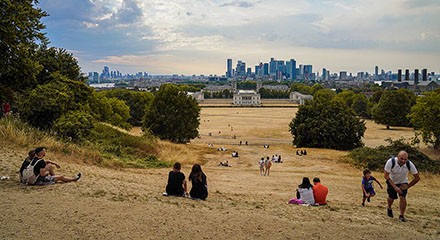
Part of a broader sequence of extreme heat events across western and central Europe, the UK has just experienced its fifth recent heatwave - this in a country once famous for its moderate climate.1 Hence the hottest day of the year was 38.1°C recorded at Kew Gardens in southwest London on August 13 - which is fitting in some way, as the first heatwave that started on May 22 also saw what was then a record temperature of 34.8°C at the very same place on May 25, surpassing by 2°C the previous record set in 1922.
This intense heat made 2026 the first year on record to see three separate days where temperatures reached at least 37°C, as well as the first year with four days at 36°C or above. So far (but watch this space!) the highest temperature ever recorded in the UK was on July 19 2022, when temperatures reached 40.3°C - which marks the only day when a reading above 40°C has been recorded.
All this shows that the UK is on course to record its hottest summer on record for mean temperature, with only average conditions needed for the remainder of August to surpass the record set only last year. Therefore provisional Met Office statistics show that the UK’s mean temperature for this year’s meteorological summer2 - due to end on August 31 - currently stands at 16.48°C, which is 1.88°C above the 1991-2020 average.3 Any hotter than this would establish a new UK record going back to 1884. Also, significantly, the country has so far had the hottest summer on record for average maximum temperatures - the previous record set in the iconic summer of 1976.
Apocalyptic
There is now speculation about another heatwave in September, with computer-forecast models suggesting that high pressure may become established to the south of the UK through the first part of September.4 There is also the fact that July was the driest on record across England and Wales since records began in 1836, with more than two thirds of England and all of Wales currently officially in drought (there are widespread hosepipe bans across southern England). And, when soil is very dry, air temperature can rise more rapidly - because no energy is lost in evaporating any soil moisture, so it goes directly into heating the air. Another additional factor is marine heat that can also influence the temperature on land, with the seas around England and Wales currently up to 3°C above average.
Anyhow, the long-range forecast for September, October and November from the Met Office suggests that the chance of a warm three-monthly period is “higher than normal” - meaning an “increased risk of heatwaves and heat‑related impacts, especially during the first half of the period”.
The long-range forecast also suggests that the three-monthly autumn period is likely to be drier than average. This spells bad news, as the unprecedented drought and the record-breaking heatwaves we have recently seen have led to devastating wildfires in which over 23,359 ha (57,720 acres) of land has been burnt.5 This brought particular devastation in Stourbridge, West Midlands: on the hottest day of the year “apocalyptic” fires broke out, destroying 19 homes and a producing a wildfire covering about 16 hectares. Andy Burnham visited the area shortly after, saying Britain “is a tinderbox right now”, as he announced plans to commission firefighting planes to combat the spread of wildfires - he also appointed a life peer, Baroness Blake of Leeds, as the UK’s first ever fire minister.6 That should put a stop to it!
Of course, these heatwaves represent a statistical acceleration of what climate scientists had already modelled, but hoped would take longer to arrive. The climate crisis is speeding up and could hurtle temperatures to 3°C, 4°C and beyond above preindustrial levels - never mind the 1.5°C accepted in the Paris Agreement. Indeed, the Institute and Faculty of Actuaries - not an organisation known for its radicalism - has calculated that temperatures of this order could bring about “civilisational collapse” some time between 2070 and 2090.7
Delusion
Not that you can tell that to the crazies. Thus Richard Tice, the deputy leader of Reform UK, told a press conference that people should “enjoy” the heatwave and “if it means that English wine and sparkling wine gets better and better, fantastic”, rather than “just be sort of doom and gloom about it”.8 Then he went on to inform his audience that “climate change has always happened” and “it always will”, suggesting that the “smarter thing” to do is “to adapt to it than think arrogantly that you can stop it”. He declared that there “no evidence” that net zero is “going to stop it”.
If by “net zero” you are alluding to meaningless pledges by government ministers to hit this or that climate target, or the greenwashing efforts by various capitalists to market and sell their products, then we would be the first to agree - you need a complete systems change if you genuinely want to confront the climate crisis. But, of course, he does not mean that - quite the opposite: Tice believes that “net zero” is far too radical and must go. Reform has long campaigned to scrap the government’s commitment to reaching net zero by 2050 and has promised to end green subsidies if elected. The party has taken tens of millions of pounds in donations from people with connections to the fossil fuel industry since it was set up in 2019 - most notably from billionaire Christopher Harborne, who owns a jet fuel brokerage and whose £5 million gift to Nigel Farage is again at the centre of a parliamentary inquiry. If anything, Tice goes further than Farage in denying that the planet is experiencing a climate crisis at all - that is all fake news, as his hero would say.
Amy Cameron, a programme director for Greenpeace UK, is quite correct to observe that Tice’s words “show that a party bankrolled by fossil fuel interests will keep denying the climate crisis for its funders’ benefit, even when its impacts are undeniable” - nurses fainting on shifts, farmers losing their crops, people running from burning homes, etc.
As for Burnham and net zero, when he was still mayor of Greater Manchester, he backed the fossil fuel treaty - a proposed international pact on phasing out coal, oil and gas - calling it a “lifeline” that “all governments” should join.9 However, in recent weeks, he has hinted that he might be ditching all that - spooking many by saying he would take a “pragmatic” approach to oil and gas drilling in the North Sea and how the government could not ignore the “potential resources” it holds. Drill, Andy, drill? You get the same line from Miatta Fahnbulleh, who as energy secretary has expressed similar views since taking office - no more talk now about “the realities” of the climate crisis, adopting radically new policies, and so on. With consultations on the Jackdaw and Rosebank field projects now closed, a decision from the government could come at any time.
Rosebank
But, of course, the argument that approving Rosebank and Jackdaw would reduce UK bills and improve energy security is complete nonsense, as they are internationally traded commodities. An analysis submitted to the Rosebank consultation and to an academic journal, applying peer-reviewed research, demonstrates that the climate damage caused by developing oil and gas fields would destroy their economic benefits many times over.10 It estimates the economic damage caused by the carbon pollution from the oil and gas produced would amount to between £119 billion and £336 billion in the coming decades, compared with the £28.7 billion in value to the UK estimated by Adura, the fossil fuel company promoting the new fields. The analysis is based on the additional CO2 being added to the atmosphere, as evidence clearly shows new oil and gas fields do not generally lead to other fields being shut down, so the whole premise for giving Rosebank and Jackdaw the green light is a delusion.
Now, 2026 so far seems to be playing out roughly the same as the year before it. But climate models strongly suggest 2027 could well bring even higher temperatures because of the El Niño effect, and it is very likely to replace 2024 as the hottest year on record.11 It will surely be another year to exceed 1.5°C above the preindustrial period - something first recorded by climate scientists in 2024 with an average figure of 1.6°C, followed the next year by 1.47°C above preindustrial levels - the third warmest on record. At this pace, getting to 2°C+ appears a distinct possibility by the early 2030s - especially with Donald Trump and his criminally reckless ‘Drill, baby, drill’ philosophy, designed to encourage the ambitions of big oil to massively degrade life on this planet.
Goldilocks
The overriding priority for communists is saving in some shape or form the ‘Goldilocks zone’ upon which our species depends. Of course, CO2, methane, etc will not kill the planet - it will remain, but we might not. The actuary prediction of civilisational collapse in about 2070 to 2090 is a terrifying reminder that our revolution could occur under such conditions, which actually represents the breakdown of ability to exist in any sort of way. When you look at the likes of Trump, there is not a shred of the ‘climate socialism’ which we have talked about regularly in this publication - not even draconian measures that at least avert the climate crisis, even if only temporarily. No, instead those in charge seem hell-bent on self-destruction - taking us with them.
We need a vision that recalibrates our programmatic vision and inspires us. We do not want to abandon the Marxist idea of abundance - only the version of it that is a mimicry of the bourgeoisie seeing life as a “fully automated communism” just consuming endless stuff.12 Communists want the “good life” for all human beings - why aren’t we spending more time playing with our children, debating, telling stories, cooking for others, learning for the sake of learning? This should be an integral part of our vision for the future, which does not involve us and things, but us and other people.
That is what makes us human beings - a vision that comes from the original communism of our ancestors, where nine tenths of food is gathered and only one tenth results from hunting. We look back to the past as well as forward to the future - going forwards, or upwards, in a spiral. This requires a return to communism that would make us fully human - not masters who dominate the environment, but act as custodians.
-
en.wikipedia.org/wiki/2026_United_Kingdom_heatwaves#Mid_August_heatwave.↩︎
-
Meteorologists split the year into four even quarters, each made up of three months, for ease of record-keeping and statistical analysis.↩︎
-
metoffice.gov.uk/blog/2026/warmest-uk-summer-on-record-increasingly-likely-as-temperatures-stay-well-above-average.↩︎
-
mirror.co.uk/news/uk-news/stourbridge-midlands-fires-emergency-evacuate-37550156.↩︎
-
actuaries.org.uk/news-and-media-releases/news-articles/2025/jan/16-jan-25-planetary-solvency-finding-our-balance-with-nature.↩︎
-
theguardian.com/politics/2026/aug/17/reform-uk-richard-tice-stop-tackling-climate-crisis-enjoy-heat.↩︎
-
en.wikipedia.org/wiki/Fossil_Fuel_Non-Proliferation_Treaty_Initiative.↩︎
-
theguardian.com/environment/2026/aug/25/climate-damage-economy-north-sea-oil-gas-fields-rosebank-jackdaw.↩︎
-
technologyreview.com/2026/08/13/1141788/summer-heat-el-nino.↩︎