
04.06.2026
Not only a field of play
With the Mexico versus South Africa opening match of the 2026 World Cup just days away, Carl Collins examines the background and inherent contradictions of the beautiful game. It is not just about money, money, money
Commencing on June 11, the six-week tournament, is jointly hosted by the United States, Canada and Mexico. It will be the largest World Cup in history. Expanded from the previous 32 teams to the 48 which qualified for 2026, and transformed into a sprawling, continent-wide tournament, it will be presented by liberals, media pundits and football officials as proof of the game’s supposedly universal and apolitical character.
Hundreds of millions - billions - will watch. Vast sums of money will circulate. Entire city centres will be reshaped around sponsorship zones, hospitality suites and security operations.
For revolutionaries the temptation exists to dismiss the tournament as little more than an immense modern ‘bread and circus’ distraction organised by the capitalist class to divert anger, pacify workers and replace collective political struggle with passive spectacle. There is some truth in that argument. Football under capitalism is saturated with exploitation, nationalism and commodification. But stopping there would be a mistake.
Football cannot be understood simply as manipulation from above, nor romanticised as a pure expression of popular culture existing outside capitalism. It emerged from the popular classes, became tied to local identities and collective life, and was later transformed into one of the world’s most profitable industries. Yet commercialisation has not erased the emotional and social attachments millions still have with their teams. The task for socialists is therefore not moral condemnation or naive celebration, but understanding football as a field of political struggle.
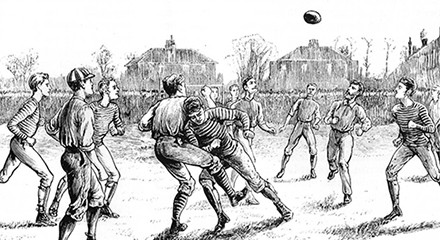
Football was not born in corporate boardrooms, but in villages, towns, docks, mines and factories. Clubs across England and beyond were often founded by workers, churches or neighbourhood associations. Matches became one of the few spaces where workers could gather collectively outside of direct managerial supervision.1
For many communities, football clubs became repositories of memory and identity. Entire generations attached family history and local pride to clubs representing districts that industrial capitalism created but often neglected. The club badge, terrace chants and matchday rituals reflected a desire for belonging in societies otherwise organised around alienation and exploitation.
Marxists who dismiss this reality as merely false consciousness misunderstand how culture operates. Workers do not live through economic struggle alone. Human beings seek community, emotional release and collective expression, and football has historically provided that. The ruling class understood this early. Employers sometimes supported football, because it channelled energies away from more confrontational forms of organisation. Politicians recognised its ability to cultivate patriotism and social cohesion. Newspapers discovered the profits generated by sporting coverage. Advertisers, broadcasters and gambling interests followed.
Yet the fact that elites sought to use football does not negate its genuine roots among ordinary people. Football became valuable to capital precisely because it possessed authentic mass appeal.
Roman circuses
The phrase, ‘bread and circuses’, is frequently invoked by sections of the left during major sporting events. Certainly, there are parallels between ancient Roman spectacles and contemporary mega-events. Governments facing crises often wrap themselves in sporting nationalism.
But a crude ‘bread and circuses’ argument risks reducing workers to passive dupes. It implies that the millions who follow football are simply manipulated into political inactivity by entertainment.
The working class is perfectly capable of contradictory consciousness. A worker may passionately support their team, while simultaneously participating in strikes, protests or political organisation. Football fandom does not mechanically erase political potential. Throughout history football crowds have often reflected broader social tensions and sometimes with remarkable intensity.
Across Europe and Latin America in particular, terraces have repeatedly become spaces where anti-racist, anti-fascist and working class traditions compete against chauvinism and reaction. In Egypt, organised football ultras played important roles during the uprisings of 2011.2
Leftwing supporters of Spanish club Rayo Vallecano, known as Los Bukaneros, are renowned not only for supporting the club, but for political and community activism in their working class Madrid district - including organising food banks, resisting evictions and protesting against ticket prices and unsociable kick-off times.3
In Britain, Football Lads and Lasses Against Fascism4 demonstrate how supporter culture can become a vehicle for anti-racist and working class political organisation, even without developing into a fully revolutionary movement. If such tendencies were able to evolve further - comparable, say, to the sports and workers’ associations historically linked to the Social Democratic Party of Germany - football culture could potentially provide an organisational basis for broader forms of political participation rooted in everyday collective life.
Football remains one of the few mass collective cultures not yet fully fragmented into isolated consumption, which is precisely why it remains a politically contested terrain.
Fascist football
Reactionary forces have long recognised football’s political potential. One of the clearest historical examples came under Benito Mussolini during the 1934 World Cup hosted by Italy. Mussolini understood the tournament as a tool for legitimising his fascist regime. It became a carefully orchestrated propaganda exercise designed to present fascist Italy as disciplined, modern and powerful. Stadium architecture, choreographed crowds and nationalist imagery all contributed to projecting the supposed unity of the fascist nation.
The success of the Italian national team was heavily politicised. Players were pressured to embody fascist ideals of masculinity, obedience and national strength. International football became intertwined with state propaganda and imperial ambition.
This was not unique to fascist Italy. Right up to the present day, authoritarian regimes have repeatedly exploited football to consolidate legitimacy through nationalism and mass spectacle. More broadly, both states and corporations have used football as a vehicle for sportswashing: employing tournaments, sponsorships, club ownership and media spectacles to enhance public image, cultivate legitimacy and divert attention from human rights abuses, corruption, environmental harms or other forms of political and economic misconduct.
The lesson is clear: football’s popularity makes it politically valuable to competing social forces. In Britain, figures associated with the far right have repeatedly attempted to use football culture as an entry point for chauvinist politics. The Football Lads Alliance emerged publicly through mobilisations claiming to defend “ordinary supporters”, while cultivating reactionary nationalism and hostility toward migrants and Muslims.
Although the FLA drew support from people with varying political views, far-right activists quickly recognised its potential as a recruiting ground. Its rhetoric depended heavily upon notions of embattled national identity, cultural grievance and masculine resentment. Football symbolism and terrace culture were appropriated to create an image of authentic popular rebellion, while directing anger away from capitalism itself toward minorities.
Figures like Tommy Robinson attempted to position themselves as defenders of ‘real’ working class communities abandoned by elites. This strategy mirrors broader far-right politics internationally: adopting the language of betrayal and community, while ultimately reinforcing racism and protecting capitalist interests.
Liberal myth
Football crowds reflect broader society. Where economic insecurity, alienation and fragmentation deepen, reactionary politics can flourish. But these same conditions can also produce solidarity, collective resistance and radical consciousness. Which tendency develops depends to a large extent upon political intervention.
Liberal commentators frequently insist that football should remain separate from politics. Yet this supposed neutrality invariably protects the status quo. National anthems, military flyovers, royal patronage, corporate branding and policing strategies are treated as natural features of the game, while anti-racist banners or labour solidarity are condemned as ‘politicisation’.
The reality is that football under capitalism is already political. The question is not whether politics enters the game, but whose politics dominate. FIFA itself embodies this contradiction. It presents football as a force for universal harmony, while operating through opaque relationships with states, corporations and security apparatuses.
The 2026 World Cup will almost certainly involve intensified border controls, enormous policing operations and extensive corporate exclusion zones around host cities. Migrant labour, precarious service work and public subsidy will underpin a tournament generating extraordinary profits for sponsors and governing bodies.
Even before a ball is kicked, the contradictions surrounding the tournament are already visible. Donald Trump’s return to office has brought renewed restrictions and hostile rhetoric directed toward migrants and several predominantly Muslim countries, including Iran. When Iran qualified, immediate questions emerged over whether supporters, journalists and officials would be able to travel freely to a World Cup supposedly celebrating international unity.5
The hypocrisy becomes even clearer when considering FIFA’s treatment of Russia and Israel. Russia remains banned from international competition following the invasion of Ukraine and was not permitted to even attempt at qualifying. Yet Israel continues to participate fully in international football despite the destruction inflicted upon Gaza and mounting global condemnation of its actions against Palestinians.
In this context, the recent stance taken in Ireland demanding stronger opposition to sporting normalisation with Israel deserves recognition. Former Irish international Richie Sadlier was correct to condemn the silence and cowardice surrounding the issue, arguing that football cannot pretend to occupy a moral vacuum, while atrocities are broadcast daily across the world.6
At the same time, millions of ordinary people will still experience genuine joy, solidarity and emotional connection through the tournament. Families and communities will gather collectively around matches. Shared moments of celebration and despair will cut across everyday isolation. Again, the contradiction remains central.
-
See R Sanders Beastly fury: the strange birth of British football New York 2010.↩︎
-
R Blaschke Power players: football in propaganda, war and revolution Chichester 2022.↩︎
-
R Dunne Working class heroes: the story of Rayo Vallecano, Madrid’s forgotten team Chichester 2017.↩︎
-
www.facebook.com/FootballFansAgainstFascism/?locale=en_GB.↩︎
-
www.theguardian.com/football/2026/mar/04/donald-trump-really-does-not-care-if-iran-play-at-football-world-cup-2026.↩︎
-
www.dailyrecord.co.uk/sport/football/football-news/ireland-spelt-out-emotional-case-37220500.amp.↩︎