
18.12.2025
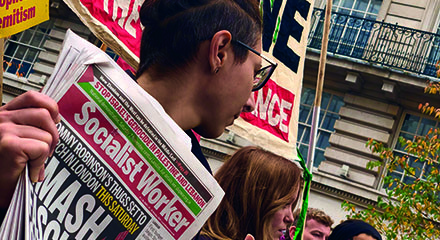
Too little, too late
Four central committee members closely associated with the ‘Comrade Delta’ scandal have been removed. Just them? Why now? asks Paul Demarty, and will it finally put this self-inflicted disaster to rest?
Bankruptcy, Ernest Hemingway famously wrote, happens “two ways”: “Gradually, then suddenly”.
Less than two months ago, the Socialist Workers Party’s first Pre-Conference Bulletin was sent to members, it included, as usual, a recommended slate for the new central committee. Nobody would have batted an eyelid at the recommendations: it was more or less the outgoing committee recommending itself as usual, and certainly the inclusion of Alex Callinicos, Weyman Bennett, Charlie Kimber and Mark Thomas was no surprise - the four having been on the body since time immemorial.
A very different picture presented itself in PCB No3, which landed on December 10. A new slate was proposed, with those four comrades replaced by Andy Brammer, Samira Ali, Judy Cox and Alan Kenny (Brammer and Ali were already on the PCB No1 slate). For once, the outgoing CC was candid about its reasoning:
We have had to confront the legacy of the 2013 crisis, when the SWP failed two women who raised complaints of sexual misconduct.
The outgoing CC has acknowledged political and procedural failures and issued a full apology to the two women, which all members of that body agreed. This builds on earlier efforts by the party leadership to correct our mistakes by transforming our procedures to ensure a robust and zero-tolerance approach to abuse and harassment. The proposed changes to the leadership … would continue this process.1
On the face of it, this is a quite extraordinary turn of events, merely because it comes now. Callinicos, Kimber, Bennett and Thomas have clung, limpet-like, to the uppermost ranks of the SWP for a dozen years since the 2013 events. No new accusations have come to light. If these four (who, it is certainly true, bear grave moral responsibility for the SWP’s crisis) were not minded to do the honourable thing a decade ago, when the catastrophic consequences of their actions were already apparent - why do so today?
Before we answer that, we should go into more detail on the particulars of the case. In the run-up to the SWP’s 2011 conference, accusations began to circulate that long-time SWP top Martin Smith had engaged in abusive and coercive sexual relations with a much younger female comrade. These were very vaguely alluded to at the conference and then dismissed. Nothing more - so it seemed - would be heard about the matter.
But, two years later, when the same comrade formally accused Smith of rape, the matter was referred to the SWP’s disputes committee - which, at the time, was largely composed of other senior SWP bods, many of whom were personally close to Smith. The verdict came down that there was no case to answer, and news rapidly circulated among the SWP’s general membership - a substantial portion of whom were rightly outraged. A rebellion began to take shape, despite the desperate use of expulsions by the leadership.
Conference 2013
When conference rolled around in January 2013, all eyes were on the vote on the disputes committee’s report, normally a minor formality. After a long debate on the Smith case, the report was narrowly accepted. A transcript of the debate was leaked to various left media outlets, including this one, and from there made it into the bourgeois media; Smith was anonymised as ‘Comrade Delta’ in the first version to be published, giving the scandal its best-known name. The SWP rebels began to operate in the open, in defiance of the organisation’s absurd bureaucratic dictates. The leadership responded with fire and fury, repeatedly attempting, by means of threats and stitch-ups, to “draw a line under the matter”.
Over the course of the year, two separate opposition factions resigned, taking with them a substantial minority of the active membership. Something like 95% of students were lost - no minor matter, when it is campus recruitment that largely refreshes the membership. Further allegations against Smith emerged, at which point he was put out to pasture. Probably worst of all, the SWP’s reputation in the wider movement - always a little shaky - was utterly destroyed. It faced repeated witch-hunts on campuses and in trade unions, a phenomenon that continued for years.
Drawing a line
If we ask ‘why now?’, then part of the reason is that even today a line has still not been drawn under the matter. People have long memories. The SWP’s reception in Liverpool at the Your Party conference was notably frosty, according to CPGB members in attendance. The ‘Comrade Delta’ fiasco had been litigated out in the open, and so people know the names. Amy Leather, who spoke at the YP conference, was widely believed to have been the de facto leader of the most hardline pro-Smith faction in 2013. Bennett was also part of this grouping. (One opposition grouping took the name, ‘In Defence of Our Party’, and its members later drolly nicknamed the hardliners the ‘In Defence of Our Martin’ faction.)
Callinicos and Kimber were core leaders, and must bear primary responsibility for the obstinate refusal of any compromise or acknowledgement of errors, when it really counted. Callinicos at one point darkly warned oppositionists that “there will be lynch mobs over this”. He was right, but the “lynch mobs” that came were the earnestly disgusted trade union and student militants, encouraged by cynical bureaucrats, who did their best to purge the rump SWP from their demesnes.
The lack of accountability for these individuals has always made a mockery of the SWP’s later attempts to offer apologies for the gross errors. When the SWP CC released a contrite statement last year, it somehow did not include any names at all - not Smith’s and not any of the committee’s members. Its lessons learned were all bureaucratic and procedural, as if the SWP was a scandal-hit municipal social care office.2
There is perhaps a further reason why action is required at this moment. Dave Renton - one of the SWP rebels then, and now a member of Revolutionary Socialism in the 21st Century, which regrouped one of the major rebel factions - is to publish a history of the crisis, Comrade Delta, in July 2026. He promises it is thoroughly researched and based on extensive interviews, and should be a must-read for all us coprologists of leftwing drama. It is probable that new specific allegations in detail against the SWP leadership of the day will be included. It is also quite possible that SWP leaders are well aware of the specific allegations for legal reasons, since the publishers will want to head off any defamation actions.
Now, it is unlikely that Renton’s book will be really transformative in anyone’s view of Callinicos and co. The general shape of their record in this scandal is quite clear, and quite dreadful enough already. Yet specific and concrete examples will tend to revive bad feeling against them, as is only natural. From this point of view, it would be prudent to ensure their tenure at the top of the SWP has already been over for six months by the time July rolls around.
The third potential motivation is more straightforward. There has been a considerable turnover of SWP membership since 2013. New members will, at some point or another, have become aware of this scandal. Those who remain members will, at least, have not found in it dispositive reasons to leave, but that is not to say they are happy to have this cloud hanging over them. It is embarrassing, and rightly so. The younger generation of SWP leaders may be quite genuinely frustrated by their organisation’s failure to settle accounts with the errors of 2013, and, if so, their patience with the CC holdouts may simply now be exhausted.
Whatever the case, the question immediately arises: will this work? We are first of all required to state what it would mean for something to ‘work’ in this sense. There are three types of answer. One is essentially moral: the SWP, and these leaders in particular, violated socialist morality in their handling of the Smith affair, and so the question is whether the very belated removal of these comrades from leadership amounts to sufficient penance. The second answer is political: does this act make it meaningfully less likely that similar mistakes will be made in future? The last is instrumental: will this in practice be enough, at last, to remove a major obstacle to the SWP’s participation in the broader movement? The ‘Comrade Delta’ affair curses them: “Instead of the cross, the albatross about my neck was hung.”
Forgiveness
Renton has, as it happens, weighed in on this, with a Substack post entitled ‘Is it time to forgive the SWP?’ It turns out he has another book, due out in May 2026, Revolutionary forgiveness (promoting two books in one blog post - you have to respect the hustle). He offers a basic heuristic for deciding whether it is time to forgive, which seems broadly reasonable:
- the perpetrator admitting they were wrong
- spelling out exactly how they were mistaken,
- promising not do anything similar again, and
- doing all they can to lower themselves and lift up the victim (“reparation”), so that they have reversed the original dynamics of power and powerlessness, inside which they committed the original wrong.
Renton allows that, according to this rubric, “actually quite a lot of progress” has been made. The major exception is on the second point. He is right to object:
The SWP still refuses to say anywhere what mistakes the organisation made in 2013. Where did the faults start? What caused them? … The [2024] apology says, “We were wrong in how we responded to the two cases”. How were you wrong? “The process we had in place at that time was entirely inadequate”. How was it inadequate? The SWP is willing to admit to the vaguest and most weightless of things - error - but can’t say what people did, or who was affected by their actions, or why they were so destructive … Now tell the truth - give us your best version of the story. Tell us honestly what you did wrong.3
This is slightly unfair. The 2024 statement at least describes the failings in its old disputes procedures, and commends its new ones in some detail. Alas, as I argued at the time4 and mentioned above, this is an entirely bureaucratic explanation and solution. The inability of the state bureaucracy to protect the vulnerable from predators is on display in the unending ‘grooming gangs’ scandal (once one gets beneath the surface layer of racist spin). It is not clear why the SWP bureaucracy could do a better job, however tied it is to ‘best practices’, especially since such ‘best practices’ are at least as much about avoiding liability as they are about preventing abuse.
And, in the end, it is the bureaucratic regime that all but ensures scandals of this type. To really settle accounts with this shameful episode would mean abandoning the very model of pseudo-Leninist organisation to which the SWP adheres, which, in turn - its leaders correctly surmise - would entail a revolution in its overall politics. Nothing of the sort will be forthcoming - and so we predict that the ‘Comrade Delta’ hangover is a long way from clearing up yet.
-
drive.google.com/file/d/14WxXdMPxATkdk-l1KmpT41RBoybaWGSv/view.↩︎
-
socialistworker.co.uk/procedural/party-statement/statement-2013.↩︎
-
davidrenton590934.substack.com/p/is-it-time-to-forgive-the-swp.↩︎
-
‘Regrets, they’ve had a few’ Weekly Worker May 23 2024: weeklyworker.co.uk/worker/1492/regrets-theyve-had-a-few.↩︎