
13.11.2025
Hypocrisy and hot air
No wonder there is anger and frustration. With no official US presence at Cop30, it is inevitable that the 1.5°C target set in Paris will not be met, writes Eddie Ford
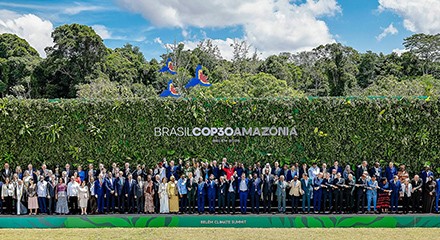
This week saw the start of the Cop30 climate conference in the northern Brazilian city of Belém, known as the gateway to the Amazon - president Lula da Silva even signed a law that symbolically transferred the capital from Brasília to the city during the period which is due to end on November 21.
Of course, given that you might as well start as you mean to go on, it was widely reported that the conference was used as an excuse to build a new four-lane highway cutting over eight miles through the protected rainforest - which saw strong opposition from the local indigenous communities and an attempt by protesters to storm the conference.
Indeed, providing yet another illustration that behind the symbolism - the token youth, women and first nation delegates - it is business as usual, Brazil’s state-owned oil company, Petrobas, was given permission last month to drill near the mouth of the Amazon. The environmental watchdog, Ibama, had originally denied it a licence because of concerns about inadequate planning to protect wildlife in case of an oil spill, but came under intense pressure to back down.1 Even though he has a much vaunted image of being a global leader on climate change, Lula da Silva - once the darling of the soft left - accused Ibama of acting as if it was “against the government” and insisted the oil revenues will help fund Brazil’s climate transition, which is obvious madness.
Consensus
As a protest against greenwashing and carbon-offset mechanisms, the Spanish artist, Josep Piñol, transformed his cancelled Evitada (‘Avoided’) project - originally conceived as a massive sculpture for Belém - by issuing symbolic carbon credits for the 57,765 tonnes of CO2 emissions that were ‘avoided’ by not producing the sculpture.2 This seems like a more fitting testimony to the Belém circus.
Meanwhile, Australia and Türkiye are vying to host Cop31 - but if there is no agreement, it will default to Bonn. (It has already been decided that Cop32 will be held in Addis Ababa, Ethiopia.)
Sir Keir Starmer and other leaders attended the pre-conference summit between November 6 and 7 ahead of the official climate talks, with the heir apparent, William Windsor, tagging along to provide royal prestige. Starmer warned that the “consensus is gone” on climate change, but apparently the UK was still “all in”. Nevertheless, do not expect him to defy the most powerful climate denialist on the planet, Donald Trump, who is not even sending an official team to Belém - though you did get an ‘alternative’ delegation from the likes of Californian governor Gavin Newsom and New Mexico’s governor, Michelle Lujan Grisham, organised by coalitions such as America Is All In, Climate Mayors and the US Climate Alliance.3
Last year at Cop29 in Baku, it was agreed for “all actors to work together” to enable the scaling up of financing to developing countries for climate action to at least $1.3 trillion per year by 2035 - but expect major disagreements. Brazil intends to launch the Tropical Forest Forever Facility (TFFF) as a “signature achievement”, since the $125 billion “blended-finance investment fund” aims to reward forest conservation in tropical countries.
The host country’s main proposal is a Climate Coalition, which is supported by a market-orientated group of academics around the Massachusetts Institute of Technology that wants a carbon price floor of $50 per tonne of CO2. The plan is to create a global emissions cap, beginning at a level close to current emissions rate, and then reducing it until reaching net-zero by 2050, meaning that for an activity which creates emissions people would buy allowances - and, as the cap decreases, the cost of the allowances will increase, creating an incentive for decarbonisation.
Other matters on the agenda, which perhaps surprisingly was agreed upon very early on, include final rules for carbon markets and efforts to create a “just transition”, looking at how governments and the private sector can put people at the centre of national and sectoral transitions. Even though the planet’s past 10 years have been the hottest in recorded history, there is the vexed question of governmental climate action plans - known as ‘Nationally Determined Contributions’ under the Paris agreement. Fewer than a third of the world’s states - 62 out of 197 - have sent those in and, from those NDCs received so far, there is an expectation of a 10% reduction in emissions. But that falls woefully short of the minimum 60% fall necessary to stay within the 1.5°C target.
Another question that needs to be urgently raised is methane - a greenhouse gas 80 times more powerful than carbon dioxide, and responsible for about a third of the warming recently recorded. Cutting it would supposedly amount to an ‘emergency brake’ on global temperatures, and at Cop26 in Glasgow in 2021 the UK, the US, the EU and other countries forged the global methane pledge - requiring a cut in methane of 30% by 2030, with 159 countries subsequently signing up. Yet, as data from satellite analysis clearly shows, emissions from some of the main signatories have actually increased. Emissions collectively from six of the signatories - the US, Australia, Kuwait, Turkmenistan, Uzbekistan and Iraq - are now 8.5% above the 2020 level.
Momentum
Unsurprisingly, popular faith in the UN climate process is faltering. As shown by the NDCs and the disastrous rise in methane production, they are mired in complacency. For instance, given that we are in Belém, industrial scale beef production is responsible for 80% of deforestation in the Amazon. This results in a massive degradation of biodiversity and, of course, a massive increase in methane. Needless to say, amongst the 30,000 people attending Cop30 there are thousands of big business representatives (generally they are categorised as coming from NGOs, but we know too that many are there to lobby on behalf of the fossil fuel industry).
Yes, we had the Paris conference 10 years ago, followed by an agreement to keep global surface temperature to “well below” 2°C above pre-industrial levels, “preferably” keeping the limit of the increase to only 1.5°C - which appeared to be the consensus referred to by Starmer. However, the geopolitical context has almost completely changed, with the rise of various rightwing and far-right governments, parties and movements that deny the reality of human-induced climate change and have a commitment to fossil fuel expansion - principally in the White House.
But, if you look at the graphs, studies and all the available public data, we are at 1.5°C now and edging above, because we are dealing with a global system - something equivalent to the often-used metaphor of an oil tanker that you simply cannot turn around. You cannot rewrite the laws of physics. Hence the momentum is there to get warmer and warmer. The danger, of course, is precisely that, as the planet gets warmer, more and more fresh water goes into oceans and you get feedback. All that in spite of the world being very successful in turning to wind power and solar energy - whatever blinkered assurances you get from Donald Trump or Nigel Farage.
In fact, worldwide solar and wind-power generation has outpaced fossil fuels this year and, for the first time on record, renewable energies generated more power than coal, according to a new analysis by the energy think tank, Ember.4 Global solar generation grew by a record 31% in the first half of 2025, while wind by 7.7% - meaning that solar and wind generation combined grew by more than 400 terawatt hours, which was more than overall global demand increased in the same period.
At the same time, China’s carbon dioxide emissions have been flat or falling for 18 months.5 China added 240GW of solar capacity in the first nine months of this year, and 61GW of wind, putting it on track for another renewables record in 2025. Last year, the country installed 333GW of solar power, more than the rest of the world put together. The obvious deduction is that it is perfectly possible to wean off polluting sources of power, as demand for electricity skyrockets, so long as investment in renewables, including solar, wind, hydropower, bioenergy and geothermal energies, continues. We can keep pace with the growing demand for electricity worldwide if there is planning and political will.
But the momentum is still there in terms of global warming. As things look at the moment, there is no reason to believe that it is possible to limit global temperature to “well below” 2°C - everything points to the opposite, and that is now ‘officially’ recognised. Hence António Guterres, the secretary general of the United Nations, recently acknowledged it is now “inevitable” that humanity will overshoot the Paris target with “devastating consequences” for the world, including the danger of passing catastrophic “tipping points” in the Amazon, the Arctic and the oceans.6 Therefore it is “absolutely indispensable” to change course to make sure that the overshoot is as short and as low in intensity as possible to avoid tipping points that see the Amazon become savannah.
We have just had what surely should be a warning sign from Hurricane Melissa in the Caribbean and the utter devastation it brought - a Category 5 hurricane that moved slowly over land, going at five miles an hour, but with winds of 185mph at its most sustained. Climate scientists have said the intensification of Melissa that saw the winds doubling from 70mph to 140mph in just a day is most likely a symptom of the rapid heating of the world’s oceans. In other words, if you did not have industrialisation, the storm would not have been as severe.
Trump’s ear
However, to avoid runaway global heating requires a radical break from the current system of ‘production for the sake of production’. Doubtless that is why Bill Gates, one of the world’s richest men, now calls for a change of emphasis, away from attempting to meet what are now hopeless targets to adapting to a hot world. Music to Trump’s ear.7 Gates considers himself an engineer, a tech-wiz, of course. He freely admits that he has no real grasp on politics. So he is perhaps incapable of even thinking about a change in the social system.
True, we are witnessing “a renewables revolution” and “the transition will inevitably accelerate” - but fossil fuels remain at the front and centre of the modern military machine (aircraft, tanks and ships run on petrol). Moreover, fossil fuels remain incredibly profitable (and provide oil and gas rich states with a big percentage of their tax revenues). Hence, everywhere it’s still: “Drill, baby, drill”.
-
theguardian.com/world/2025/oct/20/brazil-greenlights-oil-drilling-amazon.↩︎
-
earth.org/artistic-work-in-the-amazon-turns-inaction-into-climate-value-ahead-of-cop30.↩︎
-
theguardian.com/environment/2025/nov/07/cop30-climate-trump-us-officials.↩︎
-
apnews.com/article/climate-renewable-wind-solar-coal-electricity-demand-abf7b587b038bf7580de1baee6576bbc.↩︎
-
theguardian.com/world/2025/nov/11/china-co2-emissions-flat-or-falling-for-past-18-months-analysis-finds.↩︎
-
theguardian.com/environment/2025/oct/28/change-course-now-humanity-has-missed-15c-climate-target-says-un-head.↩︎
-
Here is Trump responding on X: “I (WE!) just won the War on the Climate Change Hoax. Bill Gates has finally admitted that he was completely WRONG on the issue. It took courage to do so, and for that we are all grateful. MAGA!!!” (October 29 2025).↩︎